guides2 min read
Sculpey Soufflé Sutton Slice: One Official Project
This guide stays within one official Sculpey Soufflé project and does not turn that example into a universal stamp, clay, depth, or transfer rule.
Open the guide

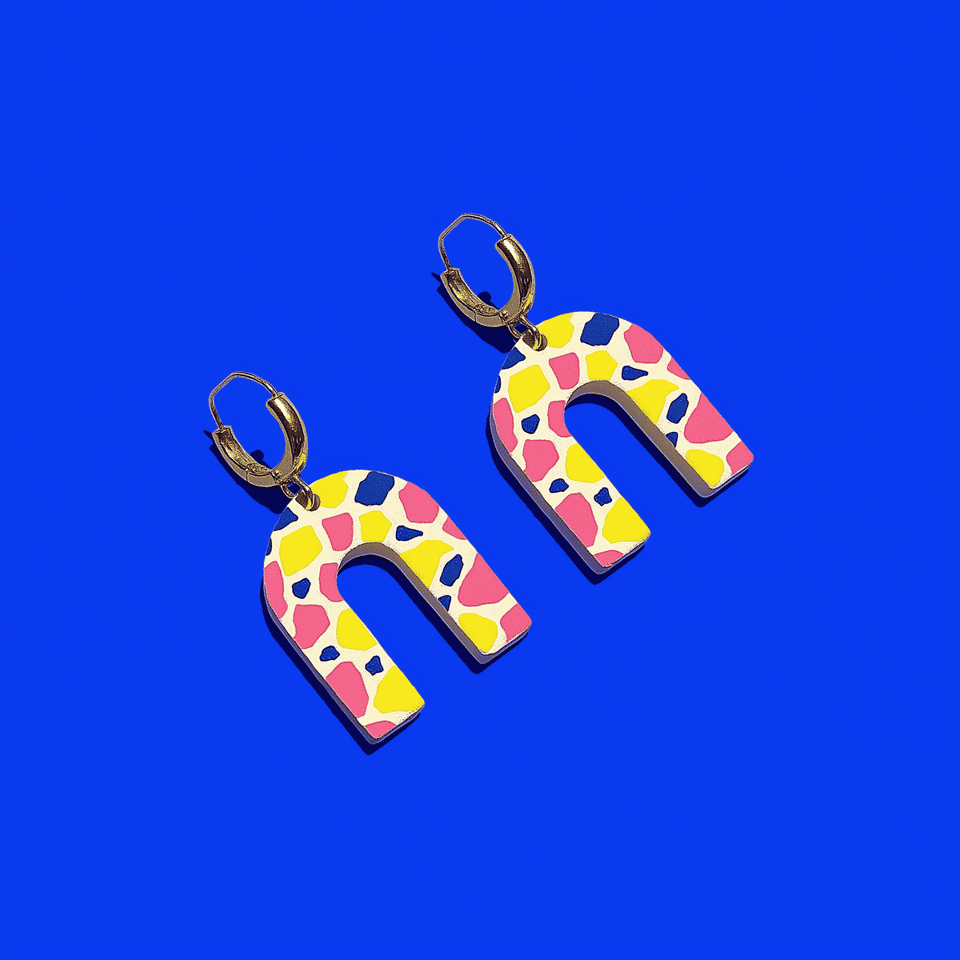
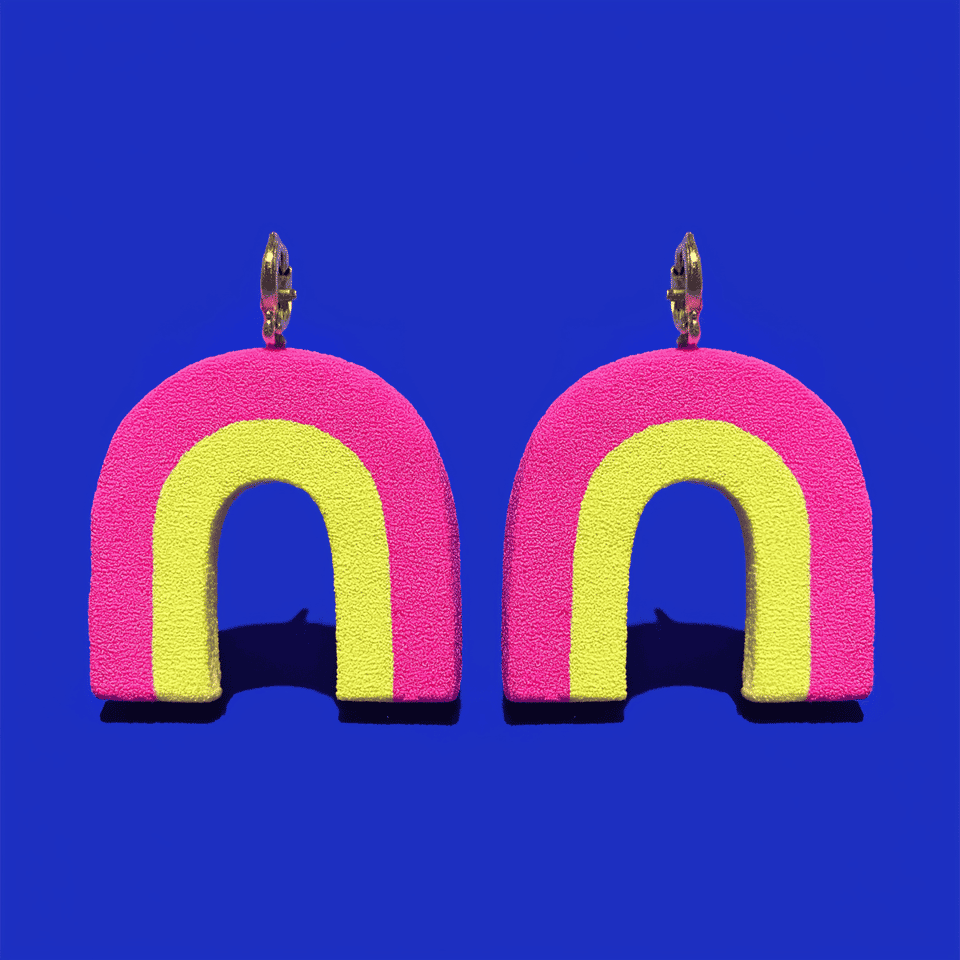
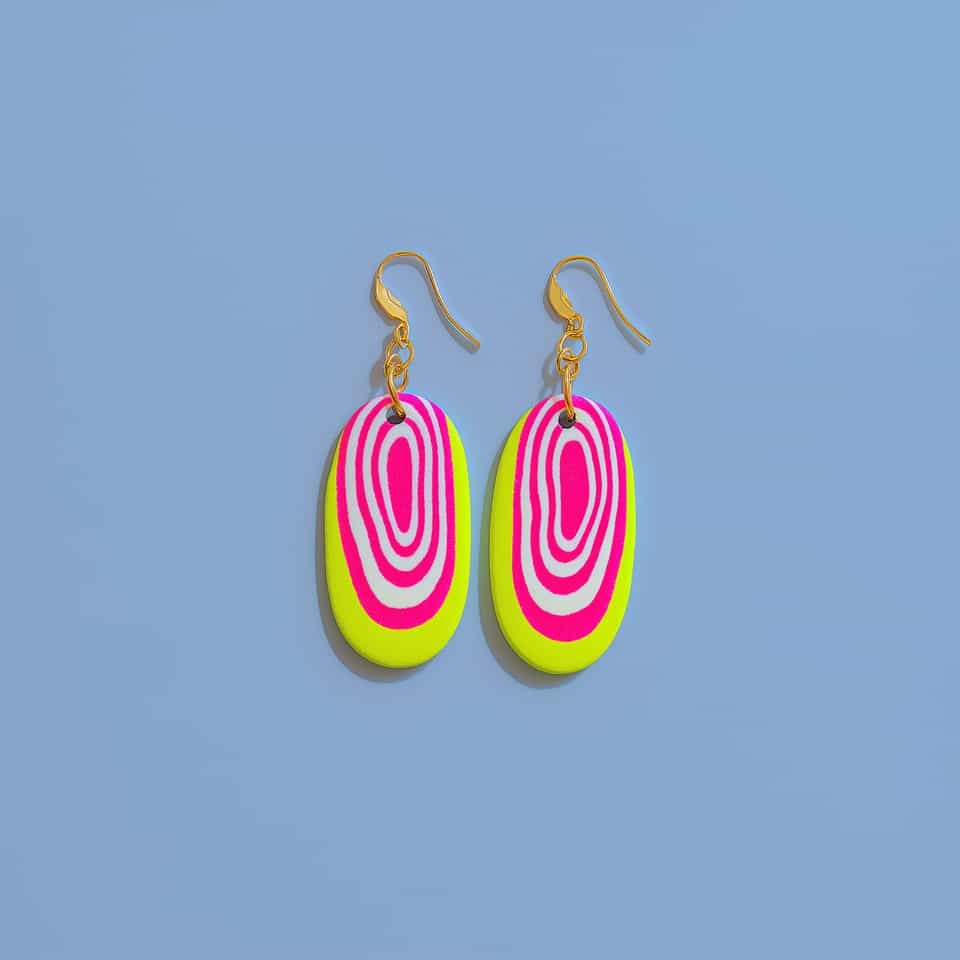
The pictures began as AI-assisted concept images and are here for inspiration. The steps are a guide to making your own version, so change the colours, size or details as you like. Clay brands, ovens, glues, finishes and hardware behave differently, so follow their product instructions and bake a scrap before a batch. Some product links on this page are affiliate links. If you buy through them, we may earn a commission at no extra cost to you. Check listing details, dimensions, materials, and fit before you buy. As an Amazon Associate I earn from qualifying purchases. Full disclosures
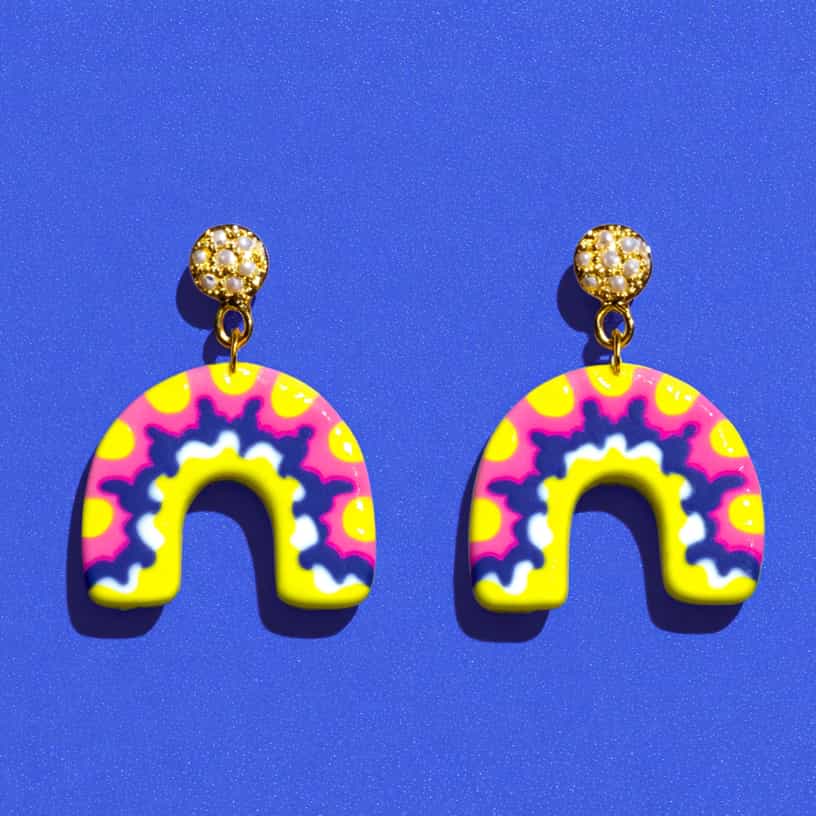
These are a matched pair of blue arch dangle earrings: an upside-down U shape with an open center, the top two thirds a royal-blue slab packed with hot-pink, soft-pink, and white squiggle motifs, and each leg dipping into a wavy chartreuse-yellow band with a tiny blue-and-white teardrop near the foot. Each arch hangs from a round gold ball-stud post by one small gold jump ring. You can build that dense squiggle field a few proven ways, then cut both arches from one patterned slab so they mirror, bake them flat, round the edges, and add the findings. Aim for thin and light so they wear comfortably all day.
A mirrored pair of flat royal-blue polymer clay arches (open-center horseshoe shape) with two legs. The upper two thirds carry a dense, organic scatter of hot-pink, soft-pink, and white curved squiggles on the blue. Each leg ends in a bright chartreuse-yellow band whose top edge is wavy where it meets the blue, with a small blue-and-white teardrop accent near each foot. Both arches hang from round gold ball-stud posts via a single small gold jump ring at the top center. The face is smooth with a soft satin-to-light-gloss sheen, so the pattern stays crisp.
Lookbook view

The squiggle field can be made several proven ways, all on a blue base slab: a layered cane or millefiori slice rolled flush; a Sutton-slice pattern cap laid over the base; or hand-placed soft-pink and white inlay pieces rolled level. The wavy chartreuse band is a separate cut-and-applied strip with a hand-cut wave edge, with tiny blue-and-white teardrops added at the feet. Whichever pattern route you pick, cut both arches from one finished slab with the same arch cutter, flip one for a true mirror, set the hanging holes at the same height, bake flat, then attach gold ball-stud posts with jump rings.
Condition each color to the same firmness so the clays move together. Roll a royal-blue base slab to one even, fairly thin thickness using guide rails or a pasta-machine setting, so the finished pair stays light on the ear.
Pattern option A (cane or millefiori): build a small logged pink-and-white cane, rest it so it firms up, reduce it by squeezing a waist in the middle and working pressure out to the ends, then slice thin even rounds and lay them across the blue base.
Pattern option B (Sutton slice): press a built pink-and-white pattern block against a texture, skim a thin pattern layer with a flexed tissue blade, and lay that cap over the blue base so the squiggles read in one pass.
Pattern option C (hand-placed inlay): cut or tear small irregular soft-pink and white squiggle shapes and arrange them densely on the blue base by eye for a scattered organic look.
For any option, lightly dust the roller and give the slab one firm even pass (no rocking) so the pattern sits flush with the blue. Re-roll a patterned slab in stages, rotating 90 degrees between passes, so thickness and pattern stay matched across both arches.
Roll a thin chartreuse-yellow strip and hand-cut a wavy top edge. Wipe any release powder off the slab with a damp swab, press the yellow band along the lower portion so its wave meets the blue, then add a tiny blue-and-white teardrop near each foot, pressing for a clean raw-to-raw bond.
Cut both arches from the one patterned slab with the same arch cutter so they match in size; cut the second from an adjacent area and flip it for a true mirror. Press the cutter straight down and lift cleanly for smooth edges.
Pierce a hanging hole at the top center of each arch with a needle tool, set both holes the same distance from the top edge, and leave a generous wall of clay between the hole and the edge so the loop will not tear out. Confirm the pair reads as a balanced mirror before baking, since holes cannot be moved after curing.
Bake the arches flat on a smooth tile lined with cardstock or parchment at your clay brand's package temperature and time; check the real oven temperature with a thermometer. A light tent of cardstock shields thin edges from scorching. Let them cool fully before any finishing.
Wet-sand the cooled edges through rising grits (keep the paper wet), rounding the cut edge so it does not feel sharp or catch hair rather than cutting a new flat. Rinse between grits.
Optional finish: test a thin water-based gloss or satin coat on baked scrap first, then brush a light coat. Keep it light so the shallow squiggle pattern stays crisp; satin or a light gloss both read well here.
Finding alternatives: for a stud-style version, embed a textured, kinked flat-pad post in the raw clay back under a thin matching clay slice before baking for a hold with no glue seam, or after the last bake glue a flat-pad post to a spot of the cured back sanded to bare clay and wiped with isopropyl alcohol, using a small dot of gel super glue, such as Loctite Super Glue Ultra Gel Control or Gorilla Super Glue Gel, and wait the full label cure time before wear. For a heavier statement version, step up to leverback ear wires through the pierced hole.
Metal findings like posts, hooks, and jump rings may contain nickel or other allergens. If your wearer has sensitive skin, choose surgical steel or titanium findings and test any sealant or coating on a small spot before wearing.
What you will need
Before you buy, match the sizes and parts to the version you want to make.
Matches the cobalt base of the arch drops.
Covers the bright pink curved motif pieces.
Useful for the yellow lower caps and accent details.
Needed for the white sections inside the curved pattern pieces.
A firm clay for the pink, white and chartreuse squiggles, so the thin shapes keep their edges while you lay them on the blue arch. It also slices clean rounds if you build the squiggles as a small cane.
Matches the round gold stud toppers visible in both images.
Needed when the finished piece hangs from connectors rather than a single solid clay body.
Needed for opening and closing jump rings cleanly during jewelry assembly.
Useful for stud and topper builds that need a flat-pad finding after baking.
Tick what you already have, then get only what is missing.
Helps trim the arches and tiny motif pieces cleanly.
ClayBake makes matched cutter packs sized to this build, so repeated shapes stay consistent. 3D print or order the set from our tools.
Roll every sheet to the same calibrated thickness with the ClayBake slab height guides.
A lightweight clay with a cohesive suede finish that holds fine textures without sticky residue.
Provides a flexible, high-strength bond between cured clay and metal findings.
Optional extras for a different finish, size or fix.
Helps the arches stay flat while the small insert pieces cure.
Useful for hardware attachment after baking when the adhesive label supports the materials and cure time.
A polymer-clay-compatible glaze option for a glossy finish. Test it on baked scrap before using it on the finished piece.
Each one walks through a technique used in this piece, in full detail.
This guide stays within one official Sculpey Soufflé project and does not turn that example into a universal stamp, clay, depth, or transfer rule.

Cutout arches and hoops work best when the wall width is even, the inner opening matches the outer curve, and the hardware choice is made from the finished front view.

Choose the top connection from the front view first, then keep the attachment short and balanced. Compare visible loop-tops, flat pads, short ring paths, and balance-line marks on a sample before you make the final pair.
Custom range
Ask for a build pack to make it yourself (the cutter or tool files, a supply list, and a plan), or ask the studio to make the finished pieces for you.
More pieces with a related form, finish, or making path.
Pin it to a board, copy the link, or keep it saved here while you make your own version.
Tag Clay Bake Studio on Instagram or TikTok so we can see how you adapted it.