How to condition polymer clay and roll an even slab for cutters
Get every clay colour to the same softness, roll each layer to its measured thickness on a tile, and let warm clay firm up before you cut.
Some links on this page are affiliate links. If you buy through them, we may earn a commission at no extra cost to you. As an Amazon Associate I earn from qualifying purchases. Disclosures

In brief
Key takeaways
- Match the softness of every colour before you roll layers. A softer colour is the one most likely to stretch out of shape when you cut it or lift it onto the base
- Roll to the millimetre number in your maker guide, with one pair of guides for each thickness. Pasta machine settings are not millimetres, so roll a scrap on each setting, measure it and write down the clay brand, setting and thickness
- For a slab thicker than your machine rolls, stack slabs to slightly more than you need, then roll them down between two guides of that thickness until the roller rests on both
- Roll thin colour layers by hand between two matching stacks of shims or playing cards, measured with calipers
- Feed folded clay into the machine with the fold entering first, so air between the halves escapes through the open edges
Article contentsOpenClose
Condition each colour until it is smooth, bends without breaking and blends into another piece with no visible seam. Then roll it on a glossy tile between two thickness guides of the same height, until the roller rests on both guides from end to end. If the slab is warm enough to smear, let it firm up before the cutter goes in.
If you came from a Clay Bake Studio build kit, your maker guide gives the thickness of every layer in millimetres. Roll to that number, with a pasta machine or with a roller and guides. An even slab is what makes the two pieces of a pair match and lets each colour layer lie flat on the one below.
What you need to condition and roll clay
- Polymer clay in each colour. Using one brand and type of clay for every colour keeps their softness closer and gives you one set of baking directions. Condition enough of each colour for a slab a little larger than all the shapes you will cut from it, plus a spare corner for a test cut.
- A glossy ceramic tile or a sheet of glass. Roll and cut on it. Raw clay grips a clean, smooth surface, which keeps the slab in place when a cutter lifts away. A tile for each colour makes a layered kit easier, but one is enough.
- An acrylic roller. Choose one longer than the gap between your guides, so it can rest on both at once.
- A pair of thickness guides for each thickness you need. Clay Bake Studio's slab height guide kit is a digital download for printing rails in labelled thicknesses with a 3D printer or print service. Without a printer, search Amazon for ready-made metric thickness guides, or use stacks of playing cards. Thin colour layers need thinner spacers, covered further down.
- A pasta machine kept for clay (optional). It does the heavy conditioning work and repeats a setting. The pasta machine comparison explains the choices before you buy one.
- A flat clay blade. Use it to slice blocks and lift thin pieces: search Amazon for a Sculpey blade set with a rigid blade. Handle the cutting edge carefully.
- Digital calipers. Labelled guides work without them. You need calipers to build card or shim stacks to a number, or to measure what each machine setting rolls.
- A needle tool or a pin. Use it to release air bubbles and lift specks out of light colours: search Amazon for clay needle tools.
How to condition polymer clay by hand or with a pasta machine
Conditioning means working the clay until it is soft, even and holds together all the way through. Clay straight from the packet can be firm in one place and softer in another, and working it evens that out.
Start with clean hands and tools. Wash and dry your hands, or wipe them with a baby wipe and let them dry, then wipe the tile and roller. Condition the lightest colour first, and clean your hands and tools again before each darker colour, so specks of dark clay do not end up in white or yellow.
Slice the block into pieces about 3 to 6 mm thick with your blade. Thin slices soften faster than a whole block.
By hand
- Warm a slice between your palms and roll it into a ball.
- Roll the ball into a long log, then press the log back into a ball. Use your palms rather than squeezing with your fingertips and thumbs.
- Repeat with each slice until it feels smooth and soft, then press the slices of one colour together.
- Flatten the clay on the tile with the roller, fold it in half and roll it flat again, pressing from the fold towards the open edges so air can escape. Repeat until the clay passes the checks below.
With a pasta machine
The Clay Bake Studio pasta machine is a Marcato Atlas 180, used for conditioning because it is much easier on the hands than kneading, especially when a design uses several colours.
- Set the thickest setting. That is setting 1 on the Sculpey machine and 0 on an Atlas. An Imperia numbers the other way, with 6 as the thickest, so check which setting gives the widest gap between the rollers on yours.
- Feed the slices through one at a time. Firm clay can come out ragged or in pieces at first. Press the pieces back together and feed them through again, slowly.
- Combine the slices. Lay the flattened slices overlapping on the tile, press them together starting from one edge, and roll them through as one slab.
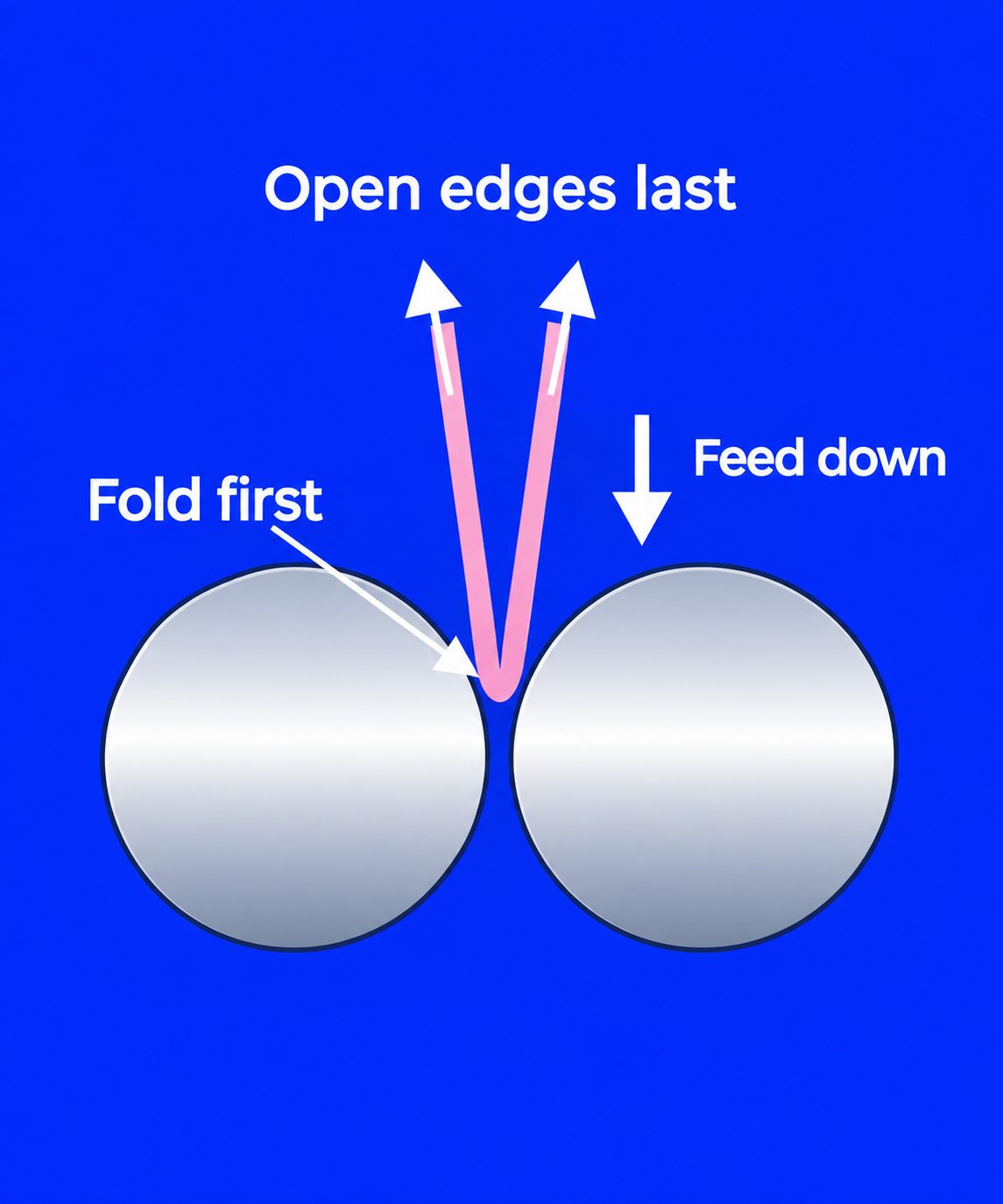
- Fold and feed the fold first. Fold the slab in half and feed it back in with the folded edge entering the rollers first. The open edges go in last, so air between the two halves is pushed out through the open side instead of being sealed inside.
- Repeat. Keep folding and rolling, fold first every time, until the clay passes the checks below. Only then move to thinner settings, one setting at a time.
Firmer clays, such as FIMO Professional, take more work. Softer clays, such as Sculpey Souffle, need very little conditioning.
How do I know the clay is conditioned enough?
Stop when the clay is smooth with a slight sheen, bends without breaking, and blends into another piece of itself with no visible seam.
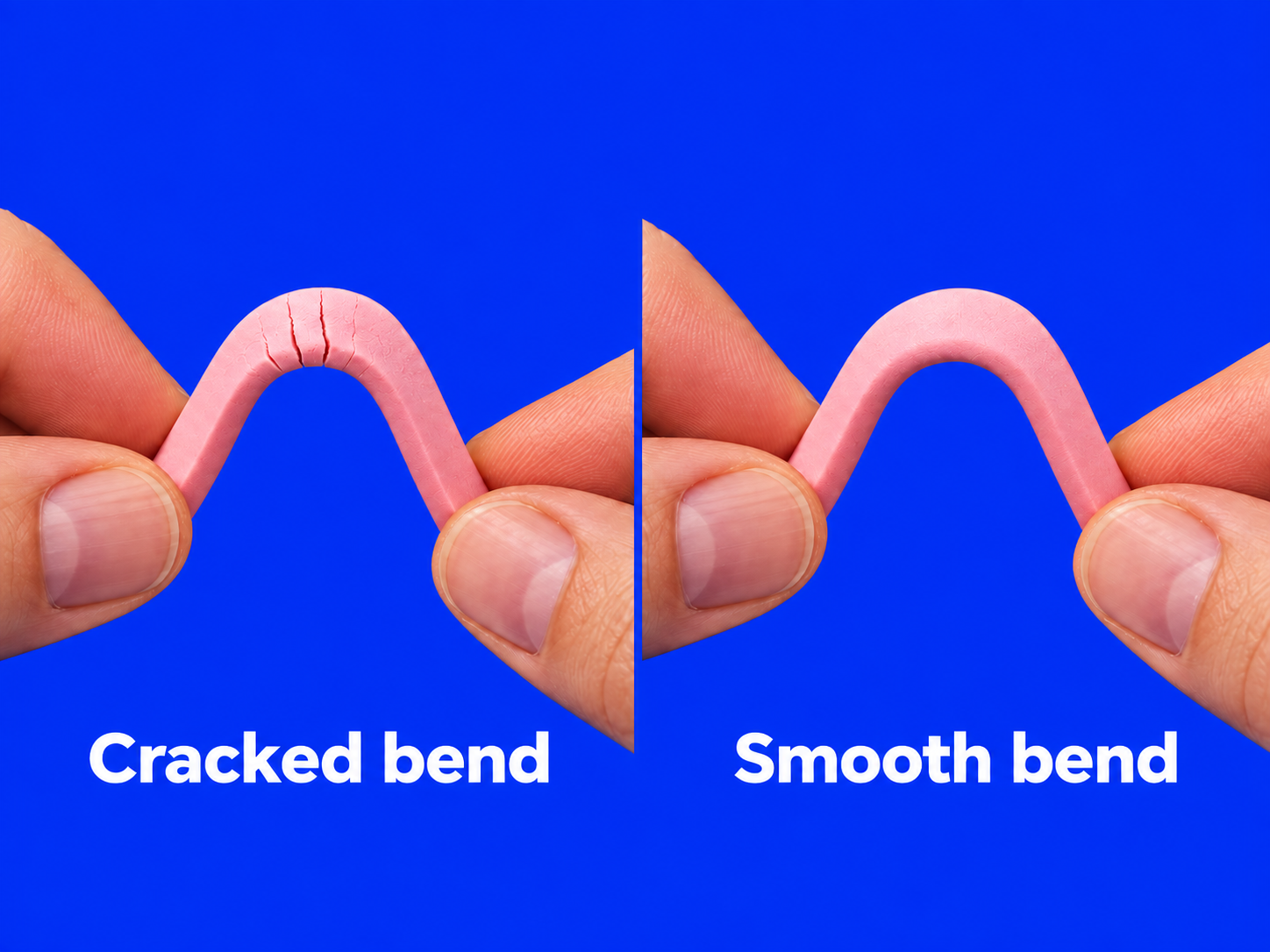
Fold a thin strip of the slab in half. Conditioned clay bends at the fold without cracks across it. Clay that still needs work cracks or breaks at the fold, feels grainy, or shows streaks or small hard lumps.
Small splits can still appear along the outer edges of a thin slab from a machine, even when the clay is workable. If the fold is clean and the surface is smooth, trim the ragged edges away instead of running more passes.
There is no set number of passes. The brand, the colour, how old the clay is and the temperature of your room all change how long it takes. If the clay becomes so warm and soft that it sticks to your hands, stop and let it rest on the tile.
Match the softness of every colour before you layer
Before you roll the colours for a layered piece, let them rest for a few minutes so they are all at room temperature, then pinch and bend a small piece of each one side by side. They should feel about the same.
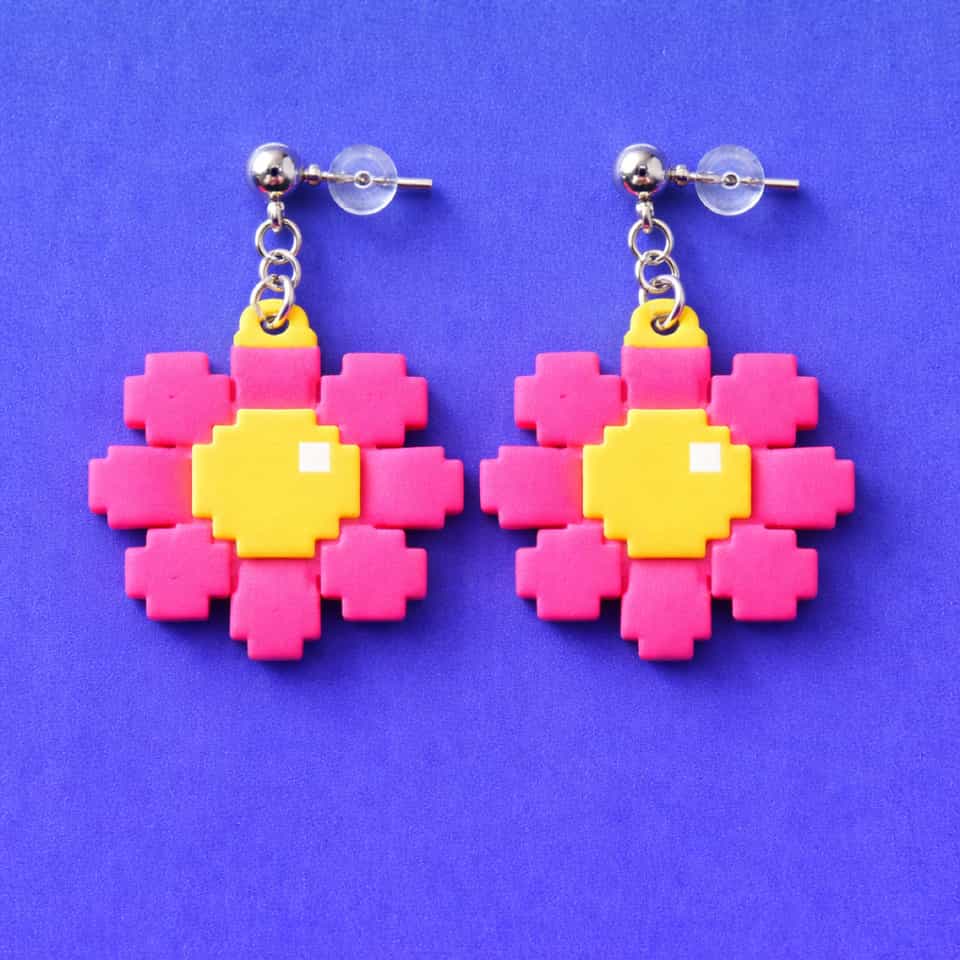
A softer colour spreads further under the same pressure. In a cane, that makes the pattern distort as you roll the cane thinner. In a flat layered piece, such as the pixel flame earrings, a soft colour layer is the one most likely to stretch out of shape when you cut it or lift it onto the base.
- One colour is firmer than the rest: give it more passes or more hand work, then compare again.
- One colour is softer than the rest: let it rest on the tile, or chill it briefly, then compare again. Mixing a little firmer clay of the same colour, brand and type into it also firms it up. If it stays too soft, the fixes table at the end covers drawing some softness out with paper.
Wrap conditioned colours in cling wrap while you work on the next one, so dust and lint stay off them.
How to roll an even slab at your kit's thickness
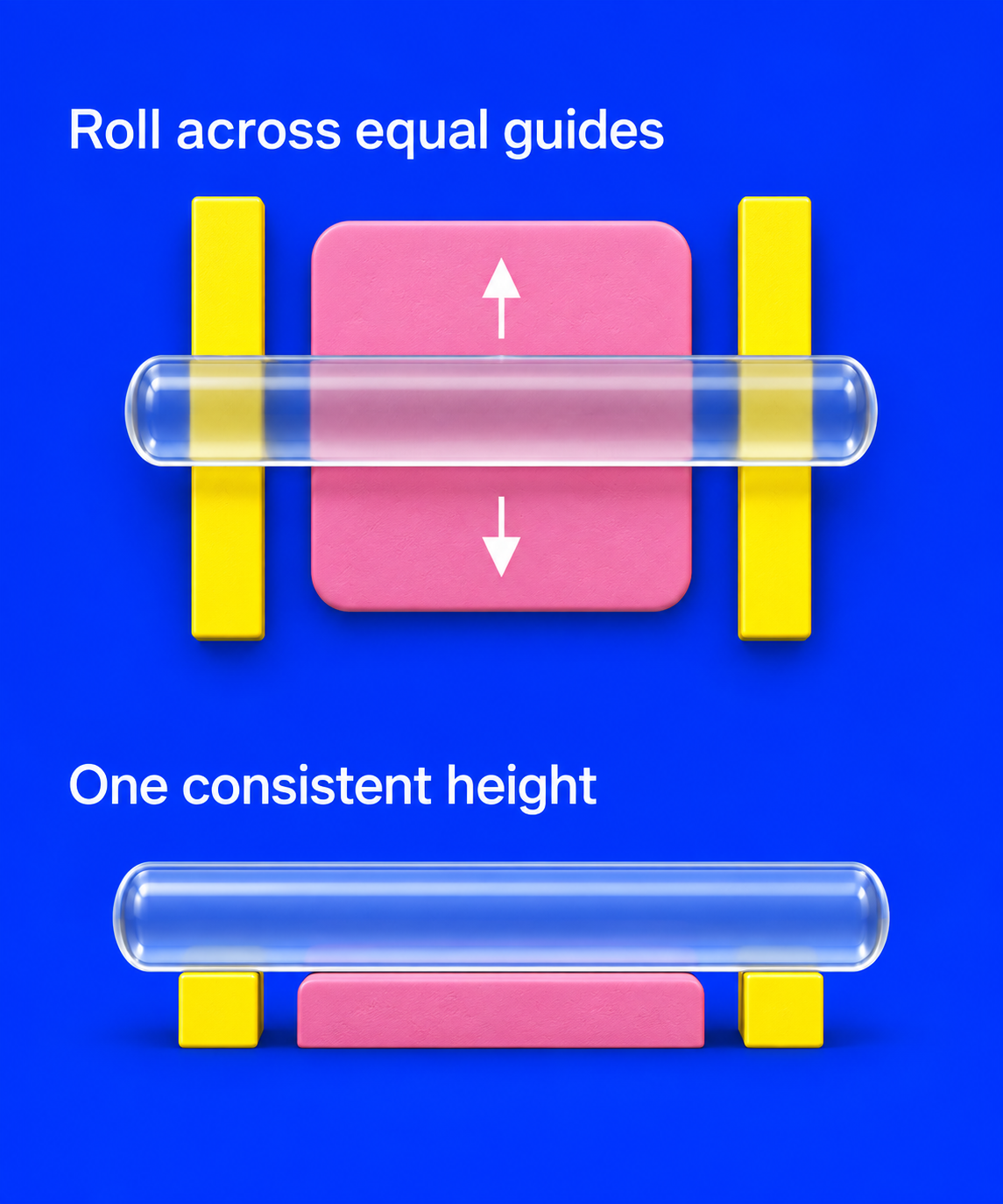
Roll on the tile between two guides of the same height, and keep rolling until the roller rests on both guides along the whole slab. A roller used without guides presses harder wherever your hands push, so the slab ends up thicker at one end or thinner in the middle. The guides stop the roller at one height, so each thickness in your kit guide needs its own pair.
- Set out the guides. Lay them on the tile parallel to each other, closer together than the length of your roller, with room on each side of the clay for it to spread.
- Start a little thicker than the guides. Use a machine slab a little thicker than the guides. For a slab thicker than your machine rolls, stack several slabs to slightly more than the guide height, pressing each one on from one edge so no air is trapped. Without a machine, flatten the conditioned clay by hand into a pad a little thicker than the guides. Keep it narrower than the gap between the guides and press it onto the tile.
- Roll along the guides. Lay the roller across both guides and roll with light, even pressure, from the middle towards one end, then from the middle towards the other.
- Turn the slab. Lift it with your blade, give it a quarter turn, press it back down and roll again. Turning spreads the pressure, so the slab does not keep stretching in one direction. If the turned slab now touches a guide, move the guides further apart.
- Finish attached to the tile. Make the last passes with the slab pressed flat onto the tile, and stop when the roller rests on both guides everywhere. Leave the slab there for cutting.
Check the guides rather than the finished slab: printed and ready-made guides are labelled with their height. When you do measure raw clay, such as a scrap from a machine setting, close the caliper jaws only until they just touch it, because jaws pressed into raw clay squeeze it and read low. For stacks of playing cards, put the same number on each side and measure both stacks. If one card more or one card fewer jumps past your number, use thin plastic shims instead.
With one tile and several colours, roll and cut one colour at a time. Slide the cut pieces onto a sheet of baking paper with your blade, wipe the tile, then roll the next colour. Your kit guide gives the order to assemble them in.
Rolling to thickness with a pasta machine
If a tutorial says “setting 3”, it means a position on that maker's dial, not a 3 mm slab: the numbers set the gap between the rollers, and each machine numbers them differently. Sculpey lists its clay conditioning machine from 2.5 mm on setting 1 to 0.63 mm on setting 9. An independent maker's review measured an Atlas 180 from 2.54 mm on its thickest setting to 0.28 mm on its thinnest, across ten settings, so the same setting number gives a different thickness on each machine.
That is why Clay Bake Studio kit guides give each thickness in millimetres. Once the clay is conditioned and a folded strip has no cracks, roll a scrap on each setting and measure it, closing the caliper jaws until they just touch the clay without squeezing it. Write down the clay brand, the setting and the thickness, then use the setting closest to your guide's number, and you can roll the same slab next batch. If your guide asks for a slab thicker than your machine rolls, stack slabs to slightly more than that thickness, then roll them down between two guides of that thickness until the roller rests on both guides.
How to roll thin colour layers between spacers
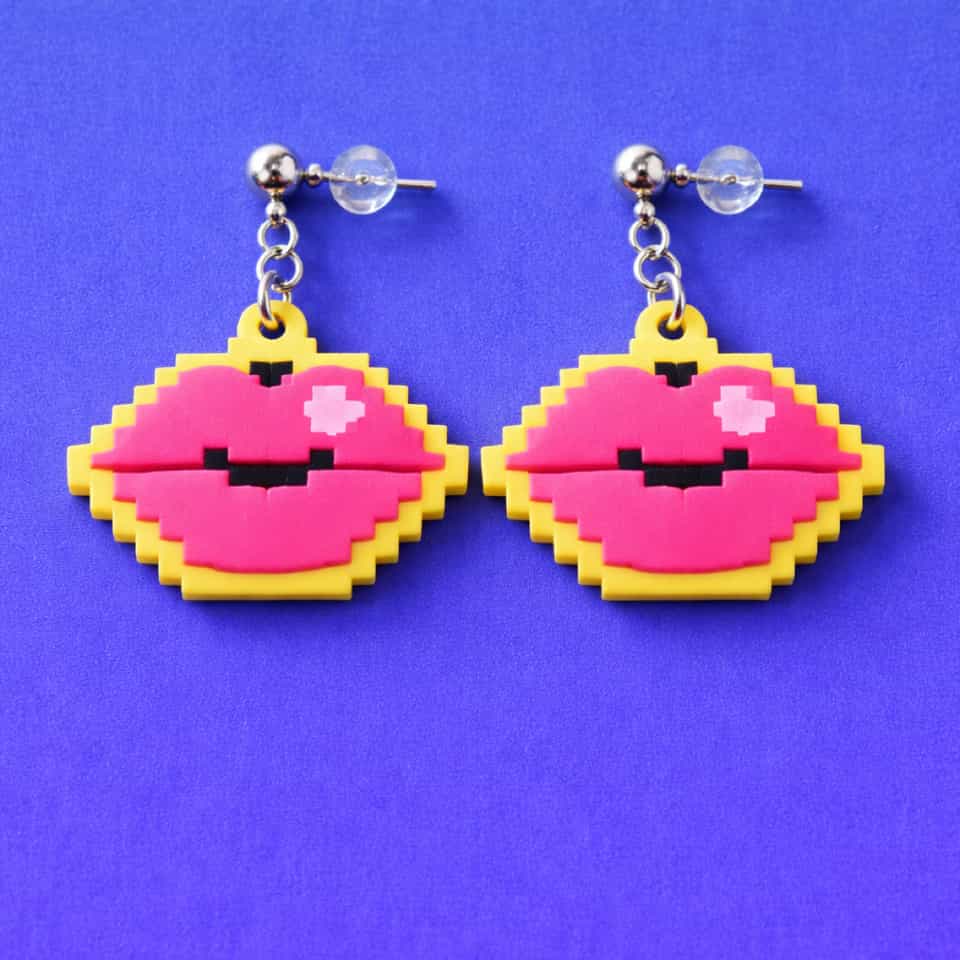
Some kits, such as the pixel lips brooch, put thin colour layers on top of a thicker base. Those layers can be thinner than some machines go, since the Sculpey machine stops at 0.63 mm, or fall between two settings on yours. Roll them by hand between thin spacers.
- Start a little thicker. Roll the conditioned colour through the machine, or by hand, to a slab a little thicker than your spacers.
- Build two matching spacers. Stack thin plastic shims or playing cards into two piles of the same height, and tape each pile together so it cannot slide under the roller: search Amazon for metric plastic shim sheets. Measure each pile with calipers so both match your guide's number.
- Roll between them. Set the clay on the tile between the spacers and roll with light pressure from the centre outwards until the roller rests on both piles.
- Cut it where it lies. Leave the layer attached to the tile for cutting. If a cut piece stretches as you lift it, chill the tile briefly, then slide your clay blade underneath the piece rather than peeling it up by an edge.
How to stop air bubbles in a flat slab
Air trapped in raw clay expands in the oven, which is why a slab that looked smooth can come out with a raised blister. Air gets in when you fold and layer the clay, so keep it out at those steps.
- Feed folds in fold first. Every time a folded slab goes through the machine, the fold enters the rollers first.
- Tear instead of folding a bubbly slab. If bubbles keep appearing, tear the slab into pieces, press them back together and roll again.
- Lay layers down from one edge. When you place one layer on another, touch it down along one edge and smooth it across towards the far edge with a fingertip, so air is pushed out ahead of your finger instead of trapped under the middle.
- Firm up sticky clay first. Very soft, sticky clay traps air more easily.
To find a bubble, look across the slab with a light at a low angle: it shows as a small raised dome. Slide the point of a needle tool or pin into the side of the bubble at a shallow angle, press the air out towards the hole with a fingertip, then smooth the spot with the roller.
Should I rest or chill the slab before cutting?
Rest or chill the slab when the clay is warm enough to smear, stretch or grip the cutter. Clay that already holds a clean edge can be cut straight away.
- Rest: leave the slab on its tile for a few minutes. Conditioning and rolling warm the clay, and it firms up again as it cools.
- Chill in the fridge: for faster firming, put the slab on its tile in the fridge for a few minutes. Aim for clay that is firm, not hard: clay chilled too far can turn brittle and crack when you cut or bend it.
- Freezer, only for very soft clay: Sculpey suggests several minutes in the freezer. Check it often, and wipe off any condensation that forms as it warms before you layer or bake it.
If the cut piece has to fold or curve afterwards, as a fortune cookie shell does, let it come back to room temperature before you bend it.
Cutting shapes from the slab
Make one test cut in a spare corner first. If the edge is clean, press the cutter straight down until it reaches the tile, lift it straight up and leave the cut shape on the tile. Peel away the surrounding clay first, then slide your blade under the shape to move it. The small centre windows in the go-go shoulder duster hex links lift out more cleanly from a firm slab. If the cutter still grips the clay, the cutter release guide covers light dusting and when cling wrap suits the shape. Once the colour pieces are cut, the pixel slab layering guide covers placing them on the base.
What if the clay is too soft, crumbly or full of specks?
Match the fix to what you can see in the clay.
| Problem | What to do first |
|---|---|
| Soft, sticky clay that smears or clings to your hands | Stop handling it and let it rest or chill. Fresh clay and a warm room both make clay softer, so a cooler spot helps. If it stays too soft, press it between sheets of plain paper to draw out some softness, then mix it again, as the soft clay leaching guide shows. Keep that as a last resort, because too much leaching can leave clay brittle. |
| Crumbly clay that will not hold together | Slice it thin, warm it in your hands and keep pressing the pieces together. Mixing in some softer clay of the same brand and type helps. If it is still stiff, add the clay maker's softener one drop at a time and mix well: Sculpey suggests starting with two to four drops per 2 oz (57 g) of clay. Too much softener makes clay sticky. Clay that crumbles because it is old or was stored somewhere hot may not come back, so keep it for scrap and open a fresh block for the kit. |
| Edges split as the slab comes out of the machine | Fold a thin strip. If the fold cracks, go back to a thicker setting and give the clay more passes before you roll thinner. If the fold is clean, trim the edges with your blade. |
| Specks, lint or dark streaks in a light colour | Lift specks out with the tip of a needle tool or pin and roll again. Before the next light colour, clean your hands, tile and roller, and run a scrap of light clay through the machine to pick up residue. |
| Lines across the slab from the rollers | Turn the slab a quarter turn before the next pass if it still fits the rollers, or finish it with the acrylic roller between guides. |
| The slab lifts with the roller or will not stay on the tile | Wipe any powder or grease off the tile, press the slab down firmly and let very soft clay firm up. |
| A thin layer tears or stretches as you lift it | Chill it on the tile briefly and slide your clay blade underneath instead of peeling it up by an edge. |
For pieces that crack after baking, the guide to polymer clay cracking works through thickness, baking and conditioning checks.
More guides in this path
Open these when the next decision is material choice, attachment, or finishing.
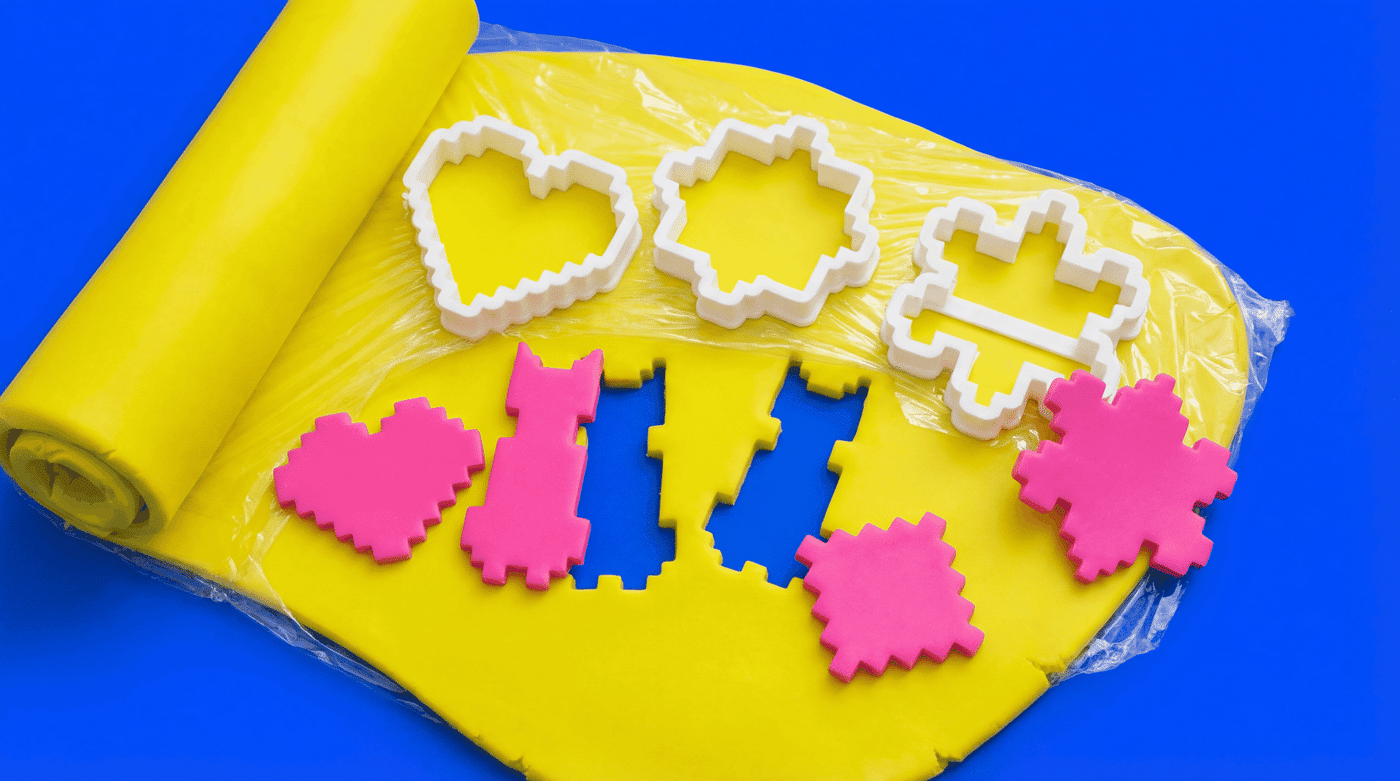
Polymer clay stuck in your cutter? How to release it and stop it sticking
Free a trapped shape, dust the cutter without leaving white clumps, and set up the slab for the next clean release. Includes the cling-wrap method for softer edges.
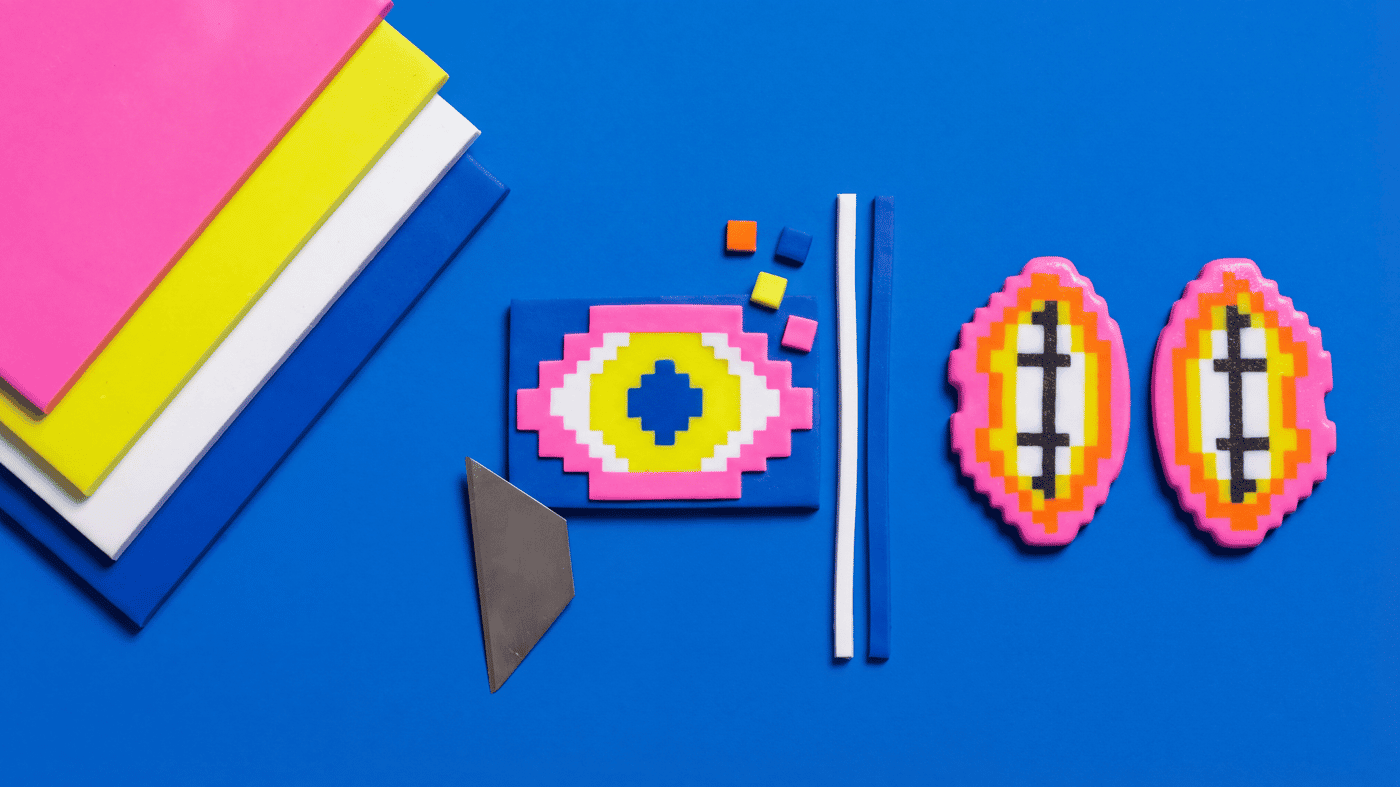
Layered pixel clay earrings: how to line up thin colour layers without stretching them
Your cutters shape each piece, but you place every colour layer by hand. Lift thin layers on a flat blade, line each one up before any pressure, then press the stack lightly through parchment.
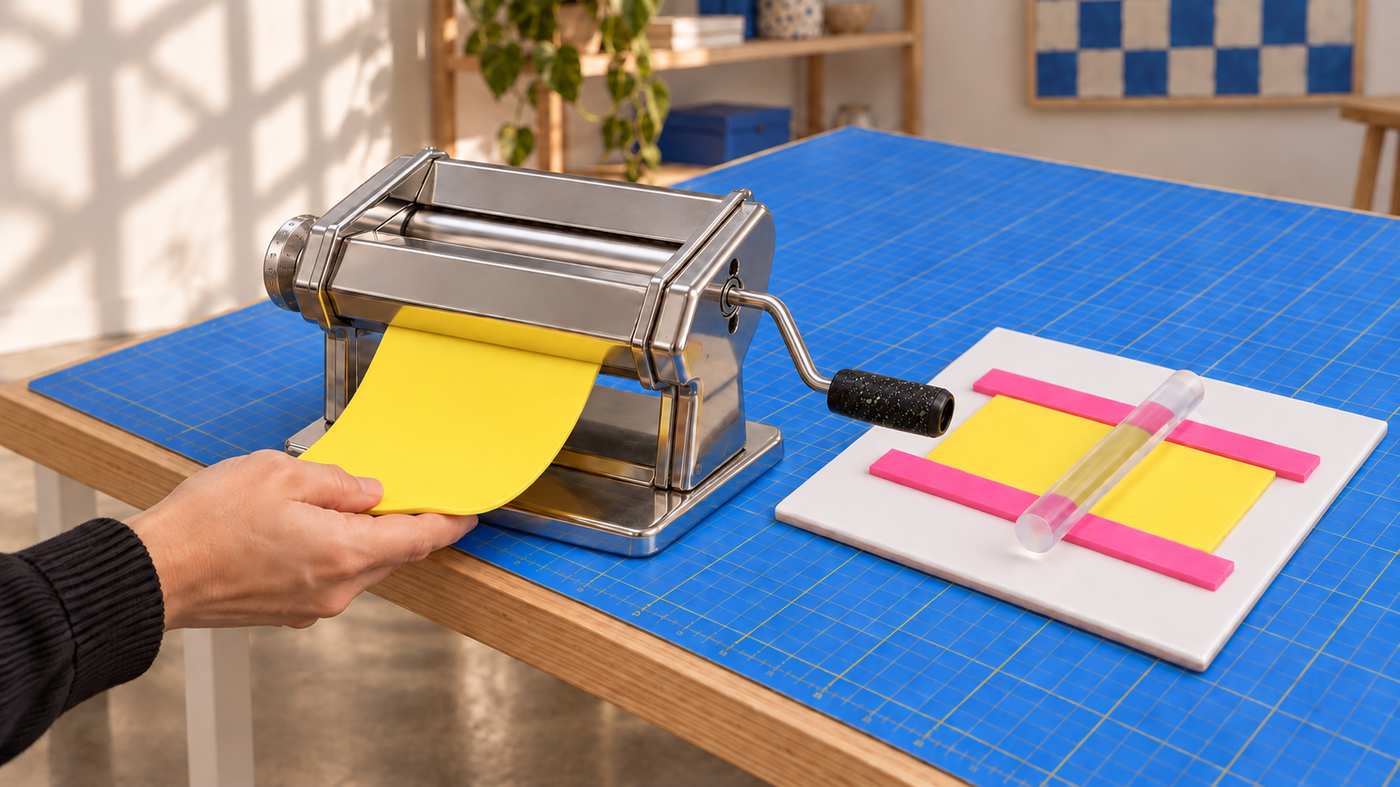
Best pasta machine for polymer clay: Atlas, Sculpey, Makin's or a roller
Buy the Marcato Atlas 150 for earring slabs and blends, or the Atlas 180 for slabs over 14 cm wide. Measured widths, thickest settings and lower-cost machines, compared.
Finished examples with related clay decisions
Each piece shows how a material, attachment, or surface choice changes the final form.