Layered pixel clay earrings: how to line up thin colour layers without stretching them
Your cutters shape each piece, but you place every colour layer by hand. Lift thin layers on a flat blade, line each one up before any pressure, then press the stack lightly through parchment.
Some links on this page are affiliate links. If you buy through them, we may earn a commission at no extra cost to you. As an Amazon Associate I earn from qualifying purchases. Disclosures

In brief
Key takeaways
- Set both bases where the pair will bake before adding layers, then carry each thin layer flat on a blade and check its edges from straight above
- Lower each layer one edge first, then nudge it into place with a needle tool. Lift and reset a piece that lands wrong, because pressing locks it where it sits
- When every layer is down, press the stack in one light pass through parchment from the centre out. Heavy pressure or a roller widens the pixel steps
- Pixel Flame, Pixel Eye and Faceted Gem pairs are identical. Flip the second clay piece only for a left and a right, like the eyes on the Boston Terrier Wall Mask
Article contentsOpenClose
Your cutters give every piece a crisp outline, but you place each colour layer by hand. Lift each thin piece on a flat blade, lower it onto the layer below one edge first, and look straight down to check where its edges sit. Nudge each piece until it is right. When the layers are down, press the stack in one light pass through a sheet of parchment, working from the centre out.
If you arrived from a ClayBake Build Kit, keep the thicknesses, layer order and margins your guide gives for your size. The kits differ on trimming, liquid clay and whether a pair is mirrored, and each of those is covered below.
If you are still choosing how to build a pixel design, the polymer clay pixel art guide compares layered cutters with a stepped silhouette, square tiles, a pixel cane and clay beads.
Do the cutters line the layers up for you?
No. Each cutter repeats one outline, so every piece comes out the same shape and size, but nothing on the cutter or the clay holds one layer in position on another. You decide where each layer sits.
In these builds a layer is one flat cut piece of a single colour. The base is the thicker bottom layer that sets the outside shape; ClayBake slab height guides roll it to an even height. The colour layers are much thinner pieces stacked on top of it, rolled between the spacers your kit guide names.
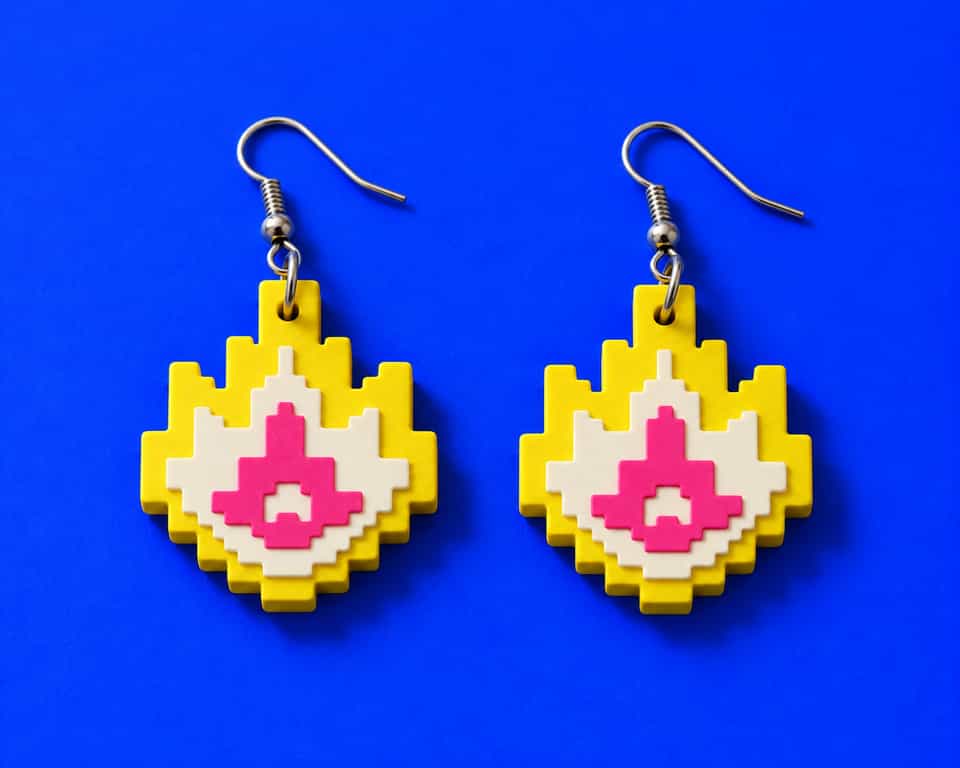
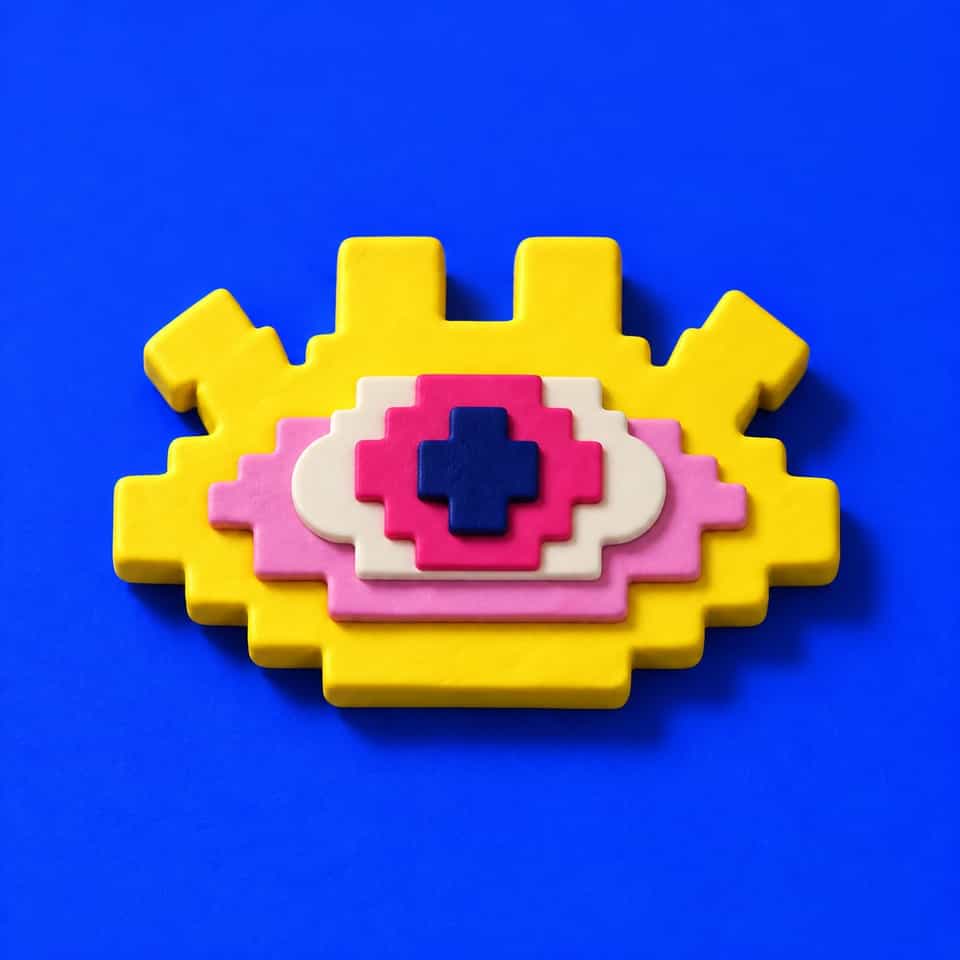
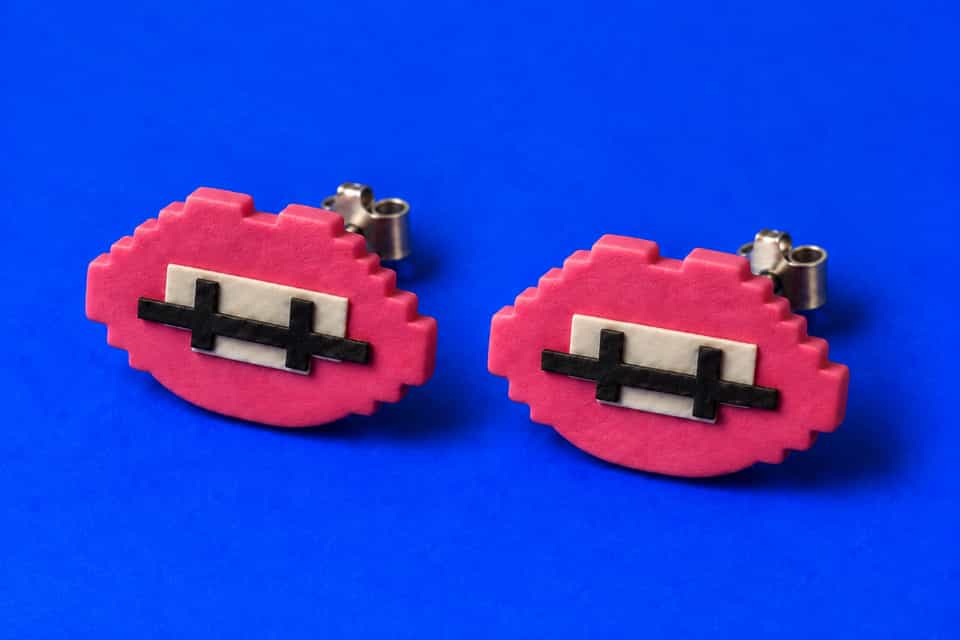
Some layers are cut as one connected piece, so the gaps inside them are already spaced for you. The white flame in the Pixel Flame Earrings and the white teeth in the Pixel Lips Brooch each lift as a single piece. You still place the whole piece by eye. Lift it in one go, supported from underneath, so the thin strips that connect its parts do not stretch. The white eye in the Pixel Eye cutter STL set is one solid piece; its rounded ends show as two white crescents once the iris covers the middle. It is wide and thin, so keep its full width supported on the blade and the ends will not droop or stretch.
Before you stack: where to build, firm clay and window plugs
Set the bases down where they will bake before you add any layers. Where you can, that is the oven-safe ceramic tile you will bake on, so the raw stack is lifted as little as possible. For a pair, put both bases side by side and build them in the same session, so you can compare them as you go and both are handled at the same clay firmness.
Stack with clay that is firm enough to hold its edges. If a cut piece sags, smears when you touch it or stretches as you lift it, it is too soft. Leave the pieces flat on their tile for a few minutes, or put the tile in the fridge briefly, and carry on when the clay feels firm again. Clay left too long in the freezer can turn brittle and crack, so a short cool rest is enough for layers you still need to lift. If the clay stays soft after cooling, the soft-clay leaching guide explains the next step.
If you have not layered this clay before, check how well it holds first. Press two offcuts together through parchment, bake and cool them, then try to lift the top piece with a fingernail. If it stays put, light pressure is enough. If it peels away, plan to use a very thin smear of liquid clay under each layer as you stack. The check is optional: you can skip it and use the liquid clay smear on every layer instead. The section on pressing explains why.
Clear every window plug while the piece is still flat on the tile. The Pixel Flame's magenta centre has a small window plug, and the Faceted Gem Earrings line layer has six inner pieces to remove. Hold the clay beside the opening down with a fingertip and lift the plug out with the point of a needle tool. Then lift the piece.
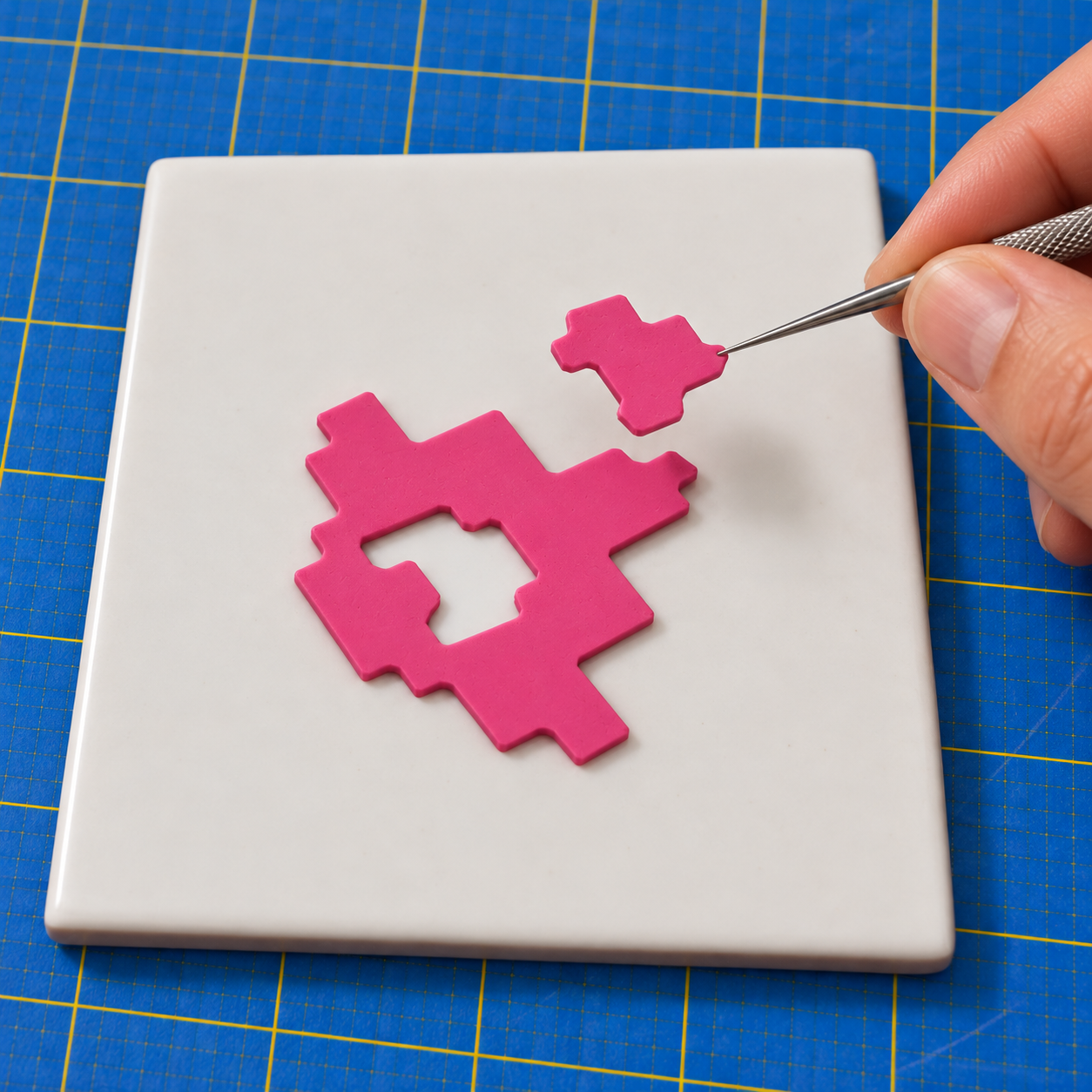
Keep powder off any side of the clay that will touch another layer. A very light brush of cornstarch on the cutter walls helps the cutter release, but the powder that stops clay sticking to a tool also stops clay sticking to clay. Dust the cutter rather than the clay where you can. If you did dust a thin sheet, brush the powder off both faces that will join before stacking. The cutter release guide shows how little powder to use.
Wash and dry your hands before you handle white or pale layers, and again after touching bright or dark clay. Specks and colour from your fingers show clearly on white. Lift any lint off the raw clay with the tip of a blade before the piece is pressed.
How do I move a thin layer without stretching it?
Slide a flat blade under the whole piece and carry it on the blade. Picking a thin layer up by an edge or a corner lets the rest of it hang, and the hanging part stretches.
- Peel away the waste first. Lift the scrap clay from around the cut piece so the piece sits on its own on the tile.
- Hold the blade by both ends. Tilt it until the sharp edge touches the tile beside the piece and the blade is almost flat. A long flexible tissue blade reaches under a whole earring layer.
- Slide it under in one steady push. Keep going until the blade reaches past the far edge and the whole piece rests on the metal.
- Carry it level to the stack. Keep the blade flat so the piece does not slide or fold.
If the piece still bends out of shape on the blade, the clay is too soft: let the slab firm up and cut a new piece. A stretched pixel step does not sit square on the layer below again, so recut it rather than pushing it back into shape.
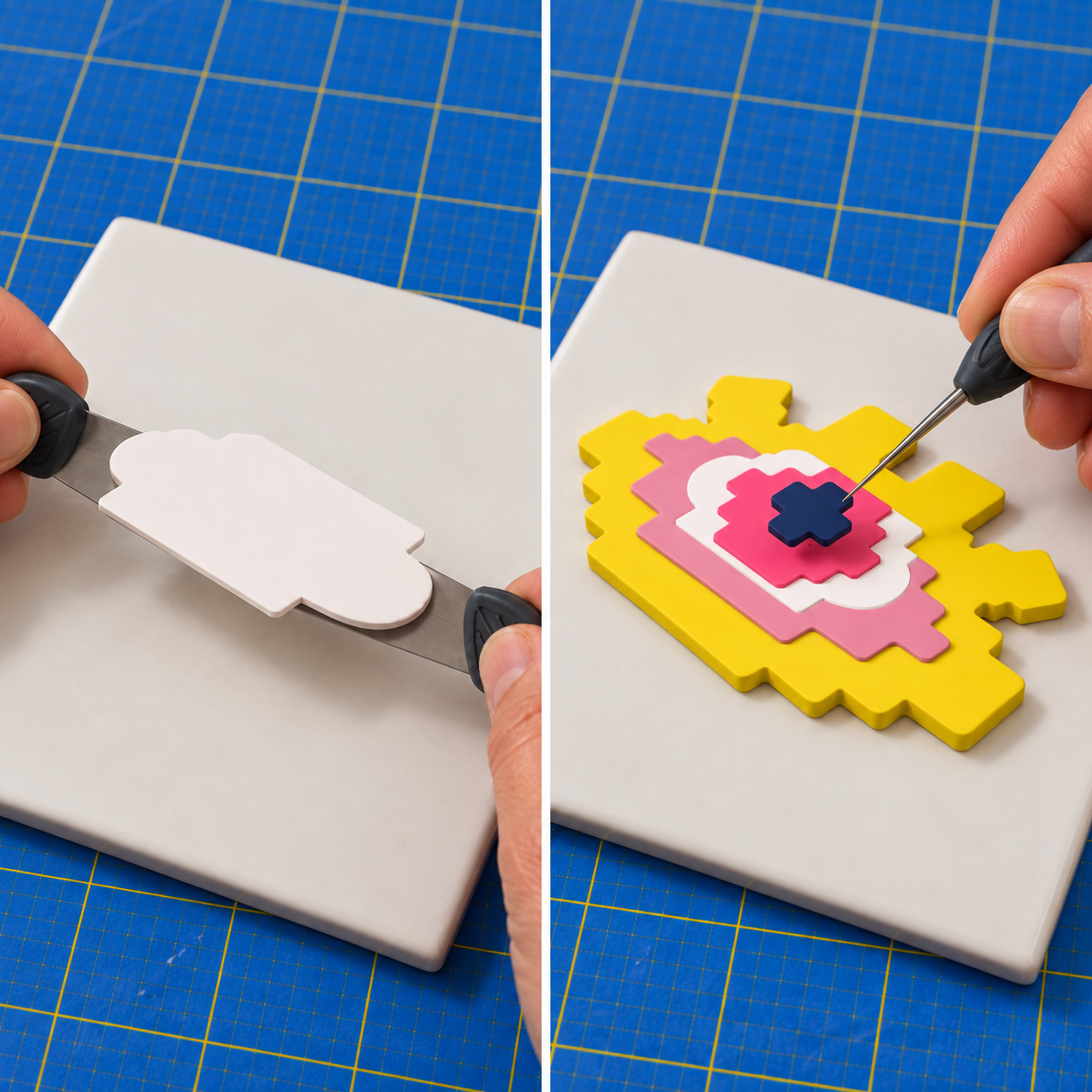
How do I put each layer in the right place?
Work from the bottom up: the base, then the largest colour piece, then smaller pieces, with the smallest detail last. A small piece placed early is easy to knock or smear while you adjust a big one around it. The kits follow that order:
- Pixel Flame: the white flame on the yellow base, then the magenta centre with white showing through its window.
- Pixel Eye: the pink backing on the yellow base, then the white eye, the iris and the pupil.
- Pixel Lips: the orange field on the pink base, then the yellow field, the connected white teeth and the fine black line.
- Faceted Gem: the connected pink line layer on an oversized yellow blank, before the final cut.
To set each piece down:
- Hold it just above its position. Look straight down so you can see the edges of the piece against the edges of the layer below.
- Lower one edge first. Touch one straight edge down exactly where it belongs, then tip the blade slowly so the rest of the piece settles onto the stack. Laying a whole thin piece down flat at once can trap a pocket of air in the middle.
- Slide the blade out. Draw it out sideways while the edge that is already down holds the clay in place.
- Check it from above. The straight edges of the new piece should run parallel to the pixel steps beneath it, and the strip of lower colour showing around it should match the finished design. That strip is not always the same width all the way round. On the Pixel Eye, the backing sits low on the base so the lashes stay uncovered, and some edges line up exactly with the edge of the layer below. Your kit guide shows where each layer sits for your size.
- Nudge it; do not press it. Push the side of a needle tool or a soft brush tip gently against an edge to move the piece a fraction at a time. The layers are only resting together at this stage, so small moves are easy.
Fix the position before you press: pressure locks a mistake in place and spreads the clay around it. If a piece lands in the wrong place or shifts, slide the blade in flat from the side where the piece overhangs most, lift it, and set it down again.
How hard should I press the layers together?
Place every layer first, then press the whole stack in one light pass. Lay a piece of baking parchment (search Amazon) over it. Press a fingertip or a flat burnishing tool down in the middle, then work out to the edges in small overlapping presses. Stop as soon as every layer lies flat against the one below, before any edge starts to spread. Peel back one corner of the paper to check before you lift it away.
The paper spreads the pressure, so the clay does not take a print or a dent, and small pieces are less likely to smear sideways. A large, multi-part face works in stages instead: the Boston Terrier Wall Mask presses its broad panels lightly before the small eye and mouth pieces go on, then touches up only loose edges at the end.
Leave the roller out of this step. Heavy pressure or rolling spreads the layers, and a spread layer widens every pixel step. Rolling a stack flat is a different technique, used when you want colour pieces pressed level with the base.
Do the layers need glue?
Light pressure through parchment is how every ClayBake pixel kit joins its layers, and each kit guide adds liquid clay only when the clay needs it. How firmly pressed layers hold after baking depends on the clay. One published maker bond test pressed raw clay onto raw clay across several brands: some brands held well with no adhesive and others came apart easily. A bakeable adhesive such as liquid clay made the bond strong in every brand tested.
That is what the optional offcut check before you stack is for. If your baked offcuts peeled apart, or you skipped the check and want the extra hold, brush a very thin smear of liquid clay onto the middle of the lower piece before you set the next layer on it. Keep it well back from the edges so none squeezes out around the pixel steps. The Pixel Flame and Pixel Lips guides also use a tiny dab under a corner that will not stay down. Keep it to a trace: a wet film under a thin layer lets it slide while you stack.
When should I trim through the whole stack?
On the Pixel Flame, Pixel Eye and Pixel Lips, trim only if a colour has spread past the base after pressing. The Faceted Gem always gets one final press of its base-layer cutter, and the Boston Terrier Wall Mask is never trimmed once the face goes on.
- Trim only if a layer spread. Pixel Flame, Pixel Eye and Pixel Lips: look at the outline after pressing. If any colour now pokes past the edge of the base, centre the base cutter over the stack so its outline sits over the base, press straight down once and lift straight up. If nothing has spread, leave the stack as it is.
- Always make one final press on an oversized blank. Faceted Gem: the yellow blank starts larger than the gem. Lay the pink line layer on it and tack it down, then centre the base-layer cutter over the pink outline and press once. Its blade follows the pink outline to cut the yellow, and it presses the pink lines in.
- Never trim the finished face. Boston Terrier Wall Mask: the head cutter is used first, on the flat base, and the raised face is built on top. Running it over the raised face would crush the layers.
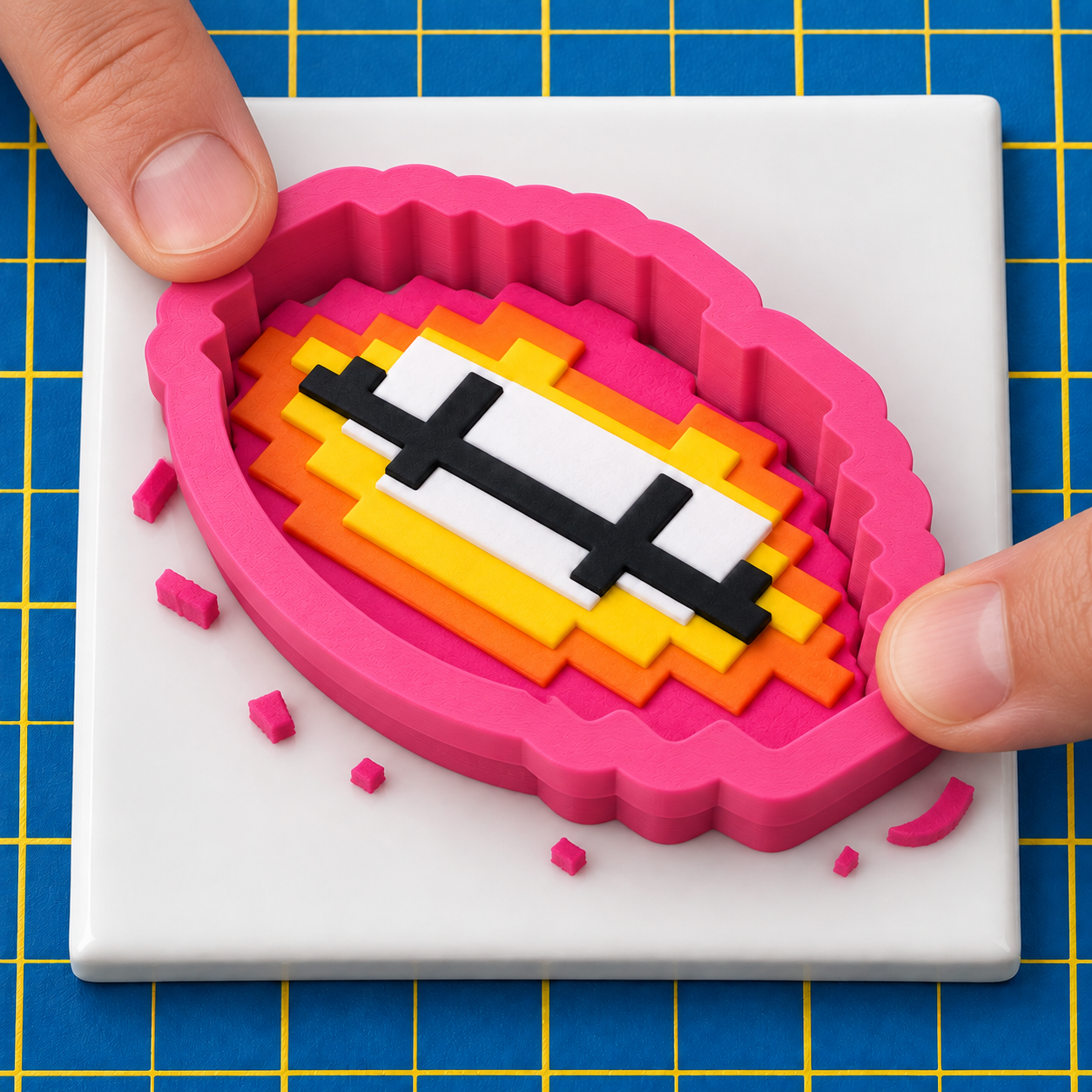
For a clean cut through several layers, leave the stack stuck to the smooth tile it was built on, so the cutter comes away and the clay stays behind. Use a clean, bare cutter and press in one straight motion. Cling wrap over a cutter rounds the top edge, which softens the crisp stepped outline a pixel design needs.
Should the second earring be a mirror image?
Only when the design leans or points one way. The ClayBake pixel earring kits make matching pairs: the Pixel Flame, the Pixel Eye studs and the Faceted Gem are identical earrings that face the same way. Cut every shape twice and build both earrings the same way, with no flipping.
A mirrored pair is one where the second piece is the reverse of the first, like a left and a right hand. To mirror a piece cut with a single cutter, turn the second clay piece face down before you place it, so its outline reverses. The Boston Terrier Wall Mask does this for its eyes: each eye cutter is used twice and the second clay piece is flipped. Its inner ears need a true left and right, so the kit includes a separate cutter for each side.
On a layered design, flip each layer's second piece before stacking it, not the finished stack, so the base still ends up underneath. For your own asymmetric design cut from a paper template, turn the template over for the second piece instead of redrawing it.
Layering problems and how to fix them
| What you see | What to do |
|---|---|
| A thin layer tore as you lifted it | Let the slab firm up, cut a new piece, and slide the blade under it in one steady push until the whole piece rests on the metal. |
| A layer stretched, smeared or lost its square steps | Lift it away and cut a new piece. Carry the next one flat on the blade and lower it one edge first. |
| A layer shifted while you pressed | Lift it off with the blade, set it down again and press more lightly through a fresh piece of parchment. |
| A bubble shows under a layer | Before baking, press gently from the bubble towards the nearest edge to push the air out. If it will not move, prick it with the point of a fine needle, press the air out through the hole and smooth the surface closed. |
| A colour pokes out past the base after pressing | If your design has a trim step, centre the base cutter over the stack and trim once. If it does not, lift and recut the piece that spread. Press more lightly on the next stack. |
| A corner keeps lifting | Tuck a tiny dab of liquid clay under it, back from the edge, and press again through parchment. |
| Lint, specks or a fingerprint on a white layer | Lift specks with the tip of a blade before pressing. Press through parchment so your fingers never touch the white clay, and wash your hands between colours. |
| Fine cracks along the cut sides | A cutter that crushes the clay instead of slicing it leaves cracks like these, and they can open further in the oven. Use a clean, sharp cutter on clay that is firm but not cold, and press straight down once. The cracked clay guide covers other causes. |
| A layer lifted after baking | Pressing it back will not rejoin baked clay. Glue it down with an adhesive suited to baked polymer clay, following the polymer clay glue guide. On the next piece, run the offcut test first. |
Baking the finished stack
Bake the stack on the oven-safe tile you built it on, without lifting the raw clay, and let it cool there. For a matte back, you can instead move it once onto parchment or plain card just before baking: slide a long blade under the whole stack in one push and set it down flat. If your design has a hanging hole, the jump ring hole guide explains punching it in raw clay or drilling it after baking. Bake by the directions on your clay's packet, check the temperature with an oven thermometer beside the clay, and let the piece cool completely before you lift it. The baking support guide covers tiles and other surfaces.
Supplies
Supplies mentioned here
Quick links to the materials and tools that fit this article. ClayBake tools stay on our own catalog.
ClayBake slab height guides
Printable rails that sit either side of your roller for the thick base slab. Measure the printed rails with calipers, then roll until the roller rides on both. The colour sheets are thinner than the lowest rail, so roll those between the measured spacers your kit guide names.
Tissue blade set
A long, flat blade slides under a thin cut layer and carries it to the stack in one piece. Keep one blade clean for lifting white and pale layers.
Baking parchment
Lay a sheet over the stack and press through it, so the clay takes the pressure without prints or smears. If you also bake on it, check the box says it is oven-safe.
More guides in this path
Open these when the next decision is material choice, attachment, or finishing.
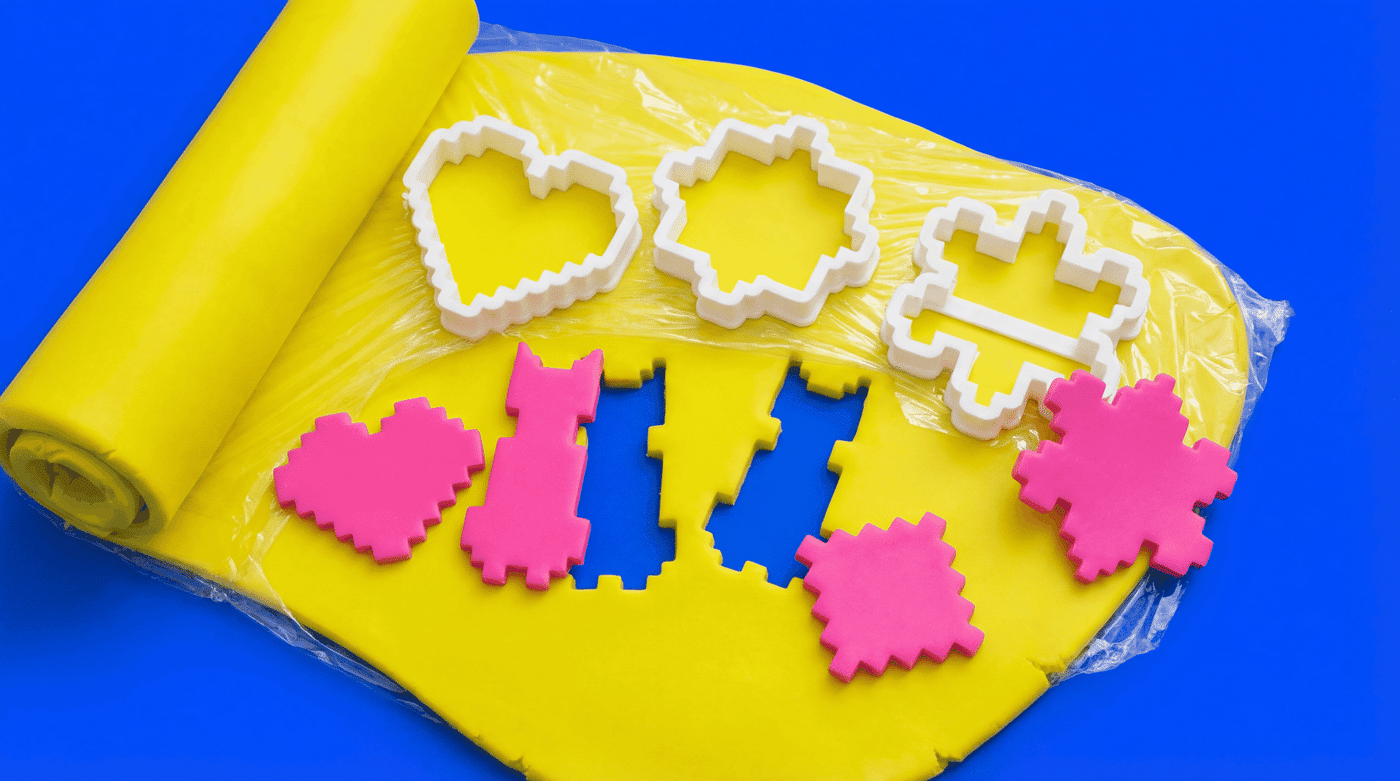
Polymer clay stuck in your cutter? How to release it and stop it sticking
Free a trapped shape, dust the cutter without leaving white clumps, and set up the slab for the next clean release. Includes the cling-wrap method for softer edges.
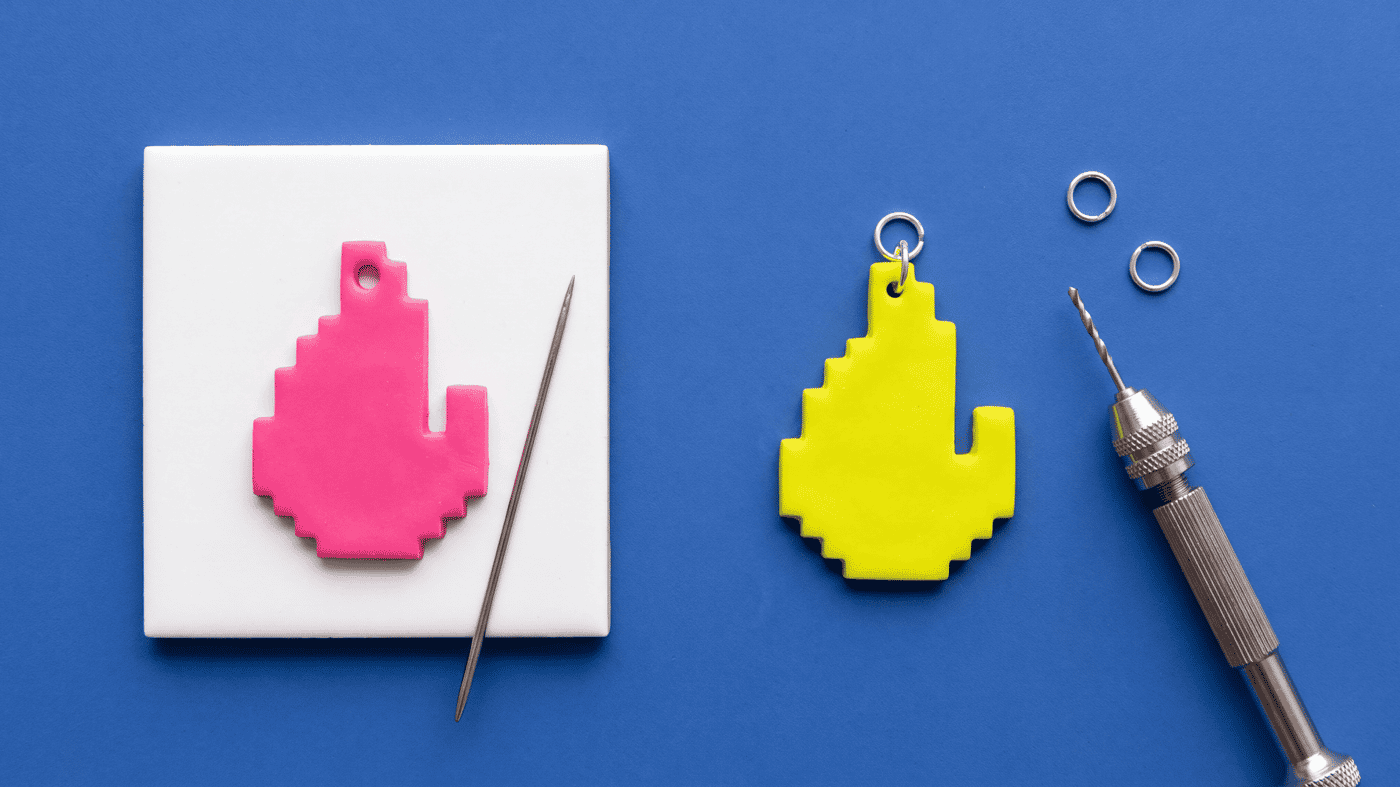
Jump ring holes in polymer clay: punch before baking or drill after?
Punch the hole in raw clay when the slab is thick, chilled and still on the tile. Drill after baking when the piece is a thin veneer, a layered stack, a pixel corner or a hole close to an edge. Fixed-hole cutters skip the marking step but carry the raw-hole caveats.
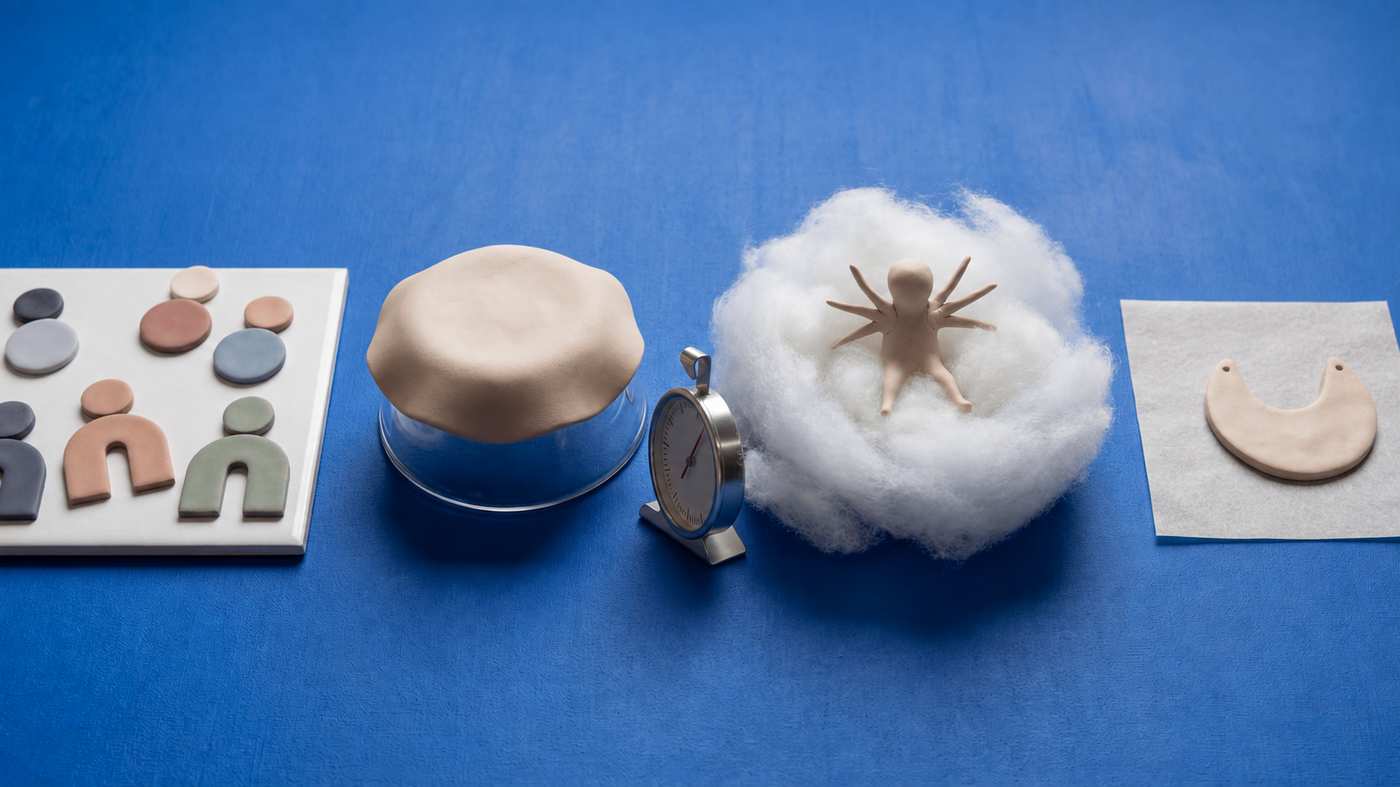
What to bake polymer clay on: tile, card and supports for flat, folded and large pieces
Bake flat pieces on a glossy tile and move them onto plain card only for a matte back. Hold curves, limbs and overhangs with fiberfill, crumpled foil or an oven-safe glass form, bake round beads on skewers, and leave everything on its support until it feels cool.
Finished examples with related clay decisions
Each piece shows how a material, attachment, or surface choice changes the final form.