How to attach small polymer clay details so they stay on and keep a crisp edge
Stop small clay details popping off after baking or spreading as you press them. Decide on liquid clay before you start, then carry, place and tap each piece so it stays on with a crisp edge.
Some links on this page are affiliate links. If you buy through them, we may earn a commission at no extra cost to you. As an Amazon Associate I earn from qualifying purchases. Disclosures

In brief
Key takeaways
- Carry each small detail on a thin blade, supported from underneath, because pinching a soft piece stretches it out of shape
- Follow your kit guide's order, or place the largest pieces first on your own designs, and lower each piece onto the base one edge first
- Tap each detail through parchment in small, even taps and stop as soon as every edge sits down, before the outline spreads
- Put a trace of liquid clay under each detail unless a baked scrap shows your clay holds with pressure alone, and add raw clay to baked clay only on an unpainted, unglazed piece, with a thin layer of liquid clay between them and a second bake
Article contentsOpenClose
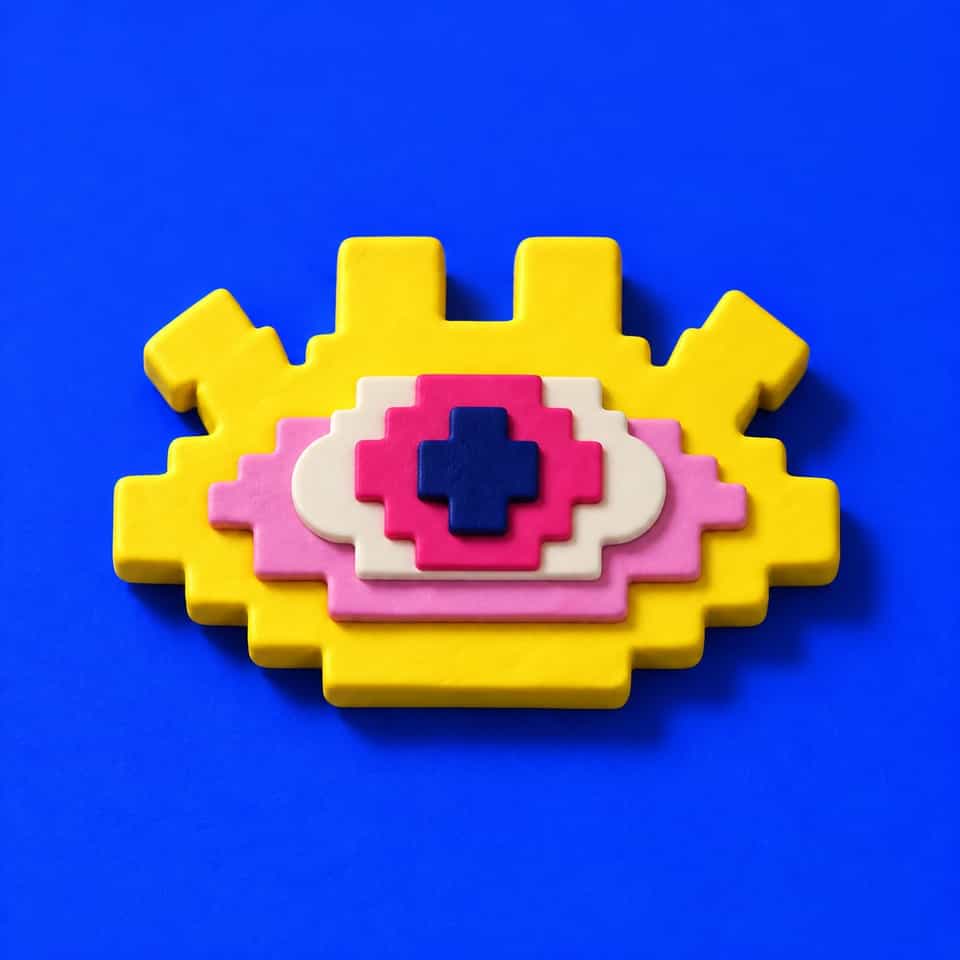
Small raw clay details stay on through the bake when each one goes down on clean clay, gets only a light tap through parchment, and sits on a trace of liquid clay (polymer clay in liquid form, which bonds as it bakes) unless your clay holds on its own. If you came from a Clay Bake Studio Build Kit step, keep the sheet thickness and placement order your kit guide gives. Stacking full-size colour layers for the Pixel Eye Brooch is a different job, covered in the guide to layering thin colour layers.
Before you place anything: tile, firm clay and clean hands
Set up these five things before the first piece goes on.
- Base on its baking tile. Cut the base and leave it on the oven-safe tile it will bake on, or on the surface your kit guide names, so the finished raw piece never has to be lifted.
- Details firm enough to lift. If a cut detail droops or stretches on a blade, the clay is too soft. Rest the sheet on a cool tile or briefly in the fridge; Sculpey notes that clay chilled too hard can turn brittle and crack. If the clay stays soft, the soft clay leaching guide explains the next step.
- Clean hands. Roll a scrap of light clay between your palms to pick up dirt and stray colour, and lift lint off the raw clay with lightly pressed tape. Sculpey notes that warm clay takes fingerprints more readily, so keep the details cool and move them on a blade.
- No heavy powder on joining faces. A light dusting of cornstarch helps a cutter release, but added clay will not stick properly over a heavy dusting. Dust the cutter, not the clay, and brush stray powder off both joining faces before placing. The cutter release guide shows how little powder you need.
- Matching repeats. On your own designs, cut repeated shapes from the same sheet in one session so they match. If your kit guide cuts and places one piece at a time, follow its order.
Do small clay pieces need glue to stick to raw clay?
It depends on the clay, so either put a trace of liquid clay under each detail or first check that your clay holds with pressure alone. Sculpey's own projects join raw pieces by pressing, but pressing hard enough for a strong join can squash a small crisp shape. Sculpey says its oven-bake clay adhesive lets pieces join with little pressure, so fine details keep their shape. Oven-bake clay adhesive and FIMO liquid are both types of liquid clay, so in this guide "liquid clay" covers any of them.
In one published maker bond test, raw clay details were pressed firmly onto raw bases without blending the edges. FIMO Professional and Cernit held with pressure alone. In some other brands, the baked detail could be flicked off with a finger, so a detail that stays put while raw can still come off after baking. With any liquid clay or bakeable adhesive between the pieces, the bond was strong in every brand she tested.
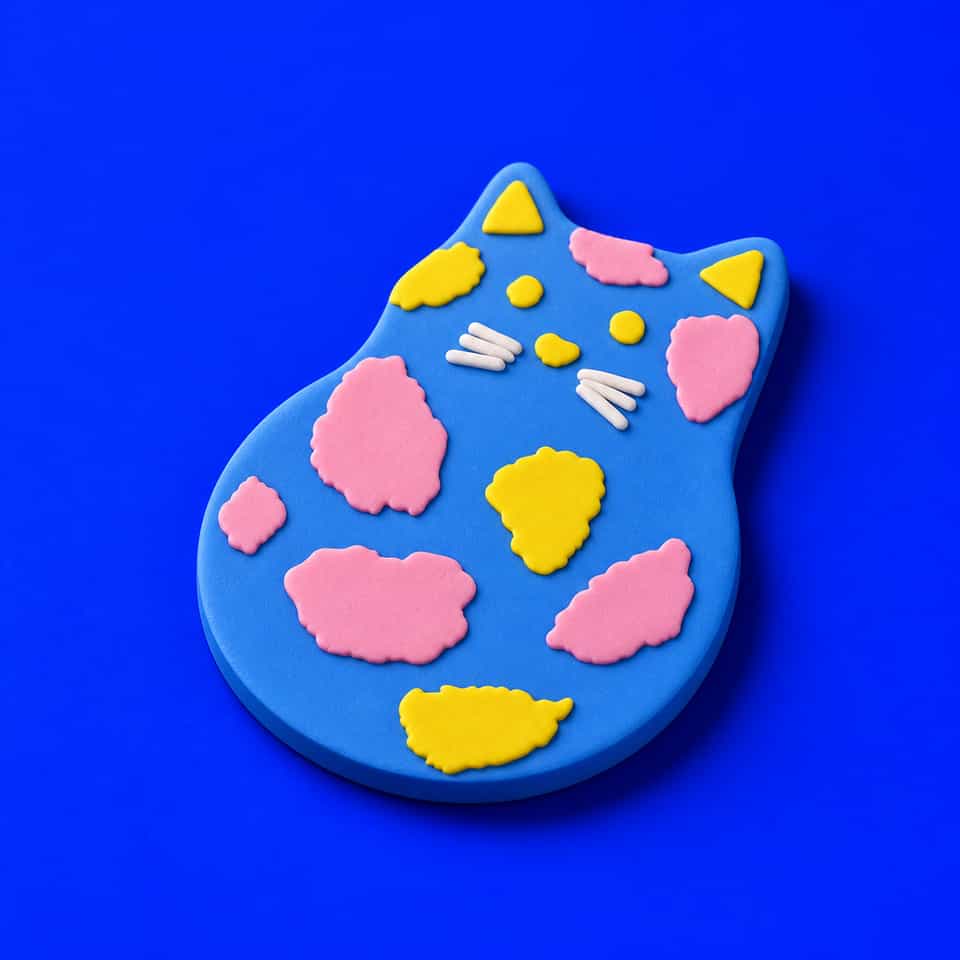
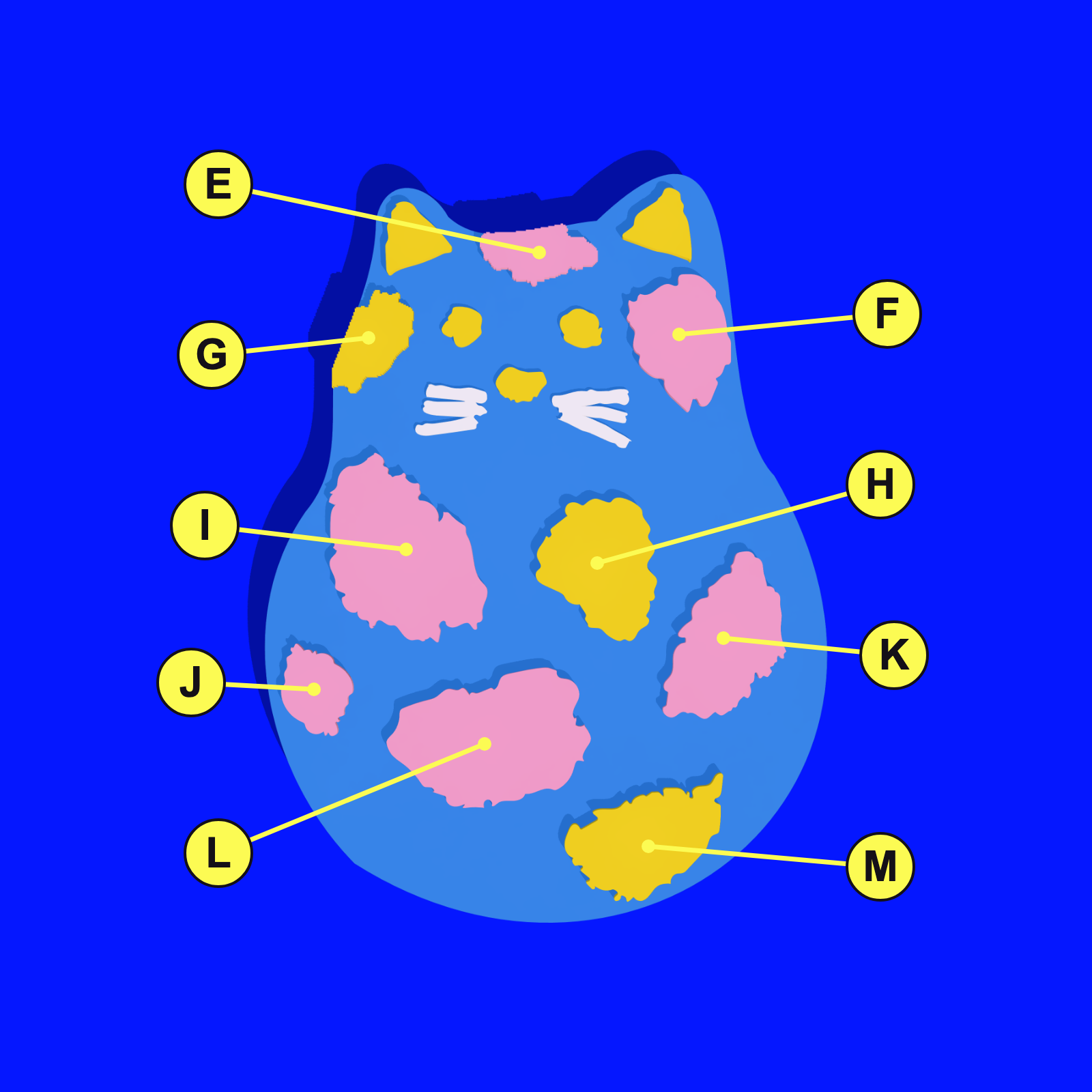
To check your clay, press a scrap detail onto a scrap base exactly the way you will press the real piece: small taps through parchment until its edges sit down. Bake it by the packet, let it cool, and try to flick the detail off with a fingernail. If it holds, a light tap alone is fine for that clay. If it comes off, use a trace under each detail. The Blue Spotted Cat guide lists a trace under each detail it adds to the body.
One bottle of liquid clay covers raw-to-raw joins. Apply the trace before you lift the detail:
- Mix the bottle. Stir or shake the liquid clay as its label directs. Squeeze a drop onto a scrap of parchment.
- Pick up a trace. Dip a needle point into the drop so only a small bead clings to it.
- Dab the base. Touch the bead to the middle of the spot on the base where the detail will sit, back from where its edges will land. Then lift and place the detail, as the next two sections show.
- Lift off any squeeze-out. After tapping the detail down, lift any shine of liquid clay at its edge straight up with the needle point, never dragging along the edge. Some liquid clays bake cloudy instead of clear, so excess can show.
Liquid clay does not dry the way glue does: the bond forms in the oven. Leave the piece flat and untouched until it bakes. Read the clay packet and the liquid clay bottle. If they give different temperatures, bake at your clay packet's temperature, as the kit guides do, and check the oven with a thermometer.
How do I pick up a tiny piece without stretching it?
Carry it on a thin blade, supported from underneath. Pinching a soft detail stretches it.
- Peel the waste away. Lift the scrap clay from around the cut detail so the piece sits alone on the tile. If you are using liquid clay, dab the base first, as above.
- Hold the blade almost flat. Hold a tissue blade, a long, thin, flexible blade, by its dull back edge near one end, almost flat, with the long sharp edge on the tile beside the detail.
- Push under in one steady move. Push the edge under the piece until the whole detail rests on the metal.
- Carry it level. Keep the blade flat on the way to the base so the piece stays put.
If the detail droops as the blade goes under, firm the sheet and cut a new piece. For a piece too small to carry on a blade, such as a tiny eye dot, use tweezers; Sculpey suggests jewellery tweezers for pieces too small to move with your fingertips. Use fine tweezers (search Amazon), close the tips just enough to hold the piece, and let go as soon as it touches down.
Placing each piece: order and setting it down
Follow your kit guide's order, or on your own designs place the largest pieces first and the smallest last. Largest first means you never reach past a finished tiny piece. Work from a reference the whole time: a placement map (a drawing that shows where each piece sits), the centreline of a face, or a picture of the finished design.
- Blue Spotted Cat: the guide seats the two inner ears first, then works through the spots from head to tail using its placement map, tapping each spot down before cutting the next.
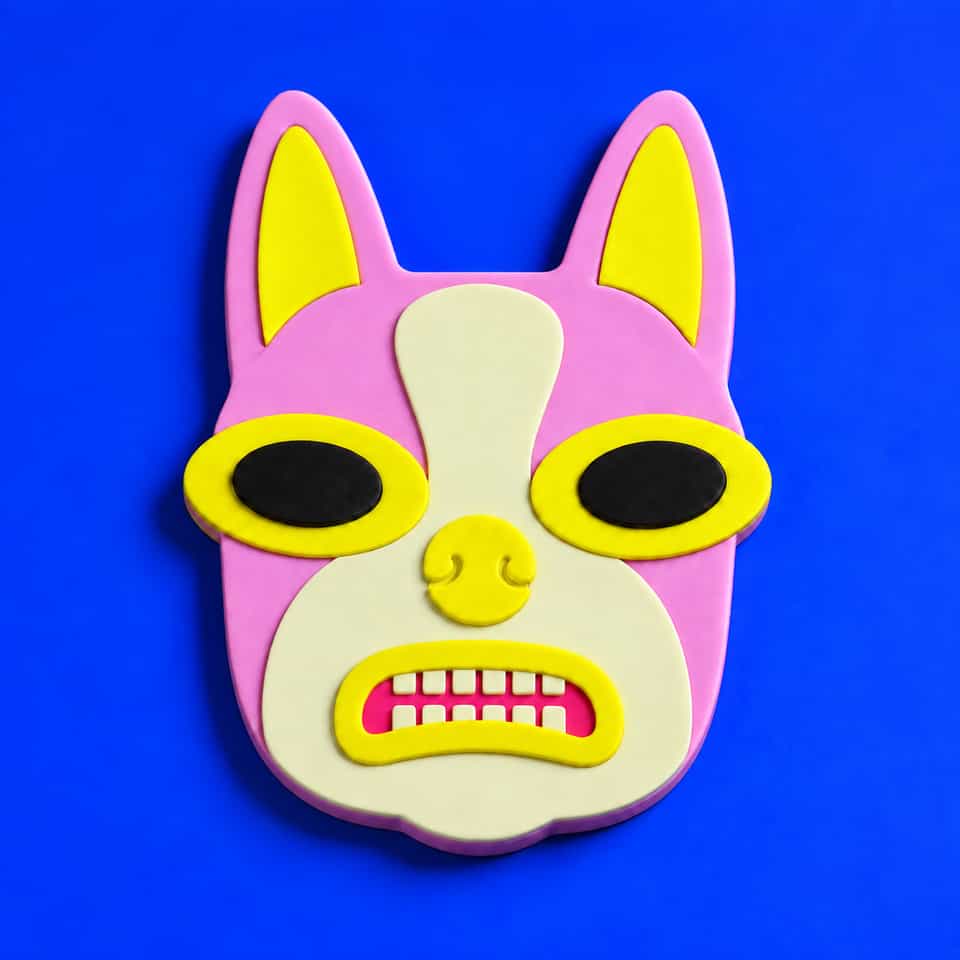
- Boston Terrier Wall Mask: the guide places the nose and mouth pieces on the centreline, the line down the middle of the face. The connected teeth piece has a window, a small opening cut inside the piece. While the piece is still flat on the tile, hold the surrounding clay flat and lift the cut clay out of the window with a blade tip, then lift the teeth on the blade, supported from below.
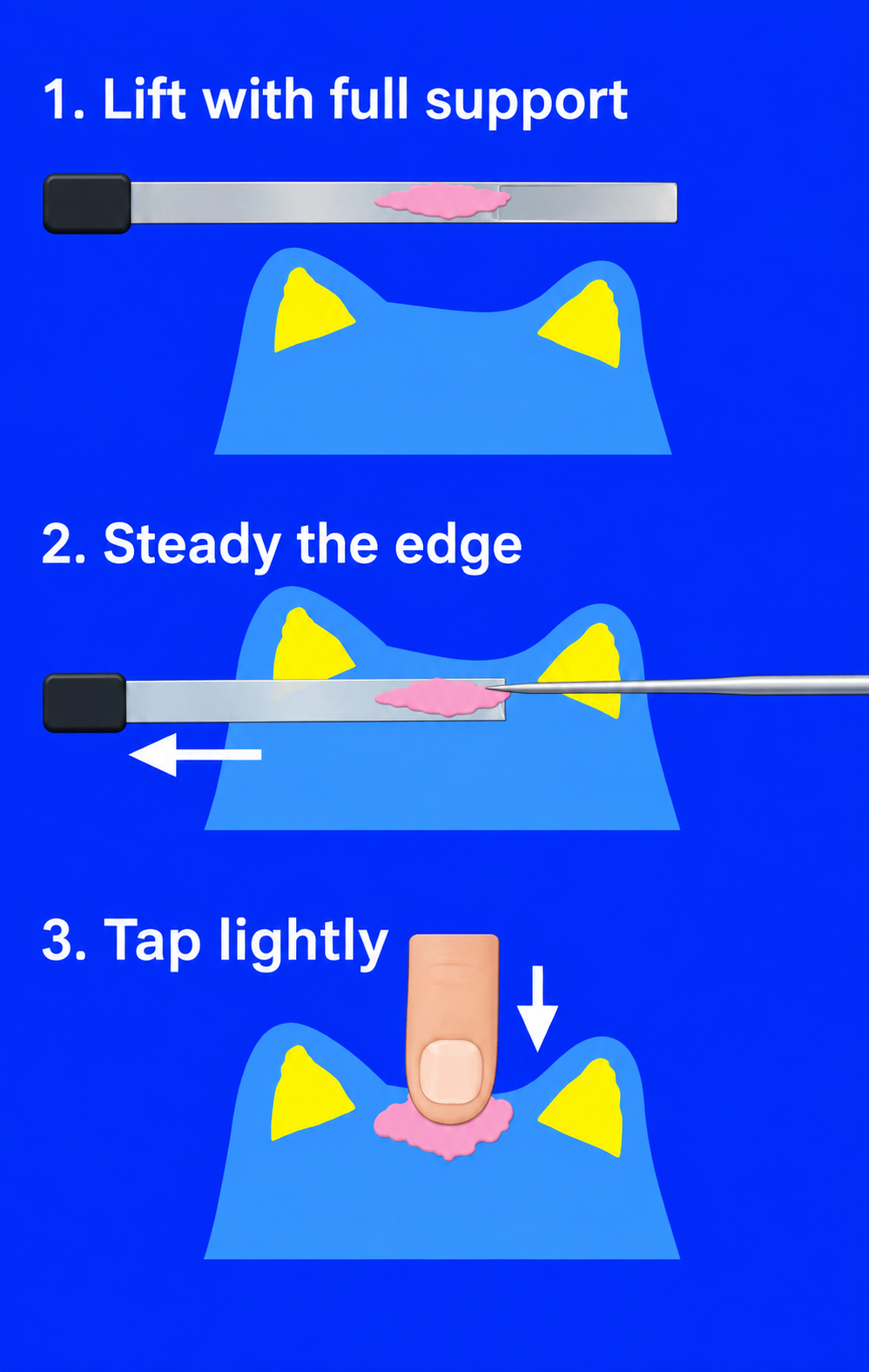
To set each piece down:
- Hold the blade just above the spot. Look straight down and compare the detail with your reference.
- Touch one edge down first. Set one edge on its spot and tip the blade slowly so the rest of the piece settles, which lets air escape from underneath.
- Draw the blade out. Pull it back out the way it came, away from the edge that is already down. If the detail starts to slide with it, hold that edge still with the side of a needle tool.
- Check from above before any pressure. For a pair such as two ears, look at the second piece against the first from straight above before you tap it down. The cat guide seats and taps each ear in turn.
How hard should I press small details?
Only hard enough for every edge to sit down; any harder and the outline starts to grow.
- Cover the detail. Lay a small piece of baking parchment (search Amazon) or a plastic deli sheet over it. Sculpey describes pressing through one of these so the clay takes no fingerprints or surface marks.
- Tap straight down. Press a fingertip or a flat tool on the paper in small, even taps across the whole detail, moving up and down, never sideways.
- Check the edges. Peel back one corner of the paper and look across the detail from low down. There should be no gap or shadow line under any edge. If you see one, lay the paper back and tap that edge again. Stop as soon as every edge sits down, before the outline widens.
- Lift the paper straight away. Sculpey notes that parchment left on raw clay for a long time draws softness out of it.
A blister is a bubble of trapped air under a detail, and Sculpey warns that trapped air expands in the oven. Press gently from the bubble towards the nearest edge to push the air out. If it will not move, slide the point of a fine needle tool into the bubble, press the air out through the hole, then smooth the hole closed with a fingertip through parchment.
What if a piece lands in the wrong place?
If you have not pressed it yet, slide the blade's long edge under it, the same way you picked it up, lift straight up and lower it again from one edge in the right spot. If it has already stretched, smeared or been tapped down, lift it off the same way and cut a new one.
For a piece only a hair off, a tiny nudge with the side of a needle tool before any pressure is fine. Sliding a piece any real distance across raw clay can smear its colour into the base, which is why the Boston Terrier guide says to remake a small part that drifts.
Should the detail sit raised or be pressed flush?
Leave a small detail raised to keep its exact outline, and make it flush only when the design needs a level surface. An applique is a cut piece left sitting on top of the base, so it keeps its outline and a small raised edge. An inlay is a piece pressed or rolled level with the base.
Rolling a raised shape flush stretches it, so its outline spreads: a dot pressed flat into a sheet distorts this way. Two methods give a flush surface:
- Cut out and replace, for an exact outline. Cut the shape out of the base, hold the surrounding clay flat and lift the cut plug out with a blade tip. Roll the new colour to the same thickness as the base, cut the same shape from it with the same cutter, and drop that piece into the hole. Tap it level through parchment. One long-time polymer clay teacher points out that a shape cut out and replaced with the same cutter fits the hole with no distortion.
- Roll in, for a scattered chip look. Keep the pieces thin and leave space between them. Set them on the base and press each one down with a fingertip first, as Sculpey's terrazzo vase project does. Lay paper over the sheet and roll across with an acrylic roller in light passes, turning the tile a quarter turn between passes so you roll from all four sides, as Sculpey's white granite terrazzo project does. Rolling the same way every pass lengthens the sheet and stretches the pieces into streaks. Stop as soon as the surface looks mostly level, the stopping point in Sculpey's faux terrazzo earrings.
The cut spots, ears, noses and mouth pieces in the Clay Bake Studio Build Kits that link here sit raised, so tap them down and keep the roller away. Where a kit guide presses a piece flush or into a marked recess, follow the guide. For slabs of chips rolled flat, see the terrazzo slab guide.
Adding a detail to clay that is already baked
A raw detail can go onto baked clay, but this join is harder than raw on raw. Sculpey's FAQ says uncured clay does not fuse with cured clay and calls adding to cured clay and rebaking difficult, and in one published maker test most brands bonded poorly raw to baked.
- Start with a bare piece. Use this method only on a piece with no paint or glaze, because Sculpey limits rebaking to unpainted, unglazed pieces.
- Let it cool completely.
- Clean the spot. Wipe the baked surface with isopropyl alcohol and let it dry.
- Dab on a thin layer. With a needle point or a small brush, dab a thin layer of liquid clay, such as FIMO liquid, where the detail goes.
- Place and tap. Lower the raw detail from one edge and tap it down through parchment. Where the design allows, let the new piece wrap slightly over an edge of the baked piece, which Sculpey suggests for security.
- Bake again by the directions on the clay packet.
In one published maker test, FIMO liquid was the only bond that made this join strong, in three of the brands tested. Staedtler makes FIMO liquid for joining unbaked FIMO to baked FIMO, and Sculpey also sells its oven-bake clay adhesive for raw-to-baked joins. Before a piece you care about, join a raw scrap to a baked scrap the same way, bake and cool it, then try to flick the detail off with a fingernail.
Small detail problems and how to fix them
| What you see | What to do |
|---|---|
| A detail stretched or lost its shape while you lifted it | The clay is too soft. Rest the sheet on a cool tile or briefly in the fridge, cut a new piece and carry it on the blade. |
| A detail drifted or landed off its spot | Before any pressure, slide the blade under it, lift straight up and set it down again, or nudge it a hair with the side of a needle tool. If it is tapped down or smeared, cut a new one. |
| A fingerprint or lint on a pale detail | Lift lint with lightly pressed tape. For a fingerprint, clean your hands with a scrap of light clay, cut a new detail and tap it down through parchment. |
| A blister or bubble under a detail | Push the air towards the nearest edge, or slide a fine needle in, press the air out and smooth the hole closed. |
| The outline spread after pressing | Cut a new piece and tap more lightly, stopping as soon as the edges sit down. For a flush finish, cut the shape out of the base and drop the new colour in. |
| An edge or corner keeps lifting | Tuck a tiny dab of liquid clay under it, back from the edge, and tap again through paper. |
| A detail came off after baking | Pressing it back on will not rejoin baked clay. Glue it with a flexible gel superglue on clean, bare clay, following the glue's label and keeping it off your fingertips; glue holds to paint or glaze and not to the clay under it. On the next piece, brush heavy powder off the join and use a trace of liquid clay. |
| A pale detail browned in the oven | On the next bake, tent the piece loosely with foil or an upturned foil pan, and check the oven with a thermometer. |
| White powdery marks around a detail | Brush the powder off before pressing. Next time, dust the cutter, not the clay. |
Moving the piece to the oven
Bake on the surface your kit guide names, or on the oven-safe tile you built on, so the raw details stay untouched. If it has to move, slide a long blade under the whole piece in one push.
White, translucent and light clays discolour more easily, so pale details can brown before the base does. Sculpey suggests tenting thin projects and high points, and experienced makers cover work every time. Tent the piece loosely with foil or an upturned foil pan, with the cover clear of the raised details.
Bake by your clay packet and check the temperature with a separate oven thermometer; the oven thermometer guide helps you choose one. Let the piece cool completely before you touch any raised details. The baking support guide covers tiles and other baking surfaces.
Supplies
Supplies mentioned here
Quick links to the materials and tools that fit this article. ClayBake tools stay on our own catalog.
Liquid Sculpey Clear (liquid polymer clay)
A trace on the base under a small detail joins the two as the clay bakes, so a light tap is enough. Stir or shake it as the label directs, and lift off any that squeezes out.
Tissue blade set
A long, thin, flexible blade slides under a small cut detail and carries it supported from underneath, so the piece keeps its shape on the way to the base.
Baking parchment
Lay a small piece over a detail and tap through it, so your fingertip leaves no print on the clay. Peel it off as soon as the edges sit down.
More guides in this path
Open these when the next decision is material choice, attachment, or finishing.
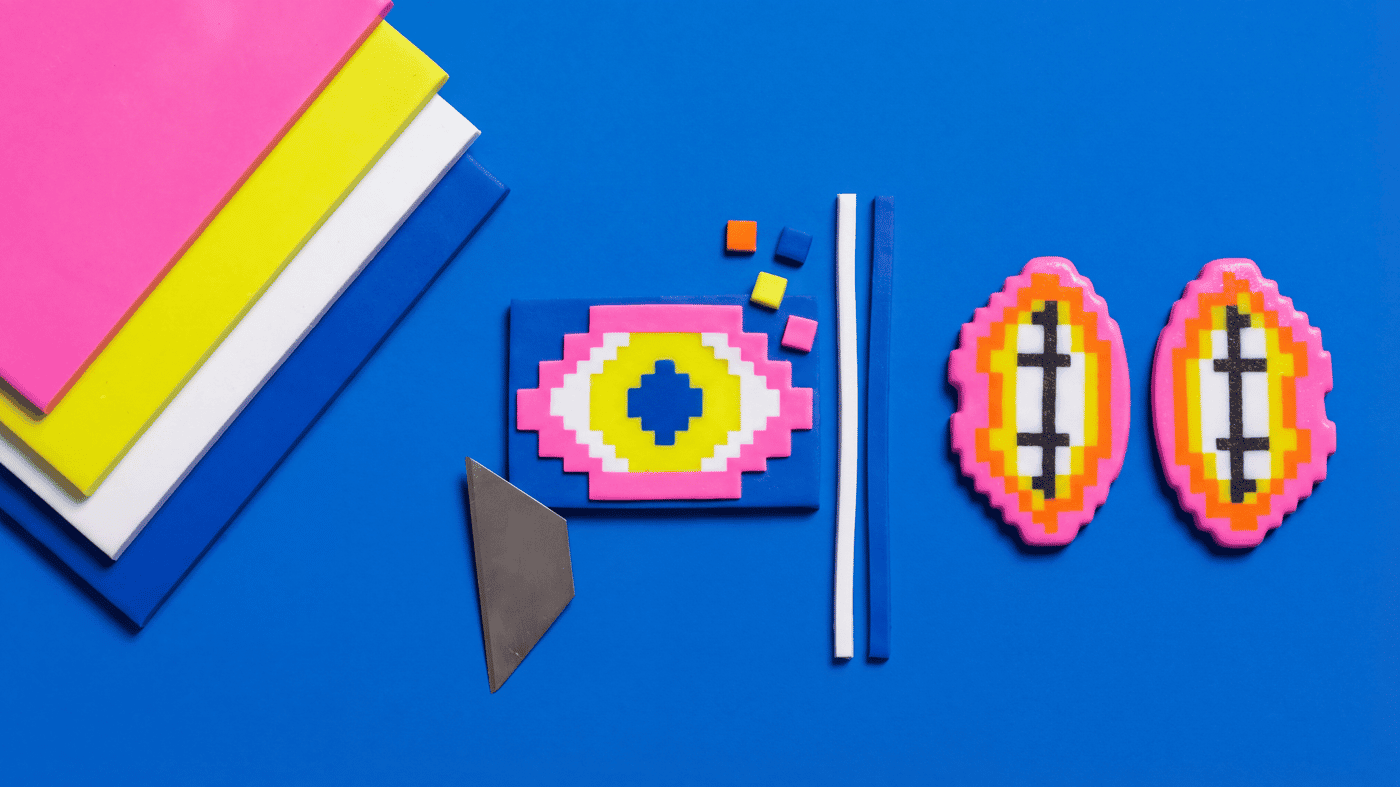
Layered pixel clay earrings: how to line up thin colour layers without stretching them
Your cutters shape each piece, but you place every colour layer by hand. Lift thin layers on a flat blade, line each one up before any pressure, then press the stack lightly through parchment.
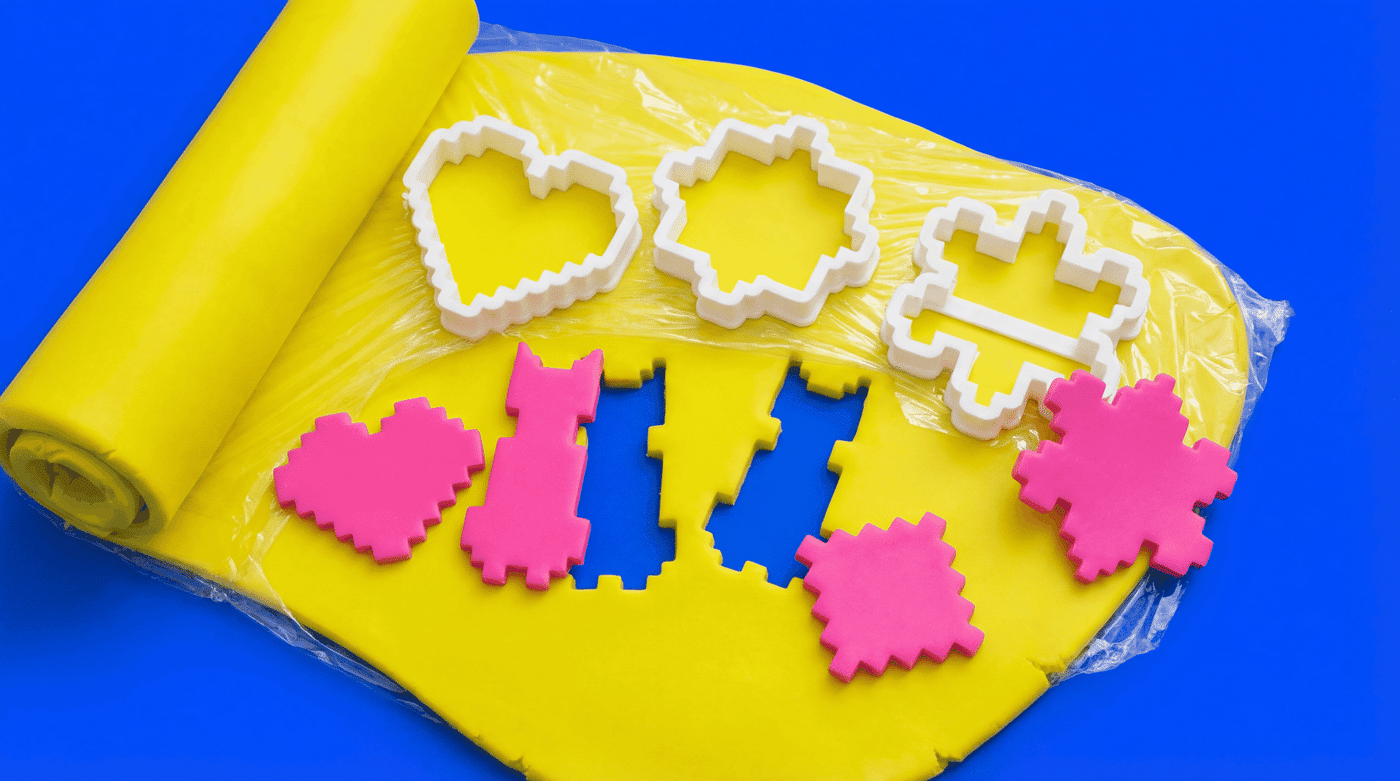
Polymer clay stuck in your cutter? How to release it and stop it sticking
Free a trapped shape, dust the cutter without leaving white clumps, and set up the slab for the next clean release. Includes the cling-wrap method for softer edges.
What to bake polymer clay on: tile, card and supports for flat, folded and large pieces
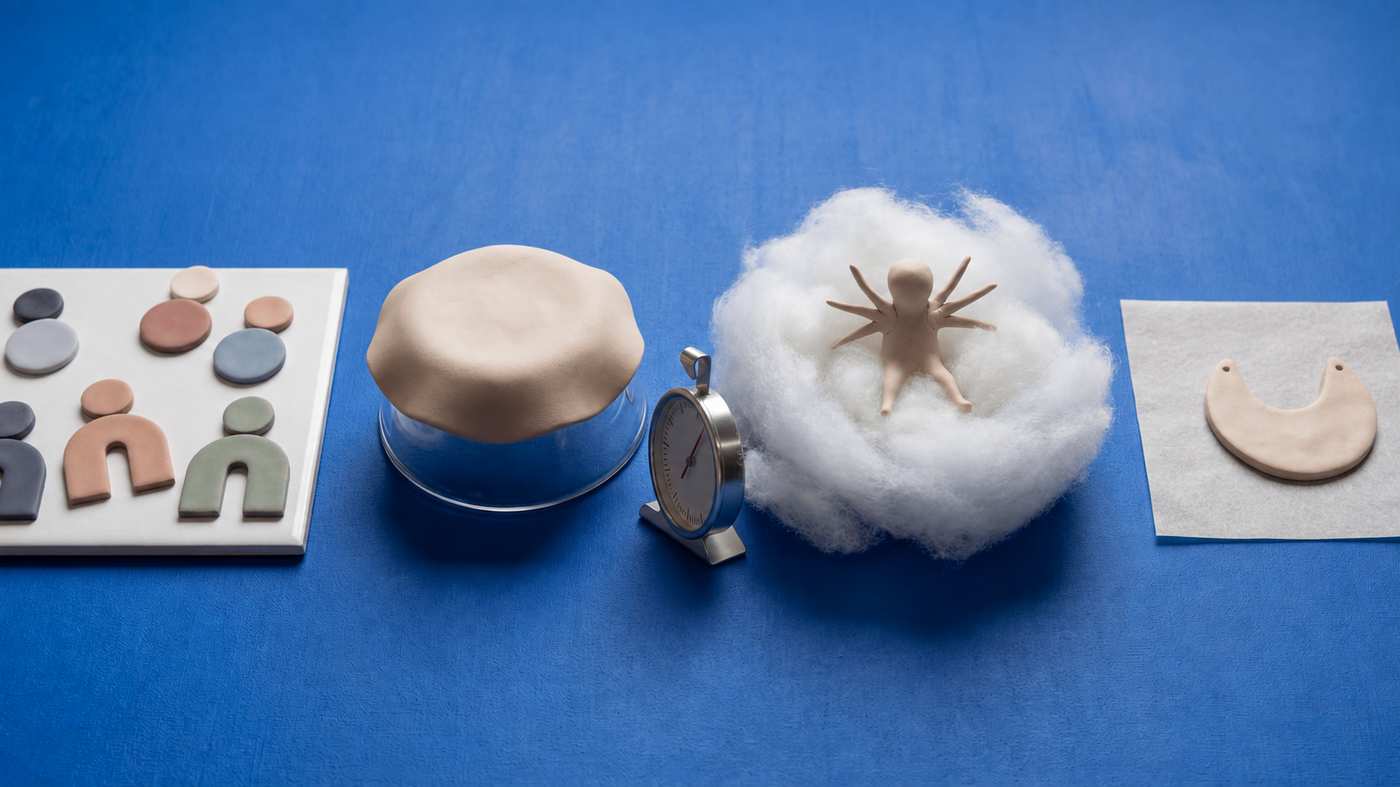
Bake flat pieces on a glossy tile and move them onto plain card only for a matte back. Hold curves, limbs and overhangs with fiberfill, crumpled foil or an oven-safe glass form, bake round beads on skewers, and leave everything on its support until it feels cool.
Finished examples with related clay decisions
Each piece shows how a material, attachment, or surface choice changes the final form.