Polymer Clay Terrazzo Slabs, Chips, and Clean Cuts
Terrazzo slabs turn muddy when chips drag, sink unevenly, or blur into the base color during rolling. The fix starts with chip size and density decisions before you ever press them in.

Lookbook view
Styled context
Treat this as a starting point for a test piece, not a finished spec. AI may help explore design directions, organize notes, and draft parts of this guide. Clay brands, ovens, glues, finishes, and hardware behave differently, so check product instructions and test on scrap before making a batch. Measurements, spacing, and timing are estimates from the reference images. Test them on scrap before making a batch. Some product links on this page are affiliate links. If you buy through them, we may earn a commission at no extra cost to you. Check listing details, dimensions, materials, and fit before you buy. As an Amazon Associate I earn from qualifying purchases. Full disclosures
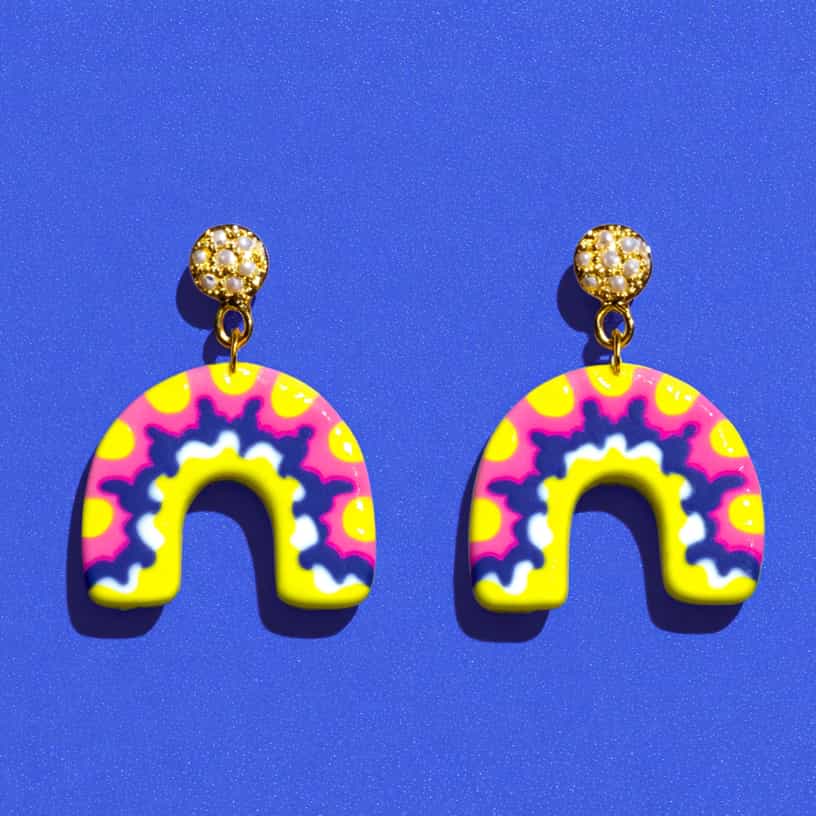
These are small terrazzo arch drops hung straight from gold huggie hoops. The pair shows a warm yellow base scattered with hot-pink, cobalt-blue, and a few white chips, all rolled flush so the face stays flat and matte. The shape is an inverted-U with a clean negative-space opening in the middle. The reliable path is to build one terrazzo slab, cut both arches from it as a mirrored pair, pierce the top holes at the same height, bake flat, then add the huggies with jump rings after cooling. There is more than one way to get the chip pattern, so I have laid out the proven options below before the shared finishing steps.
A matched pair of small inverted-U (arch) cutout drops on a royal-blue studio background, confirmed worn at compact statement-drop scale in the lifestyle shot. Each arch has a warm yellow base covered in irregular terrazzo chips: hot pink, cobalt blue, and a few small white flecks, all sitting flush with the surface (no raised relief). The center of each arch is open negative space. The face reads matte, not glossy. Each arch hangs from a small closed gold huggie hoop through a single jump ring set at the top of one leg, and the two earrings read as a mirrored pair.
Terrazzo chip slab cut into mirrored arch blanks. The face is built by scattering small clay chips across a warm yellow base slab and rolling them flush, then cutting both arches from one finished slab so the chip density matches. Findings are gold huggie hoops linked to a pierced top hole with a jump ring opened and closed sideways with two pliers. Three methods are offered: pre-baked broken chips for crisp edges, raw cut-and-applied chips for a one-bake build, and a chip-into-base roll-flush version, followed by shared mirrored-pair, bake-flat, edge-rounding, and finding steps.
Condition each color until smooth and pliable, keeping every color at the same firmness so the slab rolls evenly. Use one clay brand throughout so the whole piece bakes the same. A firmer clay like Sculpey Premo or FIMO Professional holds crisp chip edges; a lighter-bodied clay keeps these drops comfortable on the ear.
Roll the warm yellow base slab to one even thickness using guide rails or a pasta machine setting, around the thickness shown in the image (thin enough to stay light). Aim for the same thickness across the whole slab so the finished pair hangs straight.
Pattern option A (crispest edges) - Roll thin pink, blue, and white slabs, bake them flat on a tile at your clay brand's package temperature and time, cool fully, then chop them into small irregular chips with a tissue blade. Scatter the cured chips across the raw yellow base, brush a thin film of liquid polymer clay under stubborn chips, and roll everything flush.
Pattern option B (one-bake, faster) - Cut small irregular chips straight from thin raw pink, blue, and white slabs, scatter them on the raw yellow base, and press them in gently. Roll flush in light stages so the soft chips seat without smearing into stripes.
Pattern option C (terrazzo in the base) - Roll the base slightly thicker, scatter your chips, press them in with a fingertip, then roll the whole slab down to final thickness so the chips spread and sit flush as part of one slab. Scrap chips work well here.
Make a mirrored pair: cut both arches from the same finished slab with one arch cutter so they are the same size and the chip density matches. Cut the second blank and flip it so the pattern reads as a reflection of the first. Cut the inner opening with a smaller cutter or knife to make the negative-space arch.
Dust the cutter lightly with cornstarch if clay sticks (it bakes off), press straight down with even pressure, and lift cleanly so the edges are not ragged. Reroll or recut if a chip lifts at an edge.
Pierce the top hanging hole in each raw arch at the same distance from the top edge on both, keeping a generous margin of clay between the hole and the edge so the loop will not tear out. Confirm the two read as a balanced mirrored pair before baking, since holes cannot be moved after curing.
Bake the arches flat on a smooth ceramic tile lined with plain paper or an index card, at your clay brand's package temperature and time. The flat bed keeps the backs flat and the matte face clean; verify your oven with a thermometer because many ovens run off by a few degrees.
Cool fully, then wet-sand the cut edges through rising grits, keeping the paper wet, so the edges feel rounded and smooth and do not catch hair. Keep the edge moving to round it rather than cutting a new flat.
If you ever switch to a stud or glued back instead of huggies, embed a kinked-end post in the raw clay before baking for a hold with no glue seam, or score and alcohol-wipe the cooled baked back and set a flat-pad post with two-part epoxy, letting it reach full cure before wear.
Dry-fit both earrings, check that they hang front-forward and level, and confirm the weight feels light and comfortable before treating the pair as ready to wear.
Metal findings like posts, hooks, and jump rings may contain nickel or other allergens. If your wearer has sensitive skin, choose surgical steel or titanium findings and test any sealant or coating on a small spot before wearing.
Before you buy, match the sizes and parts to the version you want to make.
The color stock and clay body choices that carry the visible design.
Gets you close to the cream terrazzo base.
Covers the bright pink terrazzo chips.
Useful for the yellow terrazzo chips.
Needed for the dark terrazzo chips that sharpen the contrast.
Useful for bonding raw-on-raw applique, layered details, and small joins without crushing the shape.
A firmer polymer clay ideal for crisp details, pixel grids, and canes to prevent distortion during slicing and assembly.
A polymer clay safe glaze that seals the piece without becoming sticky over time.
What you condition with and how you keep the slab even.
Stencils, blades, and cutters for cleaner outlines.
Hole placement, bake surface, and oven check tools.
Helps the mini arches cure flat and keeps the matte face clean.
Useful for checking the real shelf temperature before baking detailed or supported polymer clay pieces.
Useful for tiny marks, seam cleanup, piercing points, and crisp separations before baking.
Posts, jump rings, chain, and connectors that finish the piece.
Matches the compact gold huggie hardware in the image pair.
Needed when the finished piece hangs from connectors rather than a single solid clay body.
Needed for opening and closing jump rings cleanly during jewelry assembly.
Adhesives and attachment choices when the build needs them.
Optional surface products if you want to shift sheen, sand, or coat.
Each one walks through a technique used in this piece, in full detail.

Terrazzo slabs turn muddy when chips drag, sink unevenly, or blur into the base color during rolling. The fix starts with chip size and density decisions before you ever press them in.

Cutout arches and hoops work best when the wall width is even, the inner opening matches the outer curve, and the hardware choice is made from the finished front view.
Custom range
Ask for a build pack to make it yourself (the cutter or tool files, a supply list, and a plan), or ask the studio to make the finished pieces for you.

More pieces with a related form, finish, or making path.
Pin it to a board, copy the link, or keep it saved here while you make your own version.
Tag Clay Bake Studio on Instagram or TikTok so we can see how you adapted it.