How to attach earring findings to polymer clay earrings
Choose a fish hook, leverback or looped stud, join it with a jump ring, add a second ring if the drop shows its edge, and check the pair before you wear it.
Some links on this page are affiliate links. If you buy through them, we may earn a commission at no extra cost to you. As an Amazon Associate I earn from qualifying purchases. Disclosures

Findings and hardware guides
Choose the part you need help with, or continue below for the earring assembly tutorial.
- Choose earring posts
- Glue earring posts
- Choose and use jump rings
- Make holes for jump rings
- Attach pendant bails
- Attach a brooch pin
- Choose brooch hardware
Start here
What to choose and check first
Join a flat clay drop to a fish-hook ear wire or a looped stud with an open jump ring, twisted open and closed with two pliers. If the clay shows its edge instead of its face, add a second ring rather than turning the ear-wire loop. Hang both earrings side by side to check they face forward, match in length and swing freely before you wear them.
Attachment steps come from Sculpey's earring pages and jewellery-supplier guides, metal wording from EU, US FTC and dermatology sources, glue choices from published maker tests, and the studio's own practice for turning drops forward and baking in studs.
Article contentsOpenClose
Earring findings are the metal parts that hold a clay earring in the ear: an ear wire, which is a hook that passes through the piercing, or a stud post. A jump ring, a small wire ring with a split you twist open, usually joins the finding to the hole in the clay. To finish a flat clay drop, choose the finding, join it so the clay shows you its face rather than its edge, then hang the pair side by side and check it before you wear it.
The steps below start from baked, cooled pieces that already have their hanging holes. If yours still need holes, the hole guide in the list at the end covers punching and drilling them.
Which findings and rings do the ClayBake kits use?
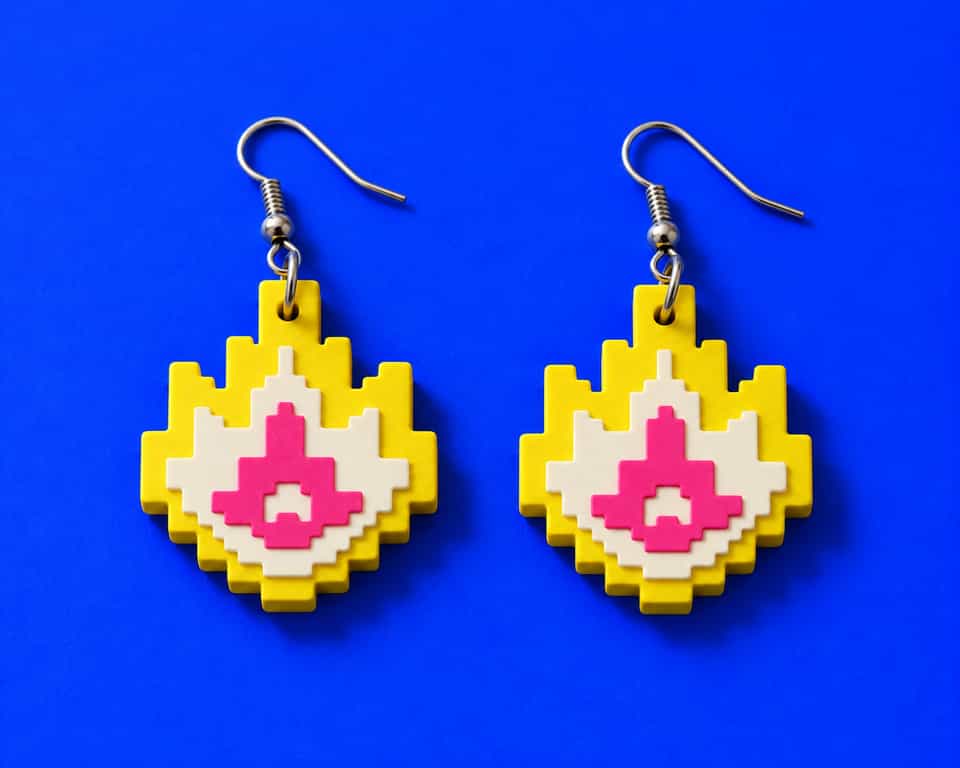
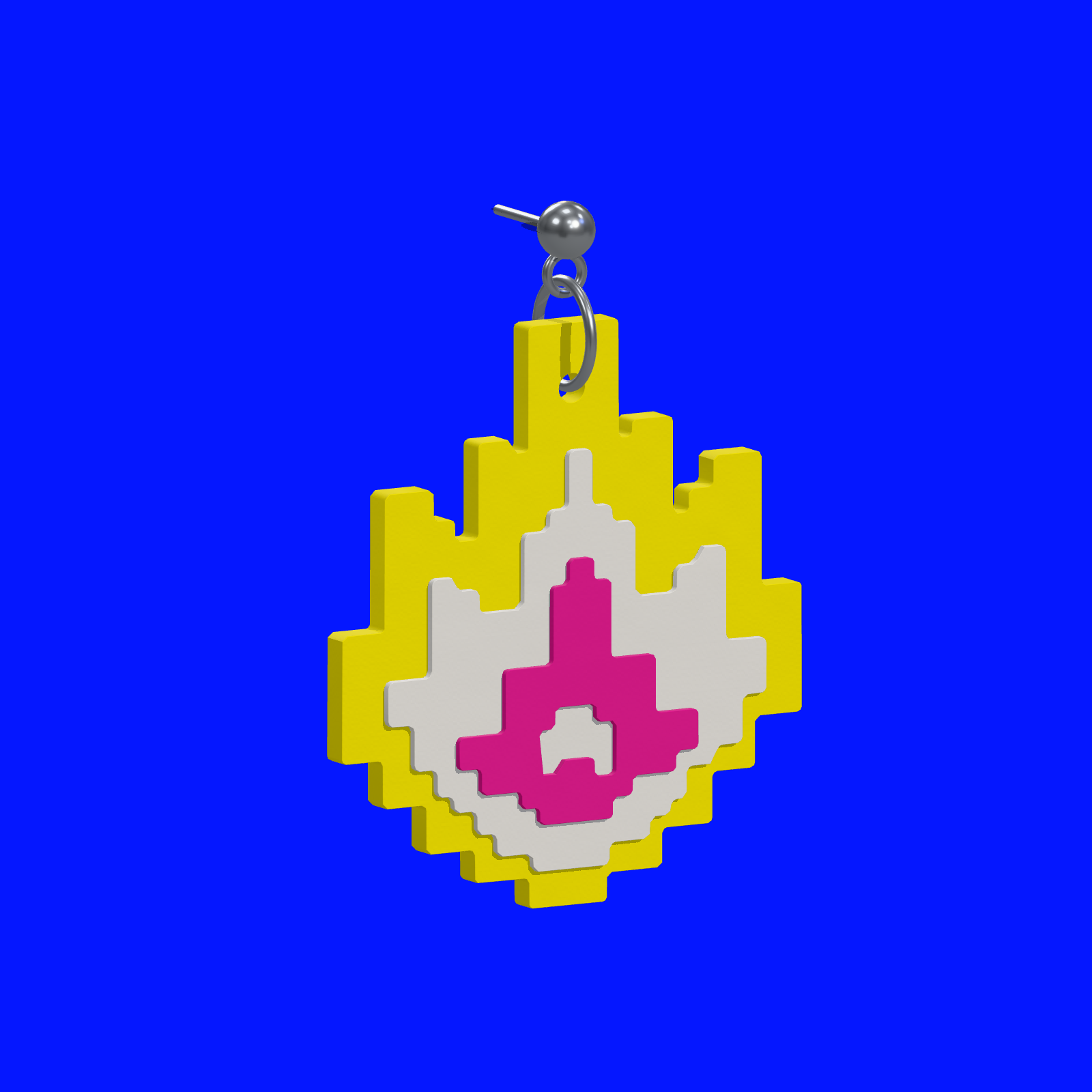
- Pixel Flame earrings: each flame hangs from a looped ball stud, as on the kit page, or a fish-hook ear wire, with one jump ring per earring. On a fish hook you may need a second ring to turn the flame forward, which the sideways section below explains. This connection needs no glue.
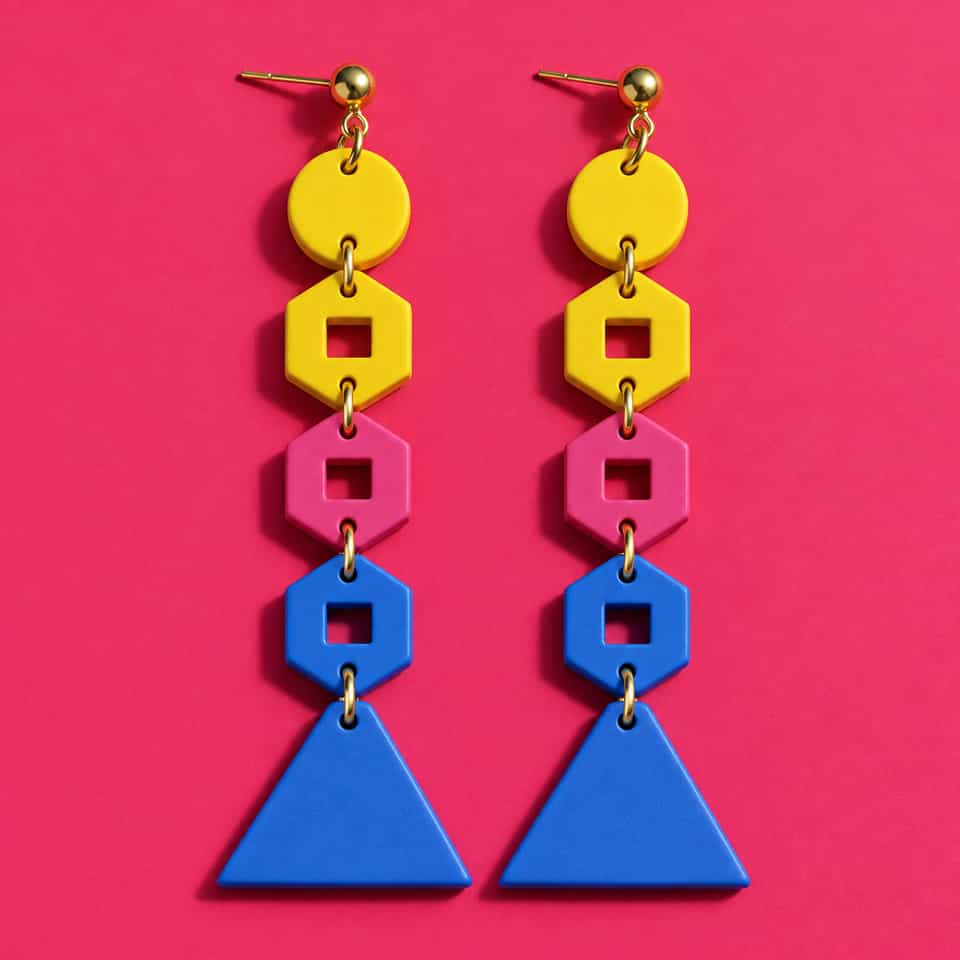
- Go-Go shoulder duster: five clay links per earring, joined with jump rings, so ten rings for a pair, hanging from a looped ball stud or a fish-hook ear wire. The kit page's pair hangs about 12 cm below the stud. At that length, give a stud a wide disc-shaped back, or give a fish hook a stopper; kidney wires or leverbacks close behind the lobe, so they are less likely to work out of the ear. Only the top join decides which way the column faces.
Your kit's PDF guide gives the jump-ring sizes for the pieces you cut. Ring packs are labelled either by inside diameter, the opening, or by outside diameter, the opening plus the wire on both sides, so check which one a pack means before you buy.
Which earring finding suits a flat clay drop?
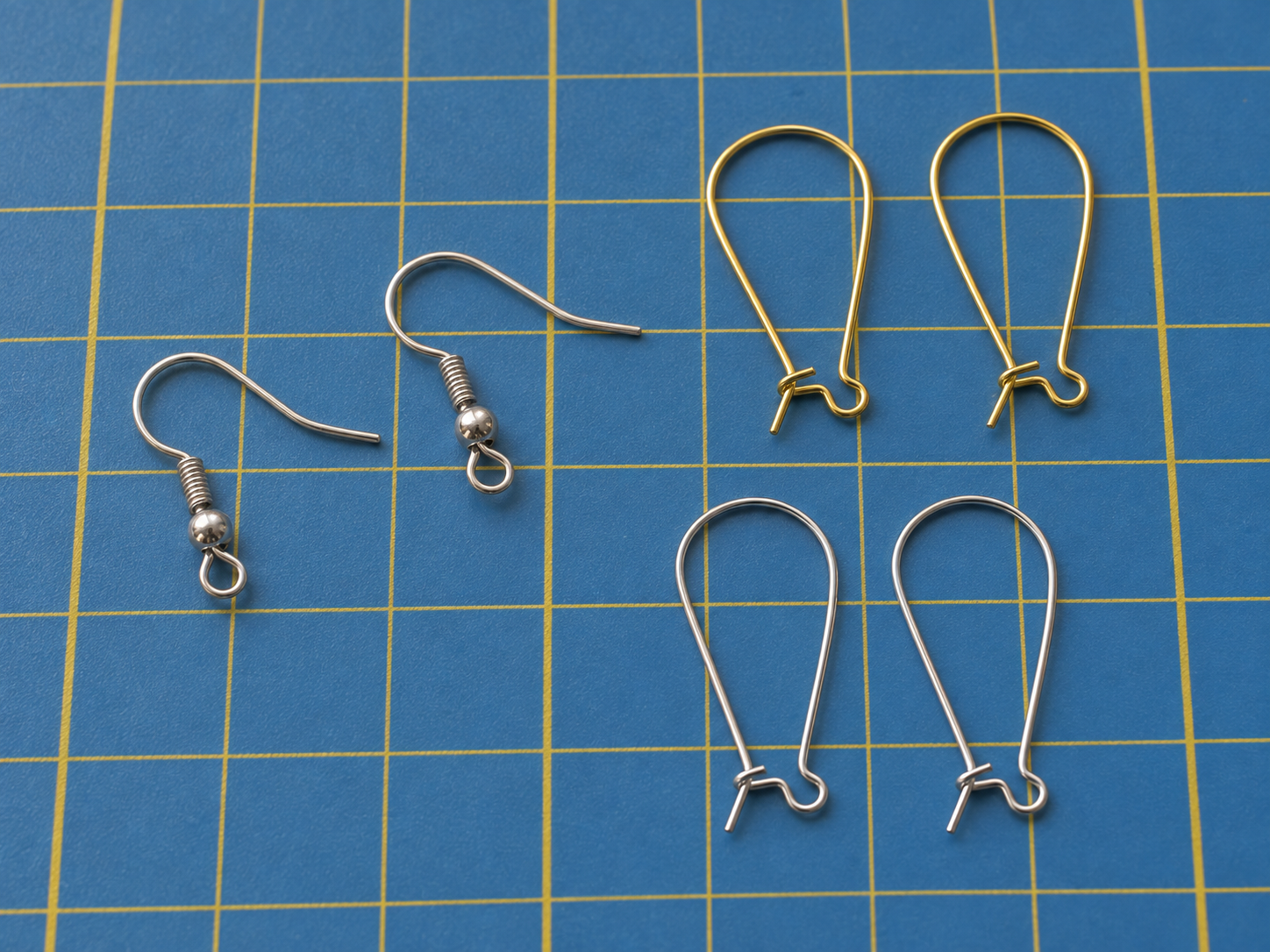
For a clay piece that hangs, you need a finding with a loop at the bottom for the jump ring. The four common types differ mainly in how they stay in the ear:
| Finding | How it stays in the ear | Suits | Where to find it |
|---|---|---|---|
| Fish-hook (French) ear wire | Hangs through the piercing with no latch, so it can work forward out of the ear. A small silicone or rubber stopper on the end of the wire helps hold it. | Light single drops. Add a stopper for anything long or swinging. | The stainless ear-hook, stopper and ring kit we use in the studio, or search fish-hook ear wires on Amazon. Stoppers on their own: search silicone backs for fish hooks. |
| Kidney ear wire | The wire hooks shut behind the lobe, so it holds more securely than an open hook. | Long or swinging drops, such as a shoulder duster. | Search kidney ear wires on Amazon. |
| Leverback | A hinged back snaps closed behind the lobe. | Long drops and pieces you want to stay put. Choose leverbacks with a hanging loop at the bottom; some have a plain front with nowhere to hang a ring. | Search leverbacks with loops on Amazon. |
| Looped ball stud | A post goes through the piercing and is held by a back; the drop hangs from a small loop under the ball. | Short, light drops that sit close to the lobe. | Search looped ball studs with backs on Amazon. |
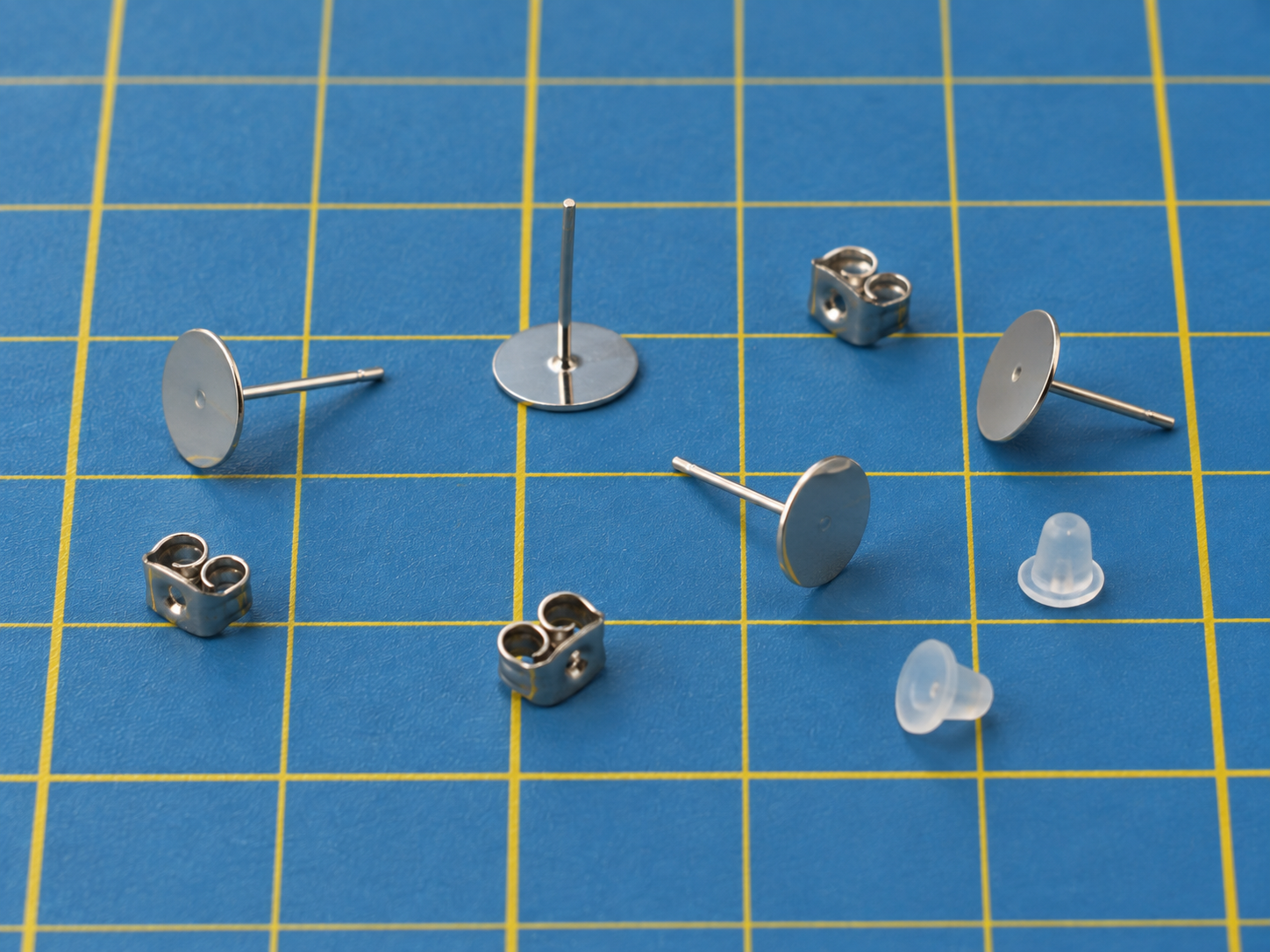
A flat-pad post, a plain stud with a small flat metal disc where the loop would be, suits studs rather than drops; the glue and baking section below covers it. A clip-on finding suits unpierced ears, but clip-ons tend to slip when the drop is heavy.
How do you attach a clay piece to an ear wire or stud?
Join the clay to the finding with one open jump ring: pass the ring through the clay hole and the finding's loop, then close it with two pliers so the ends meet flush.
You need:
- The finished clay pieces. If they get a gloss or varnish, apply it and let it cure fully before the rings go on, as the ClayBake kit guides do.
- The findings from the table above.
- Open jump rings. The ring's wire has to pass through the clay hole, and its opening has to fit around the clay above the hole and the finding's loop with room to swing. Wire of 0.8 mm (20 gauge) suits light drops, and 1 mm (18 gauge) is sturdier for heavier pieces if it fits your hole; with gauge, a lower number means thicker wire. Your kit guide gives the size for each piece. For anything else, the jump-ring guide works through the measurement; in its example, a 3 mm slab with the hole 3 mm from the edge needs about a 6 to 7 mm inside diameter. For bright pieces we use coloured rings from a 6 mm pack and a 10 mm pack; the listings do not say whether those sizes are inside or outside, so compare the opening with your piece.
- Two gripping pliers with smooth, flat tips, one for each side of the ring. We use the Hi-Spec pliers kit; check its photos for two flat-tipped pairs. Round-nose pliers have cone-shaped jaws for bending wire into loops, so they do not work as the second gripping pair.
- Open the ring with a twist. Grip the ring with one plier on each side of the split, close to it. Twist one end towards you and the other away, keeping the circle round. Sculpey's earring guide says to open rings front to back, because prying the ends apart can snap the ring.
- Thread the clay, then the finding. Pass the open ring through the hole in the clay, then through the loop at the bottom of the ear wire or stud.
- Check which way the clay faces before you close the ring. Hold the finding the way it sits in the ear, a hook hanging from your finger or a stud with its post level, and let the clay hang on the open ring. If you see the clay's edge instead of its face, you need one more ring; the next section shows why.
- Close with the reverse twist. Bring the two ends back into line until they touch, with neither end sitting higher or further forward than the other.
- Check the swing. Hold the finding and nudge the clay. It should swing freely. If the clay catches or will not swing, use a slightly larger ring whose wire still fits the hole.
For a multi-link earring such as the Go-Go duster, work from the finding down: join the top clay piece to the finding, then join each clay link to the one below with a single ring, checking the swing at every join. A ring that joins two clay pieces wraps around both clay edges, so it needs a bigger opening than a ring that joins clay to a finding.
Why does the earring face sideways, and how do you turn it forward?
Look straight at a flat clay piece and the ring through its hole shows only its edge, as a short upright line, the way a key ring sits through a flat tag. Whatever that ring hangs from sits at a right angle to it. So each metal loop between the ear wire and the clay turns the clay a quarter turn.
On many fish hooks the loop is made in line with the hook, so from the front you see only its edge. One jump ring through that loop shows you its full circle, and the clay hanging from that ring turns to show you its edge. A second ring turns the clay back to face you.
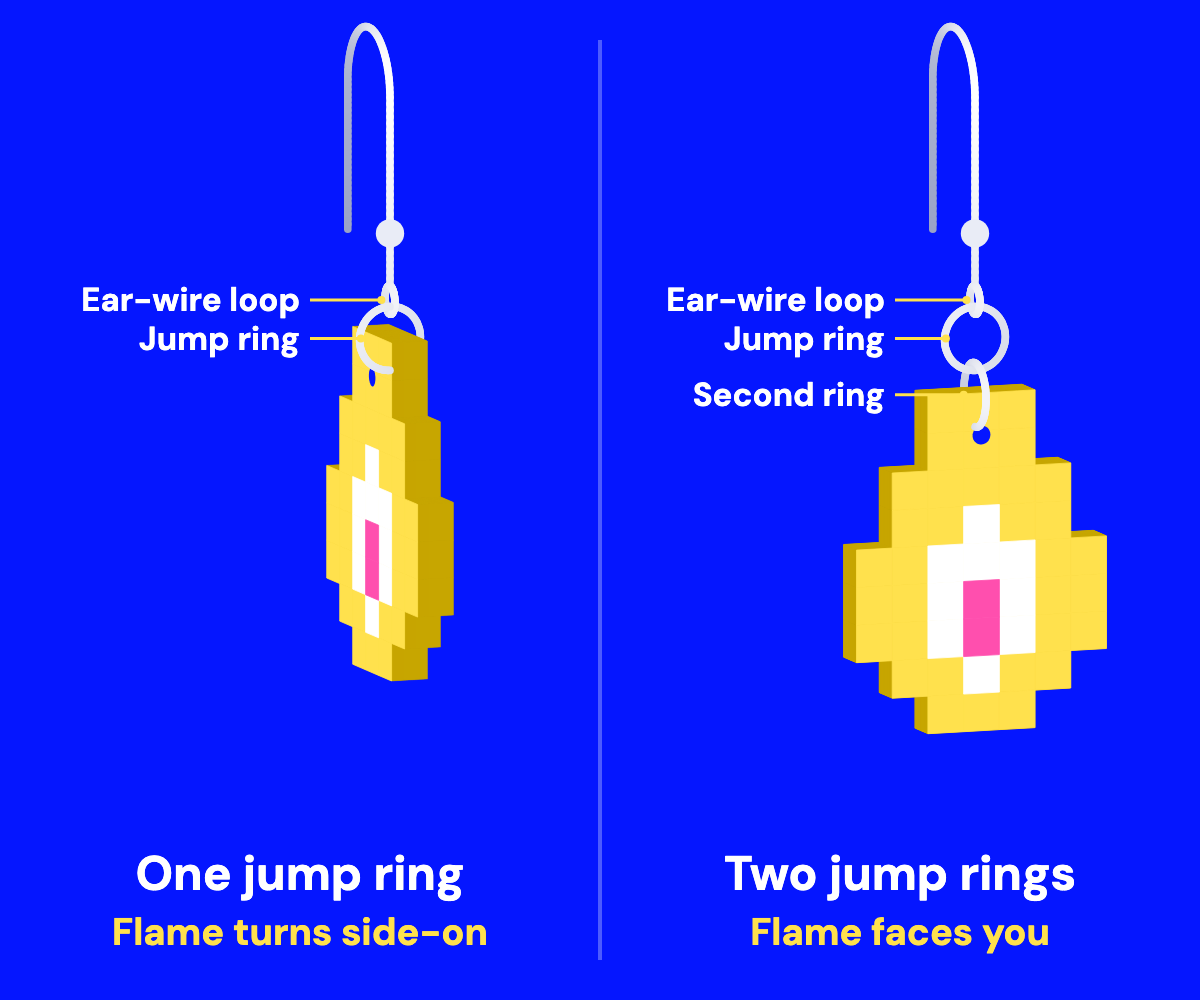
There are three ways to turn a side-on drop forward:
- Add a second jump ring. Hang the clay from a new ring and link that ring into the first one. This is how we turn a drop forward in the studio. The extra ring adds a few millimetres of length, so give both earrings the same number of rings.
- Hang the clay straight from the finding's loop, with no ring, if the loop opens like a jump ring and is big enough to go around the clay above the hole. On a hook whose loop is in line with the hook, the clay then faces forward and sits higher. A loop that is soldered closed will not open, so use a second ring instead.
- Turn the ear-wire loop. Some jewellery tutorials turn the whole loop a quarter turn with flat pliers. We found that left our earrings sitting wonky, so we add a ring instead. Turning a loop is different from opening it: opening means twisting the loop's cut end sideways to make a gap, the same way you open a jump ring.
Looped studs vary. On some you see the loop's round opening from the front, and one ring makes the clay face forward, as in the Pixel Flame render above. On others the loop shows its edge, and you need a second ring.
One ring between two clay pieces keeps them facing the same way, so on a duster the join at the ear wire or stud decides which way the whole column faces. To see the quarter turn for yourself, hold one spare ring so you see its full circle and hook a second ring onto it: the second ring hangs below, showing only its edge.
How do you check the pair before you wear it?
Hang both earrings side by side from their findings, held the way they sit when worn: hooks hanging from a finger, studs with the posts level. If you have a stand such as the T-Bar earring stand, it holds one pair still for this check.
- Direction: both show their face. If one shows its edge, count the rings on each earring. If the counts match, compare the loops on the two findings and add a ring to the odd one.
- Length: both hang at the same height. A mismatch usually means a different ring size or ring count on one side.
- Hang: both hang straight. If one tilts, first check that its ring is not catching on the clay. If the ring moves freely, the hole may sit off the piece's balance point. For the next pieces, pinch the piece lightly at its top edge and let it dangle, slide your pinch left or right until it hangs straight, and mark that point for the hole.
- Swing: every join moves freely when you nudge the lowest piece. Swap a ring that catches for a slightly larger one.
- Ring ends: every ring is closed with its ends touching, so nothing catches on hair or clothing. If a ring keeps opening, change to thicker wire, such as 1 mm (18 gauge) instead of 0.8 mm (20 gauge), as long as it still fits the hole.
- Comfort: put one on for a few minutes and notice any pull on the lobe before you make more.
How heavy is too heavy for a clay earring?
Rather than aiming for a set weight, compare: weigh the finished pair on a small digital scale that reads to 0.1 g (search small digital scales on Amazon), then weigh a pair you already wear comfortably.
A heavy drop pulls differently on a stud than on an ear wire. On a stud, the whole drop hangs from the front of a short post, so a heavier drop can tip the stud forward in the lobe; a wide disc-shaped back spreads that load. A leverback or kidney wire closes behind the lobe, so a heavier drop is less likely to work it out of the ear. To lighten a pair, cut a smaller size, use fewer links, or roll the slab thinner if the design allows. The Pixel Flame kit stops at 48 mm because the largest flame is estimated at just under 5 g per earring, including the finding and ring.
When you plan a new design, you can estimate the clay weight before baking by multiplying volume by density. Staedtler's safety data sheet for FIMO soft and effect lists 1.2 to 1.4 g per cubic centimetre. Example: a flame shape about 30 mm tall and 20 mm wide that fills roughly 60% of that rectangle, rolled 4 mm thick, is 30 × 20 × 0.6 × 4 = 1,440 mm³, or 1.44 cm³. At 1.3 g/cm³ that is about 1.9 g of clay per earring, before the finding and rings.
Which metal should the ear wire or post be made from?
The ear wire or post is the part that passes through the piercing; the rings and clay sit outside the ear. Choose that part by the metal the supplier names.
A metal can contain nickel and still release very little onto skin, and EU rules under REACH set two limits on that release, measured with a standard CEN test: less than 0.2 µg/cm² per week for the part inserted into a pierced ear, which the regulation calls the post assembly, and no more than 0.5 µg/cm² per week for other parts in direct and prolonged contact with skin.
- Stainless steel. The 304 and 316L grades sold for findings contain nickel, yet a 2019 dermatology review reports that they release less than 0.03 µg/cm² per week, and the American Academy of Dermatology includes surgical-grade stainless steel among the metals it suggests for people with a nickel allergy. Give buyers the steel grade so someone with a nickel allergy can decide.
- Titanium. For new piercings, the Association of Professional Piercers accepts implant-certified titanium to ASTM F-136 or ISO 5832-3, and commercially pure titanium to ASTM F-67. Look for one of those standards on the listing, not just the word titanium.
- Niobium. The Association of Professional Piercers also lists niobium for new piercings, and jewellery suppliers describe it as naturally nickel-free and use it for ear wires. Listings do not always say which part is niobium, so look for niobium named as the ear wire's metal, not just in a colour name.
- Sterling silver, gold-filled and plated. Sterling silver is at least 92.5% silver mixed with another metal. Gold-filled and plated wires have a gold or coloured layer over a different core metal, so look for the core metal, such as brass.
Neither "hypoallergenic" nor "nickel-free" has a US standard behind it, so do not rely on either word. The US FDA says the use of "hypoallergenic" is not governed by any federal standard or definition, writing about cosmetics, and a dermatologist who writes about nickel allergy notes that "nickel-free" is not defined by a US standard either. The metal name tells you more. The jump-ring guide compares ring metals if you want the rings to match.
What can you tell buyers about the findings?
Name the metal of each part in the supplier's words. If the ear wires are 316L stainless steel and the rings are coloured iron, say so for each part, for example: "Ear wires: 316L stainless steel, as stated by the supplier. Jump rings: coloured iron." Do not call the pair hypoallergenic, skin-safe or nickel-free on a supplier's say-so; name each part's metal and, where the supplier gives one, its nickel-release test result.
In the US, the FTC's Jewelry Guides treat misrepresenting metal content as deceptive. "Sterling silver" means at least 925 parts per thousand silver, and "gold filled" needs a layer of at least 10-karat gold making up at least one-twentieth of the weight of the metal in the whole piece. If you sell into the EU, the nickel-release limits above apply to the metal parts you sell, so ask the finding supplier for a nickel-release test result. To keep the finding supplier, grade and ring size recorded for each design, use the batch-production checklist.
When does a finding need glue, and how do you bake in a stud?
Ear wires, leverbacks, looped studs and jump rings need no glue, because the ring holds the clay. Glue and baking in are for flat-pad posts.
Sculpey's earring guide gives two ways: add posts before baking with its Oven-Bake Clay Adhesive, or glue them on after baking with super glue. In the studio we bake the post in under a thin slab of clay with liquid clay, then add a tiny amount of glue on top after baking, which we find generally the neatest finish for studs. Covering the pad means the baked clay holds the metal.
The studio's sequence is cover, bake, then a tiny amount of glue; the detailed steps below come from other makers' embedding tutorials. Makers who publish this covering method bake the stud front first, so it keeps its shape while the post and covering clay are pressed on, then bake the stud a second time. For the liquid clay layer, Sculpey sells Oven-Bake Clay Adhesive (Bake & Bond) for joining raw clay to baked clay, and in one published maker bond test FIMO liquid gel held best for that job. The steps:
- Bake the stud front and let it cool.
- Prepare the back and the pad. Sand an uneven back flat, wipe the back and the metal pad with isopropyl alcohol to remove skin oils, and lightly scratch both surfaces so the liquid clay has texture to grip.
- Cut a thin covering sheet. Roll matching clay thin, about 1.5 mm, so the back does not get bulky. Cut a small circle or the stud's back shape and poke a hole in the centre for the post.
- Add liquid clay and cover the pad. Brush a thin layer of liquid clay over the back, set the pad on it, then press the covering sheet down over the pad with the post coming through the hole. Close any gap around the post with a needle tool.
- Bake again. Lay the stud face down on the tile with the post pointing up, and bake to your clay package directions and the liquid clay's label; Sculpey lists 275 °F (130 °C) for 30 minutes for its adhesive. Check the temperature with an oven thermometer, as Sculpey's re-baking advice recommends, and bake under adult supervision. That advice covers unpainted, unglazed clay, so do this second bake before painting or glazing.
- Cool, then add the glue. The studio's finishing step: once the stud is cold, add a tiny amount of super glue on top of the covered back. Keep it off the post that goes through the ear, because Loctite's data sheet warns that the glue contains cyanoacrylate and may cause an allergic skin reaction, and let it cure fully before wearing. Never put super glue in the oven; the same data sheet says not to use it in one.
For that glue, two published maker sources name the same few super glues. In one maker's hand-pry test of adhesives on polymer clay, Gorilla Super Glue Gel and Loctite's Gel Control held both clay discs and metal washers very well. A published survey of hundreds of experienced clayers recommends flexible super glues such as Gorilla Glue Gel, Loctite Gel Control and Zap-A-Gap for joining baked clay, and for earring posts its author likes Loctite Gel Control and says Gorilla's gel also works well. Loctite sells more than one Gel Control; the one its data sheet calls flexible once set is Loctite Super Glue Ultra Gel Control, with a full cure of 12 to 24 hours, so leave glued studs a full 24 hours before wearing them.
If you glue a post straight onto a baked back without covering it, prepare the surfaces the same way and wait the full cure time. The earring glue guide and the earring post guide cover choosing each one in more detail.
Guides for holes, stud toppers, pendants and brooches
- Making or fixing the hanging hole: the punch-or-drill hole guide.
- A visible topper above the drop, or a flat pad hidden behind it: the stud toppers and connector rings guide.
- A pendant on a chain or cord: the pendant holes and bails guide.
- A brooch or badge pin: how to attach brooch backs.
In brief
Key takeaways
- For a light single drop, use a fish hook or looped ball stud; for a long or swinging earring, add a stopper or switch to kidney wires or leverbacks
- Open and close a jump ring with two pliers by twisting one end towards you and the other away, and let the clay hang on the open ring before you close it
- If a drop shows its edge instead of its face, add a second ring at the ear wire or stud: each extra ring there turns the drop a quarter turn
- Choose the ear wire or post by the metal the supplier names, and do not call a pair hypoallergenic or nickel-free on a supplier's say-so; name each part's metal instead
Finished examples with related clay decisions
Each piece shows how a material, attachment, or surface choice changes the final form.