guides2 min read
Polymer Clay Trinket Dishes, Forms, and Rims
Use a documented trinket-dish project as the starting point, verify the form and package bake, and keep the result decorative unless the maker supports another use.
Open the guide

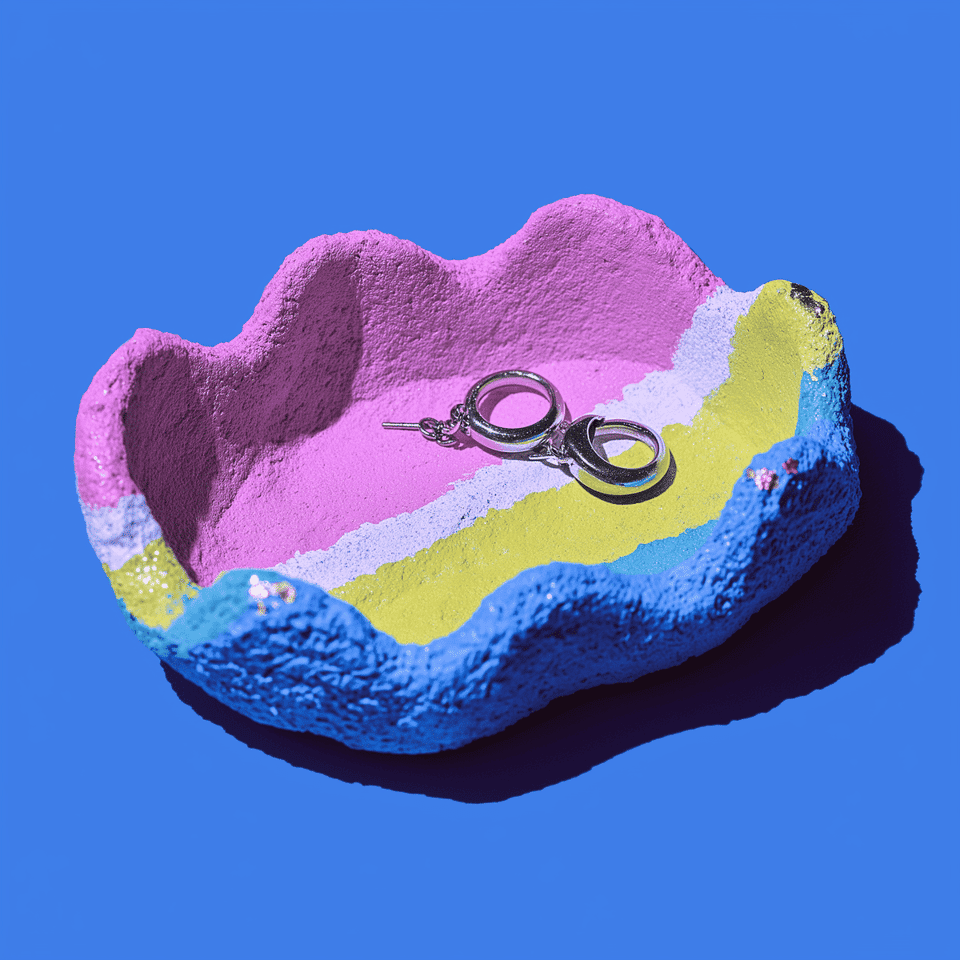
A sparkly ring dish with a wavy rim and rings of yellow and magenta nested one inside the next down to a pink floor, each yellow band edged in a thin blue line. The outside is sunny yellow with one blue stripe. The bands start as ropes coiled round a pink disc like a bullseye and rolled out, so they come out even and join cleanly. The steps knead glitter into every colour, coil and roll the bands, back them with striped yellow, raise the wall and push in the waves. The picture is here for inspiration: follow the steps as a guide, then change the colours, the band order or the waves to make your own version.
The pictures began as AI-assisted concept images and are here for inspiration. The steps are a guide to making your own version, so change the colours, size or details as you like. Clay brands, ovens, glues, finishes and hardware behave differently, so follow their product instructions and bake a scrap before a batch. Some product links on this page are affiliate links. If you buy through them, we may earn a commission at no extra cost to you. Check listing details, dimensions, materials, and fit before you buy. As an Amazon Associate I earn from qualifying purchases. Full disclosures
What gives it this look: the waves are deepest at the rim and fade towards the floor, so the top bands ripple and the bottom ones are almost round. On a dish about 10 cm across and 3.5 cm tall there are about twelve waves, the pink floor is about 6 cm across, and each band is under 1 cm wide, with the lowest yellow band the widest. The blue lines are thin, about 3 mm, and there is one more round the outside. Glitter covers every band inside and out.
Lookbook view

Build the bands on parchment on your worktable, then carry the rolled disc to the tile, so the joins are never pulled apart. Knead the glitter into all three colours before you start and roll the ropes and threads early, so you can coil without stopping. This is a dish for dry trinkets: Sculpey does not recommend making dishes you eat or drink from or serve food on, even when glazed.
Condition the yellow, fuchsia and pale blue separately, then knead glitter into each by hand: flatten the clay into a pancake, sprinkle a pinch of glitter over it, fold it in half and knead, and repeat until the sparkle is even all through and as dense as in the picture. Mix all of each colour in one go, so the sparkle matches across the dish. Roll glitter clay with the acrylic roller, not a pasta machine: Sculpey's machine instructions ask for clay with added glitter to be kept out of the rollers, where the particles can lodge in them or scratch them.
Help with this step
On a sheet of parchment, press a ball of fuchsia into a disc about 3.5 cm across and 5 mm thick for the floor. Roll ropes about 5 mm thick of yellow and fuchsia, and threads about 2 mm thick of blue. Wrap them round the disc one at a time, each pressed firmly against the last, in this order from the middle out: blue, yellow, yellow, blue, fuchsia, yellow, blue, fuchsia, yellow. Cut the end of each rope at a slant where it meets itself so there is no lump, and start each one at a different point round the circle, so the joins do not line up.
Lay a second sheet of parchment over the coil and roll from the middle outward in every direction, a few passes at a time, until the ropes have spread into bands with no gaps between them and the whole disc is about 3 mm thick, with a 3 mm guide or an equal stack of playing cards under each end of the roller. The disc grows to about 14 cm across. Peel back the parchment and check every seam has closed; roll across any that has not.
Help with this step
Roll the rest of the yellow about 2 mm thick, a little bigger than the disc. Trace a circle about 8 cm across in its middle with the needle, lay a blue thread along the line and roll it in under parchment until it is level with the yellow. Turn the yellow over so the blue ring is underneath, lay the banded disc on top, bands up, and roll lightly from the middle outward so no air is trapped, until the two are joined. The blue ring becomes the stripe round the outside of the dish. Trim the yellow to the edge of the disc.
Slide the disc onto the ceramic tile. Lift the outer part up into a wall about 3.5 cm tall all round, a little at a time with both hands, so the pink floor stays about 6 cm across and level on the tile. Chill the dish briefly if the wall starts to slump.
Help with this step
Work round the top of the wall making about twelve soft waves: push the clay outward between two fingertips of one hand while the thumb of the other presses in between them from outside, then move on. Let each wave fade out towards the floor, so the top bands wave most and the ones near the floor stay almost round, as in the picture. Round the top edge with a fingertip so it is not sharp and does not chip.
Help with this step
Crumple a strip of foil into a loose ring and pack it round the outside of the wall, touching every wave, so the wall cannot sag outward as the clay softens in the oven before it hardens. Tent a foil pan loosely over the dish to shield the yellow, check the oven with a thermometer beside the tile, and bake by the instructions on the Premo packet, going by the 5 mm wall. Let the dish cool fully on the tile before you take the foil away.
Help with this step
Leave the dish as it comes out of the oven for the soft, sugary sparkle in the picture; the glitter is in the clay, so it needs no coat to show. Use it for rings, earrings and other dry trinkets: Sculpey does not recommend dishes you eat or drink from or serve food on, even when glazed, so keep food, drinks and water out of it.
Help with this step
What you will need
Everything here is used in the steps above. The clay and glitter are for this dish; most makers already own the tools, so tick those off first.
Two 2 oz (57 g) blocks of yellow, one of fuchsia and half a block of pale blue make a dish about 10 cm across, with a pinch of glitter in each.
The yellow bands, the rim and the whole outside of the dish; buy two blocks.
The magenta pink floor and the two pink bands. All three colours are Premo, so one packet's bake instructions cover the dish.
Rolled into thin threads for the blue lines between the bands and the stripe round the outside.
Kneaded into all three colours, fine glitter spreads evenly through the clay and gives the all-over sparkle in the picture.
Crumpled into a loose ring round the outside of the wall, it holds the waves up in the oven.
Tick what you already have, then get only what is missing.
Rolls the coiled bullseye flat until the bands close up, and rolls the yellow backing. Roll glitter clay with a roller, not a pasta machine.
Cuts the end of each rope at a slant so it meets itself without a lump.
Traces the round blank and the circle for the outside stripe, and pricks any air bubble.
Coil the bands on it and roll through it, so the glitter clay never sticks to the roller.
Shape and bake the dish on the tile, so it is never lifted while soft and the floor stays level.
Sits beside the tile so you bake at the temperature on the Premo packet; the yellow shows scorching first if the oven runs hot.
For even rolling, a tent over the yellow, a dish that rocks, or a crack.
Set one under each end of the roller so the coiled bullseye rolls down to an even 3 mm and the yellow backing to 2 mm, and the joined wall bakes through evenly with no thin spots in the waves.
Turned upside down over the dish as a loose tent, it shields the yellow from direct heat.
Only if the baked dish rocks: rub the base flat on a wet sheet.
Wear it for any sanding on the baked dish, to keep clay dust out of your lungs.
Only for a crack: mixed with dust filed from a baked offcut, it makes a matching putty that fills the crack.
Each one walks through a technique used in this piece, in full detail.
Use a documented trinket-dish project as the starting point, verify the form and package bake, and keep the result decorative unless the maker supports another use.

Bake flat pieces on a glossy tile and move them onto plain card only for a matte back. Hold curves, limbs and overhangs with fiberfill, crumpled foil or an oven-safe glass form, bake round beads on skewers, and leave everything on its support until it feels cool.

Get every clay colour to the same softness, roll each layer to its measured thickness on a tile, and let warm clay firm up before you cut.
Custom range
Ask for a build pack to make it yourself (a supply list and a making plan for your version), or ask the studio to make the finished pieces for you.
More pieces with a related form, finish, or making path.
Pin it to a board, copy the link, or keep it saved here while you make your own version.
Tag Clay Bake Studio on Instagram or TikTok so we can see how you adapted it.