Polymer clay stuck in your cutter? How to release it and stop it sticking
Free a trapped shape, dust the cutter without leaving white clumps, and set up the slab for the next clean release. Includes the cling-wrap method for softer edges.

The pictures began as AI-assisted concept images and are here for inspiration. The steps are a guide to making your own version, so change the colours, size or details as you like. Clay brands, ovens, glues, finishes and hardware behave differently, so follow their product instructions and bake a scrap before a batch. Some product links on this page are affiliate links. If you buy through them, we may earn a commission at no extra cost to you. Check listing details, dimensions, materials, and fit before you buy. As an Amazon Associate I earn from qualifying purchases. Full disclosures
This is a matching set of five round sew-through buttons in bright chartreuse with bold hot-pink waves running across each face, finished glassy and high-gloss with only a shallow dome and two centered holes. The trick is making one even patterned slab so every button matches, then cutting clean circles and baking them dead flat so they sit nicely on a cardigan. Below are three proven ways to get those clean pink waves so you can pick the one that fits your tools. Whichever you choose, the holes and the flat full-length bake are the same.
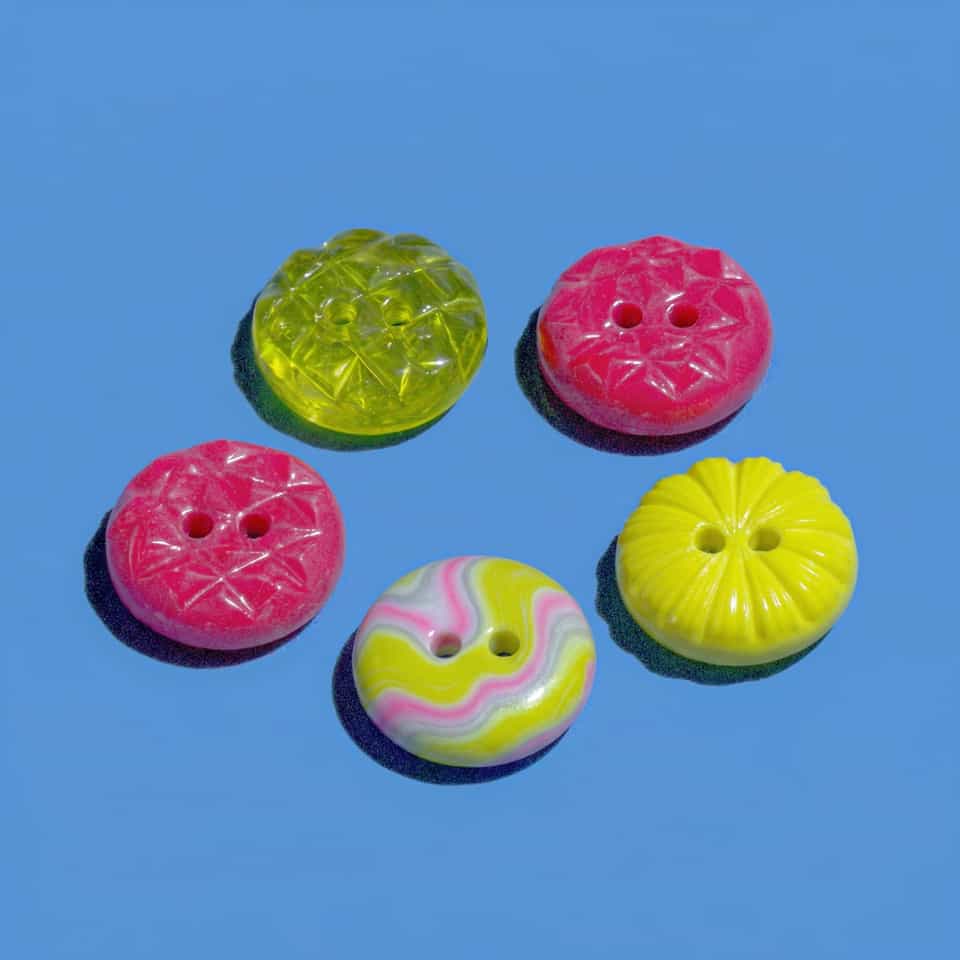
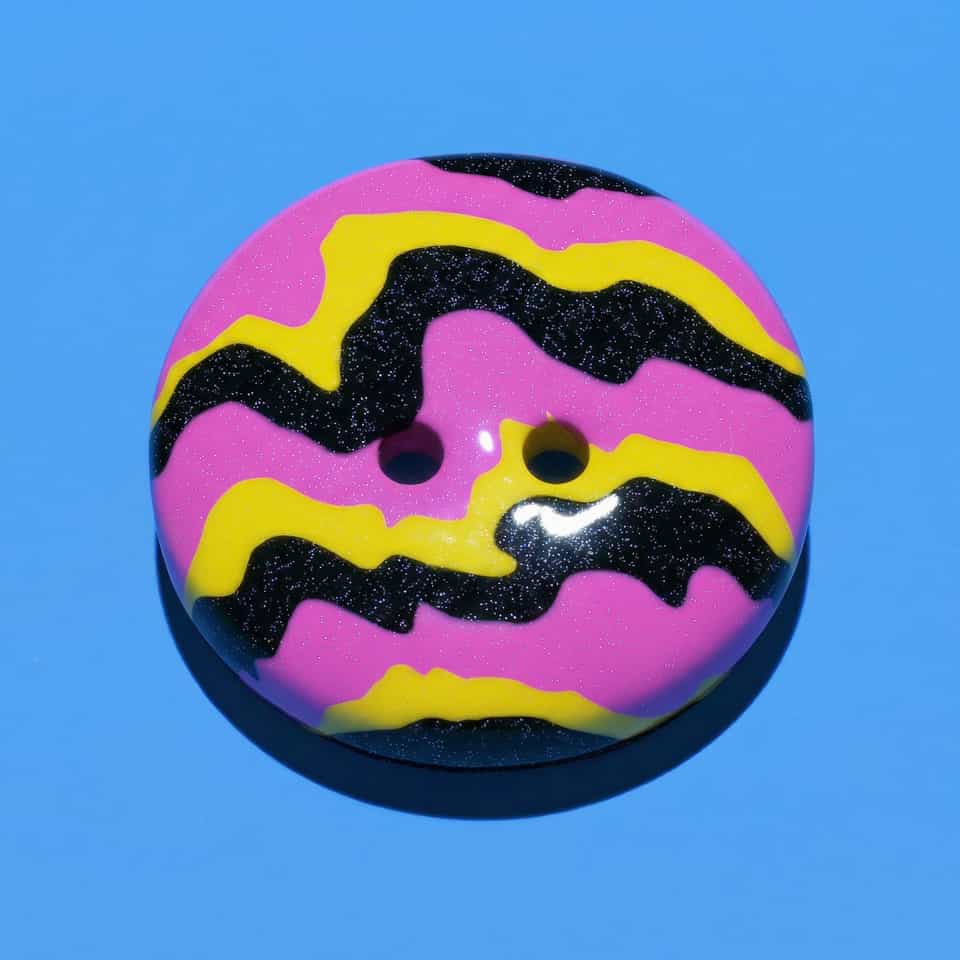
Five matching round buttons on a chartreuse (bright lemon-green) base, each crossed by a few bold hot-pink wavy bands that flow diagonally in clean, distinct stripes rather than a muddy marble. The faces are high-gloss and only slightly domed, each with two centered sew-through holes, sized for small cardigan or shirt closures. The lifestyle shot shows the set repeated down a cream cardigan placket.
Lookbook view

These are striped-slab buttons: a two-tone chartreuse and hot-pink pattern built into one slab, cut into matching round blanks, pierced for two-hole sewing, and baked flat. The clean directional waves point to a folded or distorted striped slab (or mokume-gane shaved veneer); a wave texture roller pressed into a pink-over-chartreuse blank is a faster alternative. FIMO Professional holds the crisp color edges, and a short chill helps a Premo slab cut clean. The glossy look comes from buffing or a thin water-based gloss after baking.
Mix and condition your clay first. Blend one full batch of chartreuse (bright yellow nudged with a little green) so the whole set matches, and condition the hot pink separately until both are smooth. FIMO Professional keeps the pink edges crisp, or chill a Premo slab briefly before cutting.
Pattern option A, folded striped slab: roll a chartreuse slab and a thinner hot-pink slab on one even setting, stack them, then fold and gently re-roll a couple of times without fully blending so you get a few clean stripes. Bend, pinch, or drag a tool across the stack to push the straight stripes into waves, then re-roll lightly to even it out.
Pattern option B, mokume-gane: stack several thin chartreuse and hot-pink layers into a block, press to bond out the air, then push textures or a ball tool into the top so the flat layers warp into hills and valleys. Shave thin slices off the high spots with a stiff blade held nearly flat and lay them onto a chartreuse base slab; rolling reveals the organic pink waves.
Pattern option C, wave texture roller: roll an even chartreuse slab, lay a thin hot-pink slab or pink stripes on top, then press or roll a wavy texture roller across it so the pink distorts into waves. Roll lightly to merge so the surface stays smooth, since these faces read glossy, not deeply textured.
Roll the patterned slab to one even button thickness using guide strips, stepping down a setting at a time with a quarter turn between passes so the waves stretch evenly and the slab does not ripple.
Dust a round cutter with a little cornstarch, press straight down, give a tiny wiggle, and lift away the waste so each circle stays crisp and unstretched. Use the same cutter for every button so the set matches, and lay the widest pink waves so they still read after cutting.
Pierce the two centered sew-through holes now, while the clay is raw. Hold a needle or blunt tapestry needle straight down and make two evenly spaced holes set well in from the edge, sized a touch larger than your sewing needle and doubled thread so a needle passes easily.
Smooth the cut edge with a fingertip and ease the face into the shallow dome the photo shows. Keep it shallow so a small cardigan button sits flat and stitches down without feeling bulky.
Bake the buttons flat on cardstock or parchment set on a ceramic tile, and leave them on the tile through the whole bake. For a guaranteed-flat result, rest a second tile (over paper) on top so the edges cannot lift as the oven heats.
Bake at your clay brand's package temperature for the full time on the package, timing by the thickest part, and bake the full time or a little longer. Buttons flex and get washed, so a complete cure is what keeps them from cracking at the holes. Use an oven thermometer since oven dials drift.
Let the buttons cool completely, then check and clear the two holes. If an opening drifted or closed slightly, true it up with a bead reamer or a fine pin-vise drill so thread passes without dragging on a sharp edge.
Finish for the glassy look in the photo: lightly sand and buff for a no-coat shine that survives laundry, or brush one thin coat of a water-based gloss such as Varathane, tested on baked scrap first. Bare, fully cured buttons are machine washable; once glossed, hand-wash and hang-dry to protect the coat.
Thread-test one button on scrap fabric before sewing the whole set onto a garment to confirm the holes are smooth and the edge does not chip under tension.
What you will need
Start with the clay colours, your cutters, something to make the holes, and a bake surface. Add finishing or testing tools only if your version needs them.
Useful for the bright yellow base that you can shift toward chartreuse.
Mix a little into yellow to push the base closer to the chartreuse in the photo.
A firm clay for the chartreuse and pink wave slab, so the pink wave edges stay crisp when you cut the five buttons from it.
Tick what you already have, then get only what is missing.
Roll every sheet to the same calibrated thickness with the ClayBake slab height guides.
Use it with thickness guides to flatten the striped blank evenly before cutting the button circles.
Useful for keeping the striped blank and the button edges crisp.
ClayBake makes matched cutter packs sized to this build, so repeated shapes stay consistent. 3D print or order the set from our tools.
Essential for marking the two sew-through holes while the buttons are still raw.
A flat white tile helps the buttons bake evenly and gives you a clean surface for checking color and dust.
Matches the hot pink stripe color in the finished buttons.
A lightweight clay with a cohesive suede finish that holds fine textures without sticky residue.
Optional extras for a different finish, size or fix.
Useful if you want more reliable bake control than your oven dial alone can give you.
Useful only if you want to match the brighter wet-look shine on the finished buttons.
A polymer-clay-compatible glaze option for a glossy finish. Test it on baked scrap before using it on the finished piece.
These guides cover the cutting, hole placement, and surface-building choices that matter when you sew-through buttons in polymer clay.
Custom range
Ask for a build pack to make it yourself (the cutter or tool files, a supply list, and a plan), or ask the studio to make the finished pieces for you.
More button builds with different silhouettes, surface treatments, or finish ideas to try on your own set.
Pin it to a board, copy the link, or keep it saved here while you make your own version.
Tag Clay Bake Studio on Instagram or TikTok so we can see how you adapted it.