How to make polymer clay mushrooms: a desk toadstool, an earring charm and a plant-pot pick
A polymer clay mushroom is a domed cap with a socket pressed into its underside and a teardrop stem seated in it. Make a desk toadstool from a quarter bar of clay per piece, an earring charm with the eye pin set before baking, or a pick for a plant pot.
Some links on this page are affiliate links. If you buy through them, we may earn a commission at no extra cost to you. As an Amazon Associate I earn from qualifying purchases. Disclosures

In brief
Key takeaways
- Shape a thick dome for the cap and a thick teardrop for the stem from equal portions (Sculpey's kawaii mushroom uses a quarter of a 2 oz bar for each), then push a rounded socket into the underside of the cap
- Press the stem's foot outward so it stands on its own, seat the stem's narrow top in the socket and smooth the seam from underneath; add a drop of liquid clay or oven-bake adhesive when pressing would squash the dome
- Press the spots into the raw cap, or set them on a drop of liquid clay on a steep dome, so they bake on with the mushroom
- Rest the overhanging rim on a loose foil ring, bake at the temperature on your clay packet for the time it gives for the thickest part, and leave the mushroom on the tile until it is cool
- For an earring charm, push a bent eye pin down through the cap into the stem before baking; for a plant-pot pick, bake the mushroom on a toothpick left sticking out below the foot
Article contentsOpenClose
To make a polymer clay mushroom, shape a thick dome for the cap, press a rounded hollow into its underside, roll a thick teardrop for the stem and seat the stem's narrow end in that hollow. Then add spots, prop up the rim of the cap, and bake the joined mushroom on a tile.
Sculpey's own kawaii mushroom project uses a quarter of a 2 oz bar of clay for the cap and another quarter for the stem, about 14 g each. That makes a mushroom that stands on a desk. The same two shapes rolled from smaller, matched balls make an earring charm, and a toothpick pushed up through the stem turns a mushroom into a pick for a plant pot. The steps below make the desk toadstool first, then show what changes for the charm and the pick.
Polymer clay stays soft until it is baked in a home oven. If the clay you have dries in the air instead, the polymer clay vs air-dry clay guide explains how the two differ.
What you need for a red toadstool with white spots
One desk-sized toadstool takes half a bar of clay in total, a ball-ended tool, a glossy tile to build and bake on, and an oven thermometer.
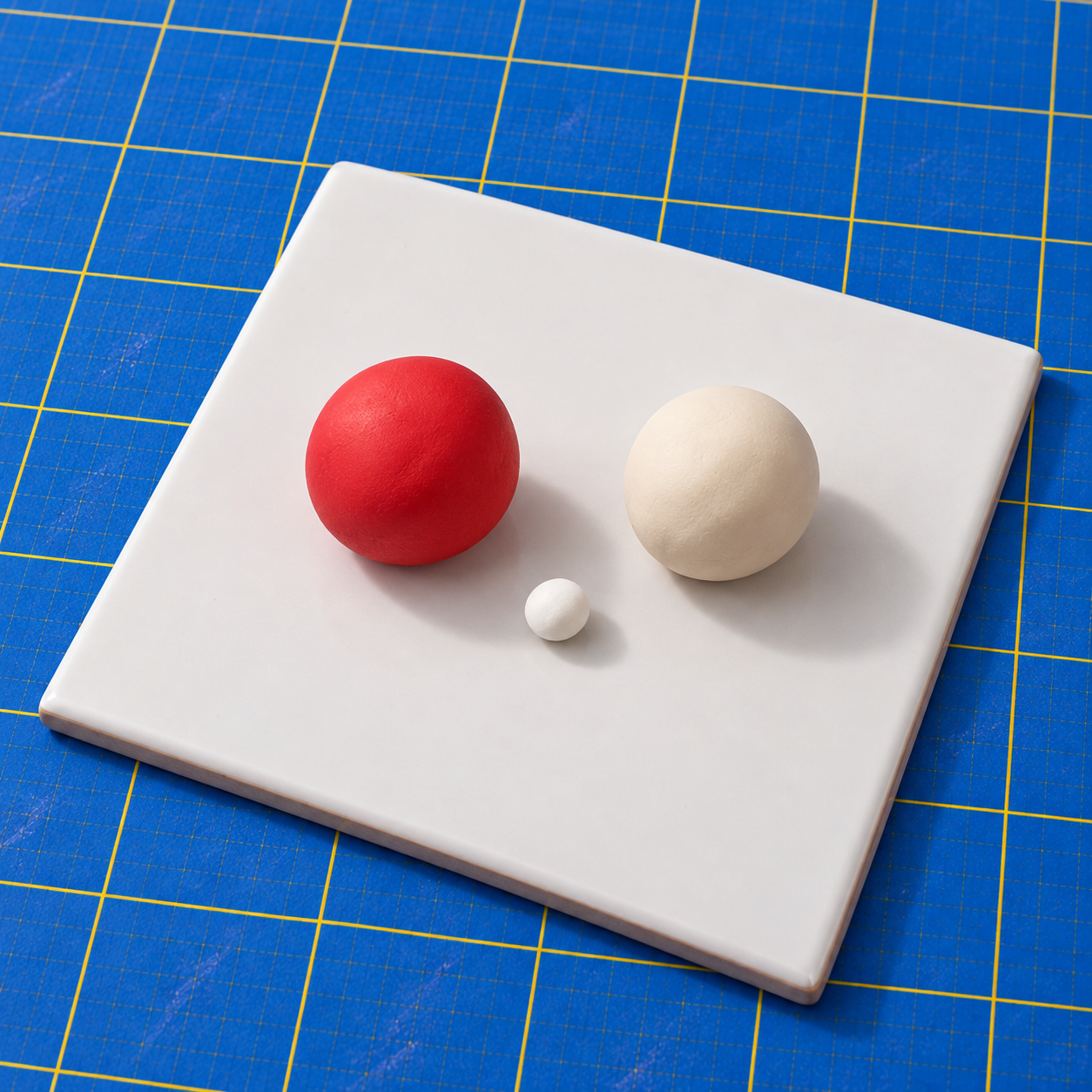
- Cap: a quarter of a 2 oz bar of red, such as Premo Cadmium Red Hue. Sculpey's kawaii mushroom uses Sculpey III; if you plan to wear the mushroom, read the charm section before choosing a clay.
- Stem and spots: a quarter bar of white or beige for the stem, plus a pinch of white for the spots. One bar of Premo White covers both. Sculpey's kawaii mushroom needs only 1/64 of a bar each of yellow and white for its spots.
- A ball-ended tool to press the socket under the cap. The Sculpey dual-end detail tools combine metal ball ends with flexible tips for smoothing seams. A fingertip works on a large cap.
- A needle tool if you want gills under the cap. A clay needle tool scores fine lines; a sewing needle will do.
- Liquid clay or oven-bake adhesive: a small bottle of Sculpey Oven-Bake Clay Adhesive (sold as Bake & Bond) or Translucent Liquid Sculpey, for joins and spots you cannot press hard.
- A glossy ceramic tile to build on and bake on, so the mushroom never has to be lifted while it is soft. Sculpey recommends plain glossy tiles only; the guide to baking surfaces and supports explains why.
- Kitchen foil to prop up the cap, or a little polyester fibrefill.
- An oven thermometer to stand beside the tile. Sculpey's baking guide says to put one in the baking area where you can read it through the oven door.
- For a charm: eye pins and ear wires. For a pot pick: a wooden toothpick.
Knead each colour until it is soft and warm before you shape anything, as Sculpey's kawaii mushroom does first. Sculpey says unconditioned clay is much more likely to crack in the oven. If the clay crumbles or stays stiff, the conditioning guide covers how to bring it round.
How to shape a stem that stands up
Roll the stem clay into a thick teardrop, stand it on its wide end on the tile, and press the bottom edge outward a little so the foot spreads wider than the stem.
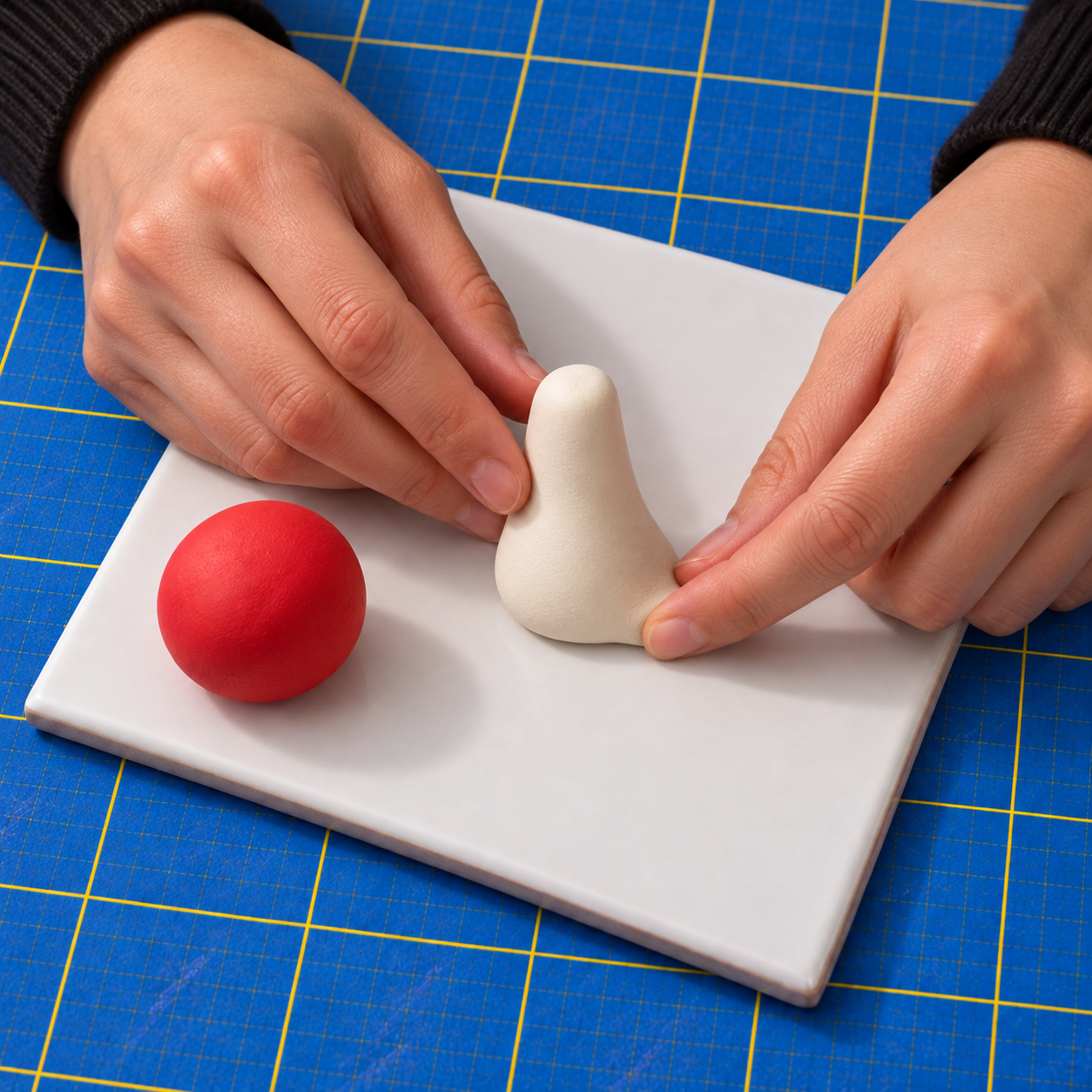
Sculpey's kawaii mushroom uses a thick teardrop for the stem, which gives a short, chubby toadstool. For a taller, straighter stem, use the shape from Sculpey's gnome-and-mushroom project instead: roll the ball into a log, press the edges of one end so they fan out a little, and round off the other end. In both shapes the rounded, narrower top goes into the cap and the widened foot keeps the mushroom standing once the cap adds weight on top.
Stand the stem on the tile and look at it from eye level. It should stand straight without a hand on it. If it tilts, press the foot wider on the low side before you go on. Leave it where it is: the tile you build on is the tile you bake on.
For a mushroom much bigger than Sculpey's quarter-bar size, build the stem around a core of tightly crumpled foil and wrap the clay over it. Sculpey recommends crushed foil as bulk to keep the clay layer a consistent thickness, because variation in thickness is one of the most common reasons baked clay cracks.
How to shape the cap and press the socket underneath
Roll the cap clay into a ball, press it into a thick dome that is fullest in the middle, then turn it over and push a rounded hollow into the centre of the underside with a ball tool or your fingertip.
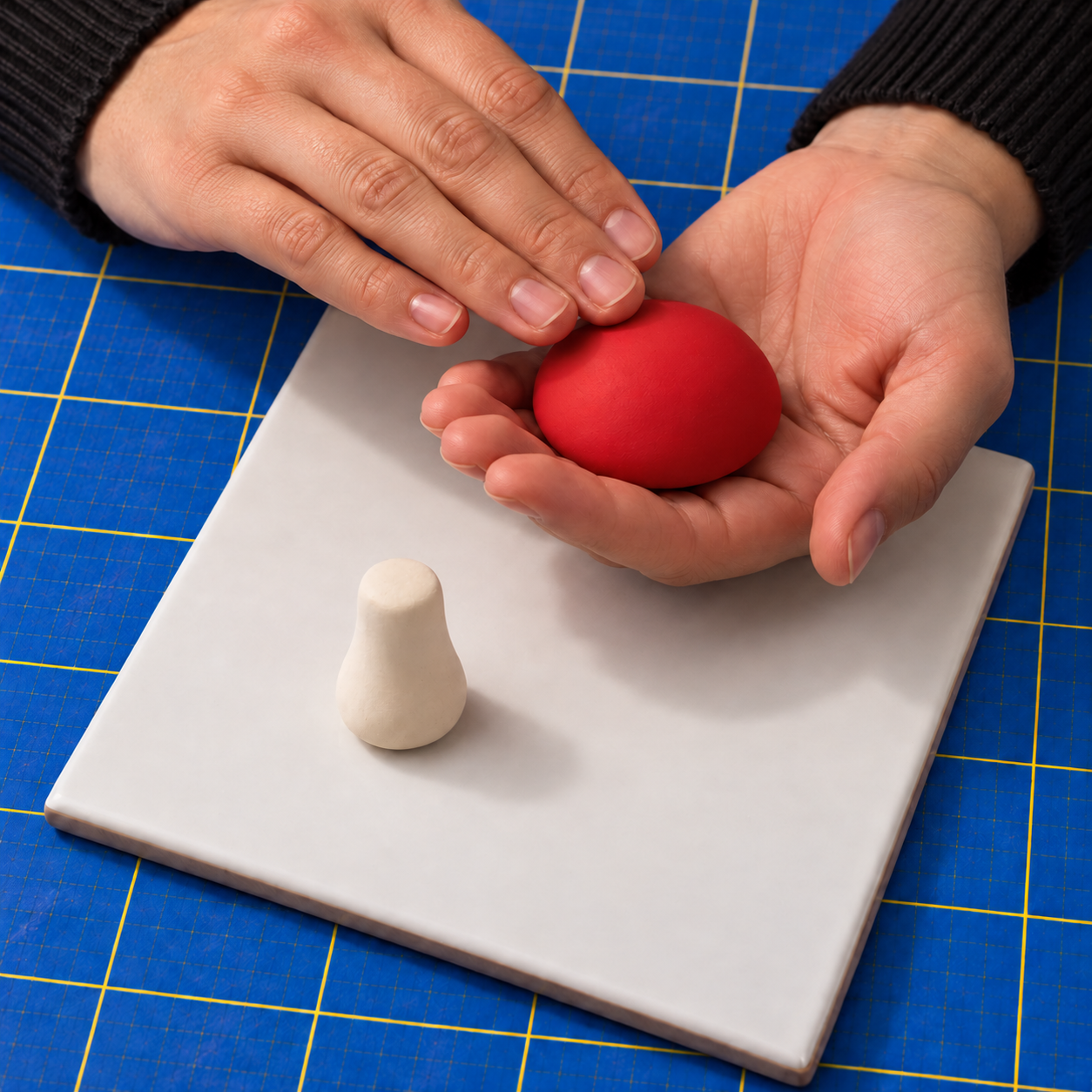
Flatten the ball partly with your palm so it forms a low dome, then shape the edge down with your fingers until it looks like a cap. Sculpey's Bake Shop mushroom describes the target as a dome that is thick in the middle; a thick middle leaves room for the socket without the top going thin. Turn the cap over in your palm and press the ball end of the tool into the centre, rocking it slightly, to make a round hollow about as wide as the top of the stem. Sculpey's kawaii mushroom does exactly this: it uses a tool to push a rounded hole into the bottom of the cap for the stem.
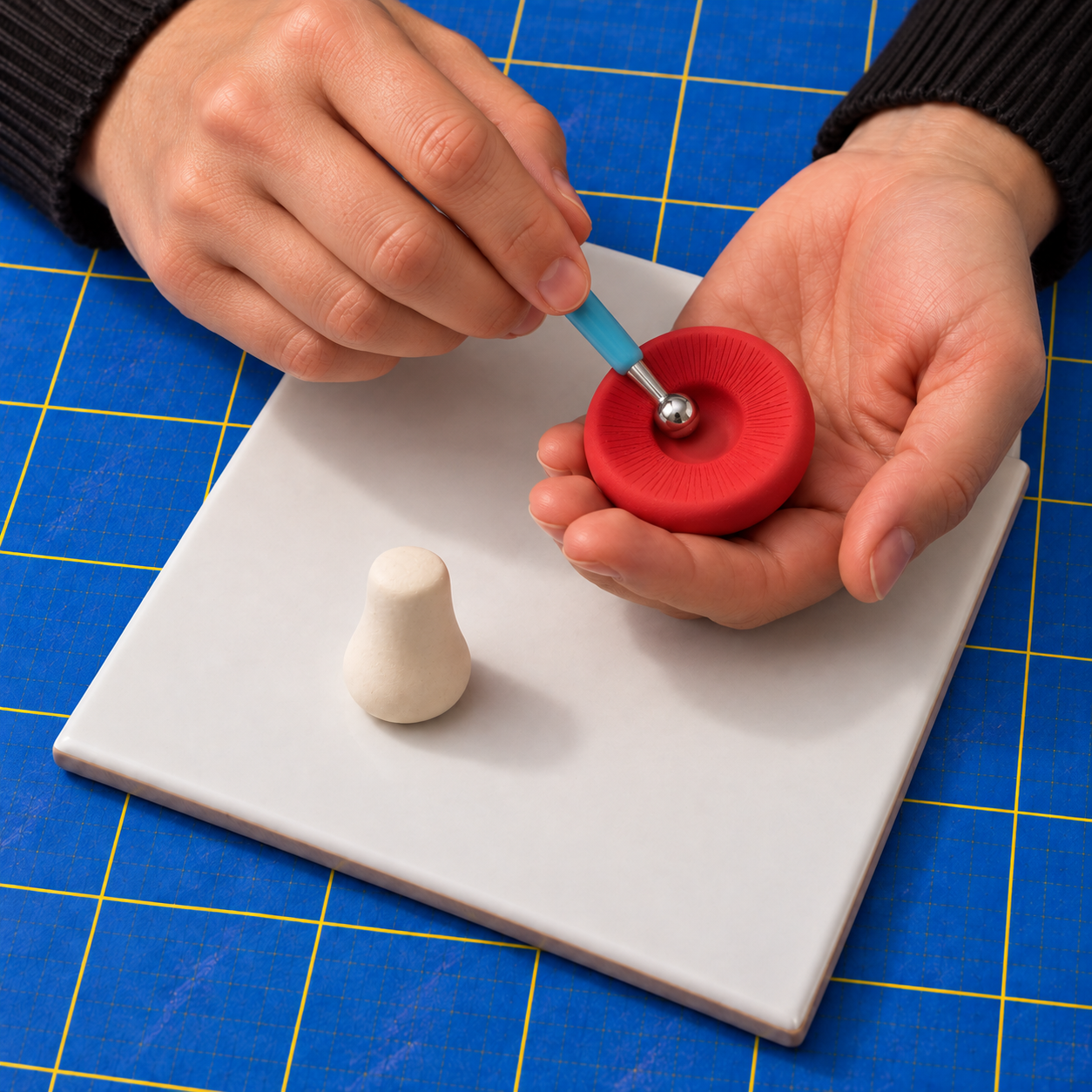
For a thinner, more open cap, use the pinch-pot method from Sculpey's gnome-and-mushroom project. Push a finger into the centre of the ball, pinch the edges out into a small bowl, and keep pressing and shaping until the cap is the size you want. Turn it over and the bowl becomes the underside. A pinch-pot cap is lighter, but its rim is thin, so it needs support in the oven.
For gills, score thin lines on the underside from the edge of the socket out to the rim with a needle tool, before the cap goes on the stem. Keep them shallow so they read as texture rather than cuts, and leave the socket itself smooth so the stem still seats flat.
How to join the cap to the stem
Push the rounded top of the stem up into the socket, press the cap down until it sits level, and smooth the seam from underneath. The cap and stem bake as one piece; Sculpey's kawaii mushroom notes that if you carry the two parts separately, you join them again before baking.
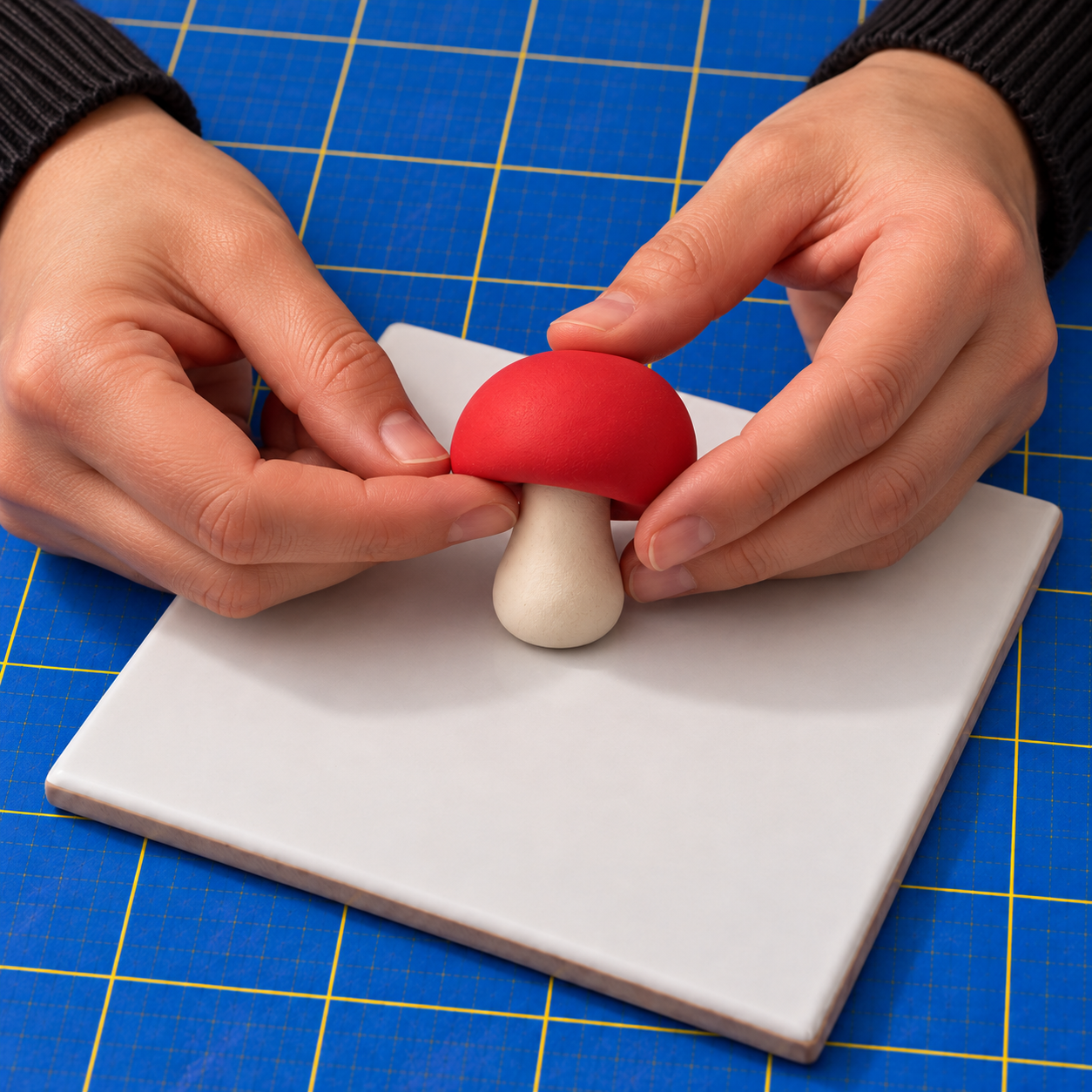
Choose the join by what the mushroom will become. Sculpey's three mushroom projects each use a different one:
| Join | How it works | Use it for |
|---|---|---|
| Socket | The stem's rounded top sits in the hollow pressed under the cap (Sculpey III Kawaii Mushroom). | A short desk mushroom with a thick dome cap |
| Toothpick | A toothpick runs up through the centre of the stem and the cap is pushed onto the top. Sculpey notes the toothpick still steadies the mushroom even if it does not reach into the cap (Sculpey Bake Shop Mushroom). | A tall stem, a mushroom baked standing on foil, or a pick for a plant pot |
| Pinch-pot cap | A bowl-shaped cap is pressed straight onto a log stem with a fanned foot (Original Sculpey Gnome and Mushroom). | A lighter cap with a thinner rim |
Whichever join you use, add a drop of liquid clay when pressing would squash the dome, for example on a very round cap or one that already carries spots. Put a drop of oven-bake adhesive or translucent liquid clay in the socket, then seat the stem. Sculpey's guide to its Oven-Bake Clay Adhesive describes using just a drop at the joint to connect very round parts without the pressure a join normally needs, with the bond forming during baking. Sculpey's cupcake earrings join a domed top to its base the same way, with a dollop of translucent liquid clay.
To hide the seam, work the clay at the join upward and outward from underneath with a fingertip or the soft tip of the detail tool, so the line between cap and stem disappears. If a line still shows, press a thin ring of stem-coloured clay around the join and smooth it into both pieces.
Then check the mushroom from eye level. The cap should sit centred over the stem. Sculpey's gnome-and-mushroom project warns that a lopsided mushroom can tip and fall while it bakes, so if yours leans, lift the cap off, press the foot wider, and seat the cap again. Add faces and other small details last, once the cap is on, so your fingers are not pressing on them while you join the pieces; the figurine guide covers faces on small characters.
How to add spots that stay on the cap
Press each spot onto the raw cap so it bakes on with the mushroom. On a steep dome, where pressing would dent the cap, set each spot on a drop of liquid clay or oven-bake adhesive instead.
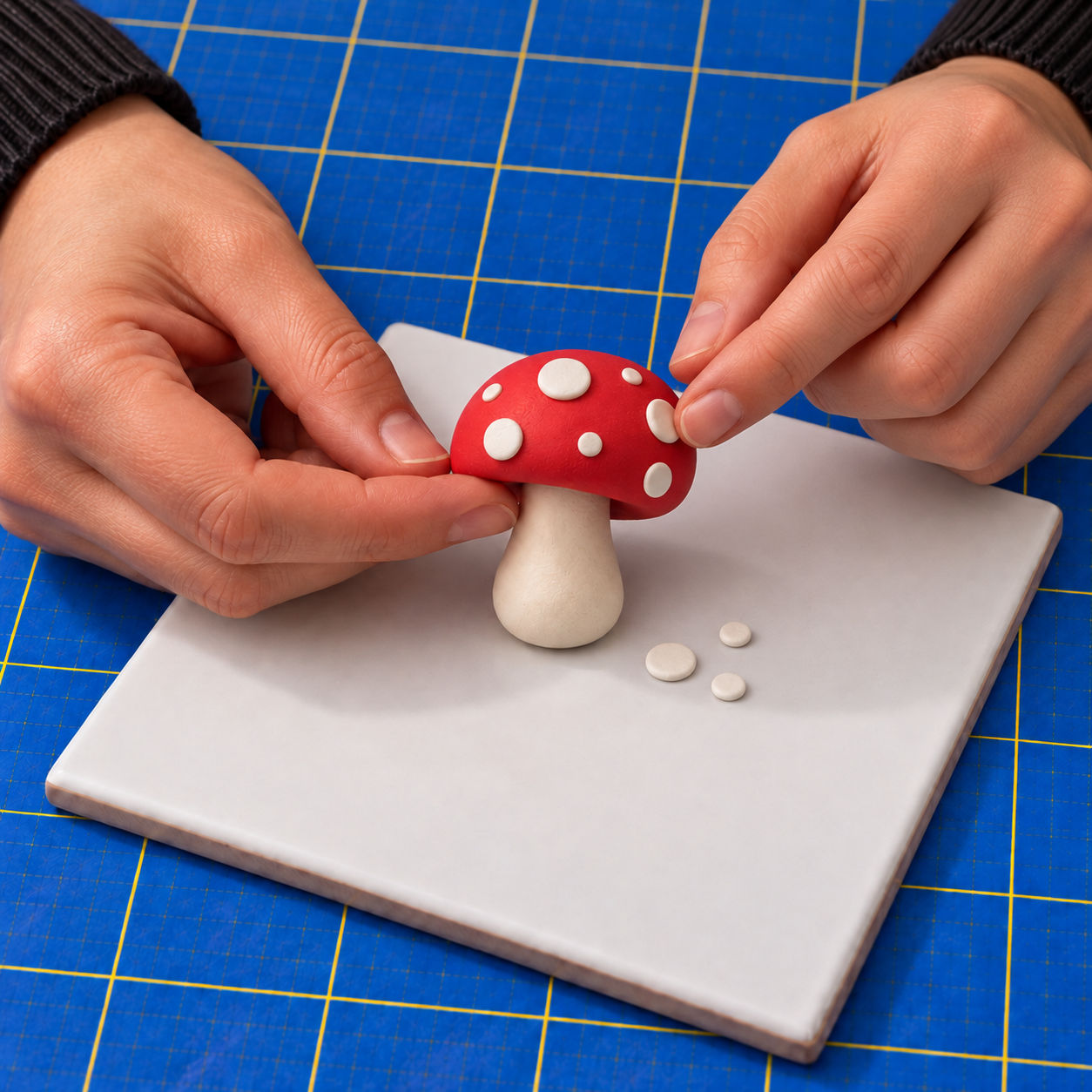
Sculpey's projects use three kinds of spot:
- Pressed dots. Roll small balls of white, flatten each one between your fingertips into a thin disc, and press it onto the cap with steady, even pressure so it bonds into the surface rather than sitting on top. Sculpey's Bake Shop mushroom flattens small pieces of clay and presses them onto the dome. Mix two or three sizes and scatter them unevenly for a more natural toadstool.
- Marbled slices. Sculpey's kawaii mushroom swirls a pinch of yellow into a pinch of white, rolls the mix into a thin log and slices off rounds for marbled spots.
- Painted spots. Sculpey's gnome-and-mushroom project bakes the mushroom plain white, then paints the cap red and adds white spots with acrylic paint. Paint needs a clean, cool baked surface; the guide to paint and finishes on polymer clay explains how to get it to stick.
You can spot the cap in your palm before it goes on the stem, as Sculpey's Bake Shop mushroom does, or after joining. Spotting first keeps your fingers off the stem; if you do, use a drop of liquid clay in the socket so you can seat the cap without pressing hard on the spots.
How to support the cap and bake the mushroom
Tuck a loose ring of crumpled foil or a little fibrefill under the rim of the cap wherever it overhangs the stem, then bake at the temperature on your clay packet for the time the packet gives for the thickest part.
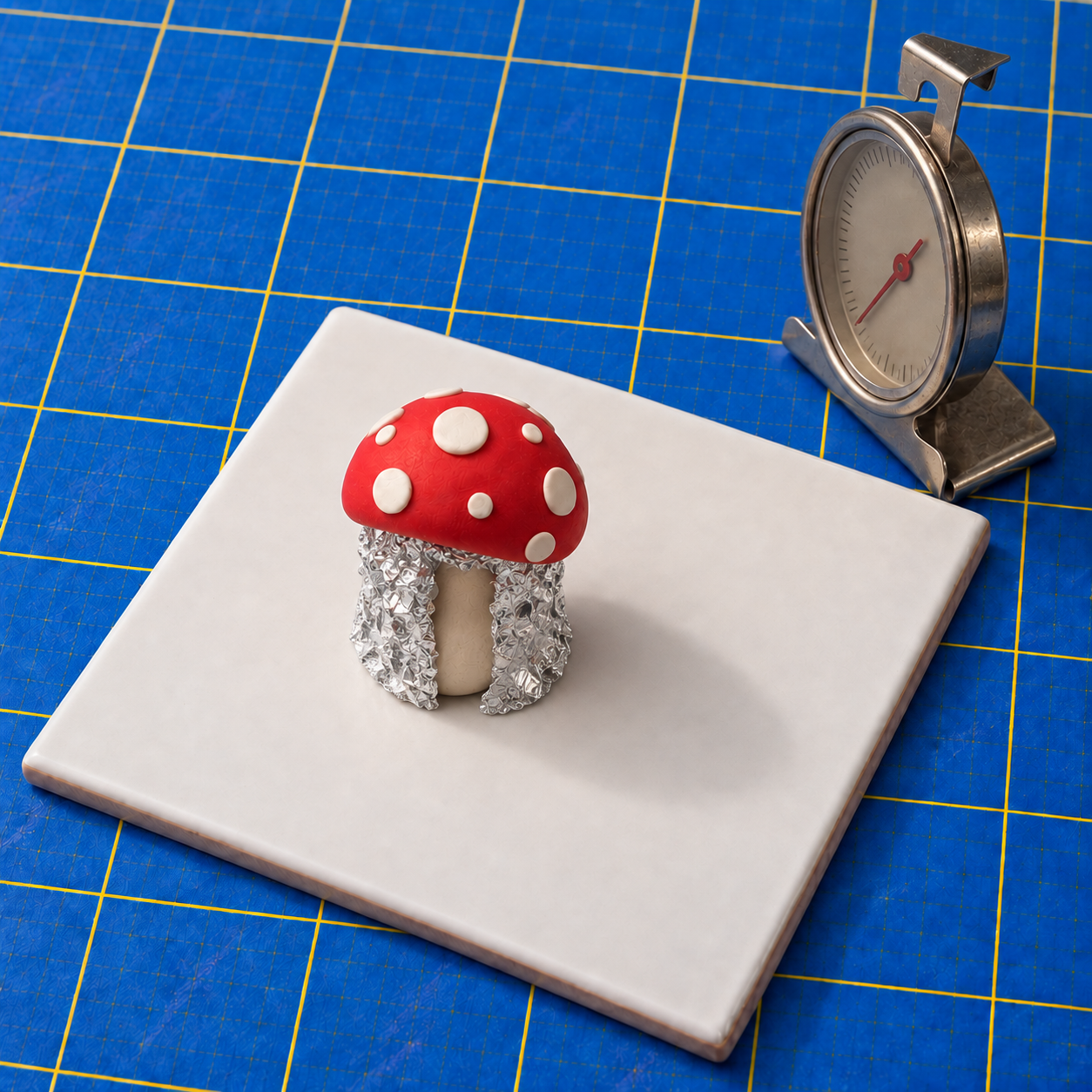
Sculpey's baking guidance says extended or raised parts of the clay can sag or crack when heated, because clay softens slightly in the oven before it hardens. A mushroom cap is exactly that kind of part. Shape a strip of foil into a ring about as tall as the stem, slide it around the stem, and let the rim of the cap rest on it without pressing a dent into the clay. Sculpey's forest-scene mushrooms are baked with paper towels propping the caps for the same reason. A pinch-pot cap with a thin rim needs it most. The guide to baking surfaces and supports covers other props and when to use them.
Sculpey's baking guide gives 275°F (130°C) for its main lines, including Premo, Soufflé and Sculpey III, for 15 to 30 minutes per 1/4 inch (6 mm) of the thickest part; the kawaii and gnome mushroom projects give 15 minutes per 1/4 inch for Sculpey III and Original Sculpey. On a mushroom the thickest part is usually the stem or the middle of the cap, so measure there and use the time printed on your own packet for that thickness. Sculpey warns that underbaked clay is brittle and that clay left in the oven too long can overheat and crack, so keep to the packet time.
- Stand the thermometer on the shelf beside the tile and let the oven reach the packet temperature before the mushroom goes in.
- Cover the mushroom with a tent of foil that does not touch it, as Sculpey suggests, to keep a white stem from browning.
- After the bake, leave the mushroom on the tile until the tile and the stem feel cool. Sculpey notes that clay hardens as it cools, so a warm mushroom can still bend at the join.
An adult should handle the oven step. Follow the ventilation directions on the clay packet and in your oven's instructions, and keep small finished mushrooms away from young children who might put them in their mouths. The polymer clay safety guide covers keeping clay tools and food tools apart.
How to make a mushroom charm or earring
A charm uses the same cap, socket and stem rolled from much smaller balls, with an eye pin pushed down through the cap into the stem before baking, so the loop sits on top ready for an ear wire.
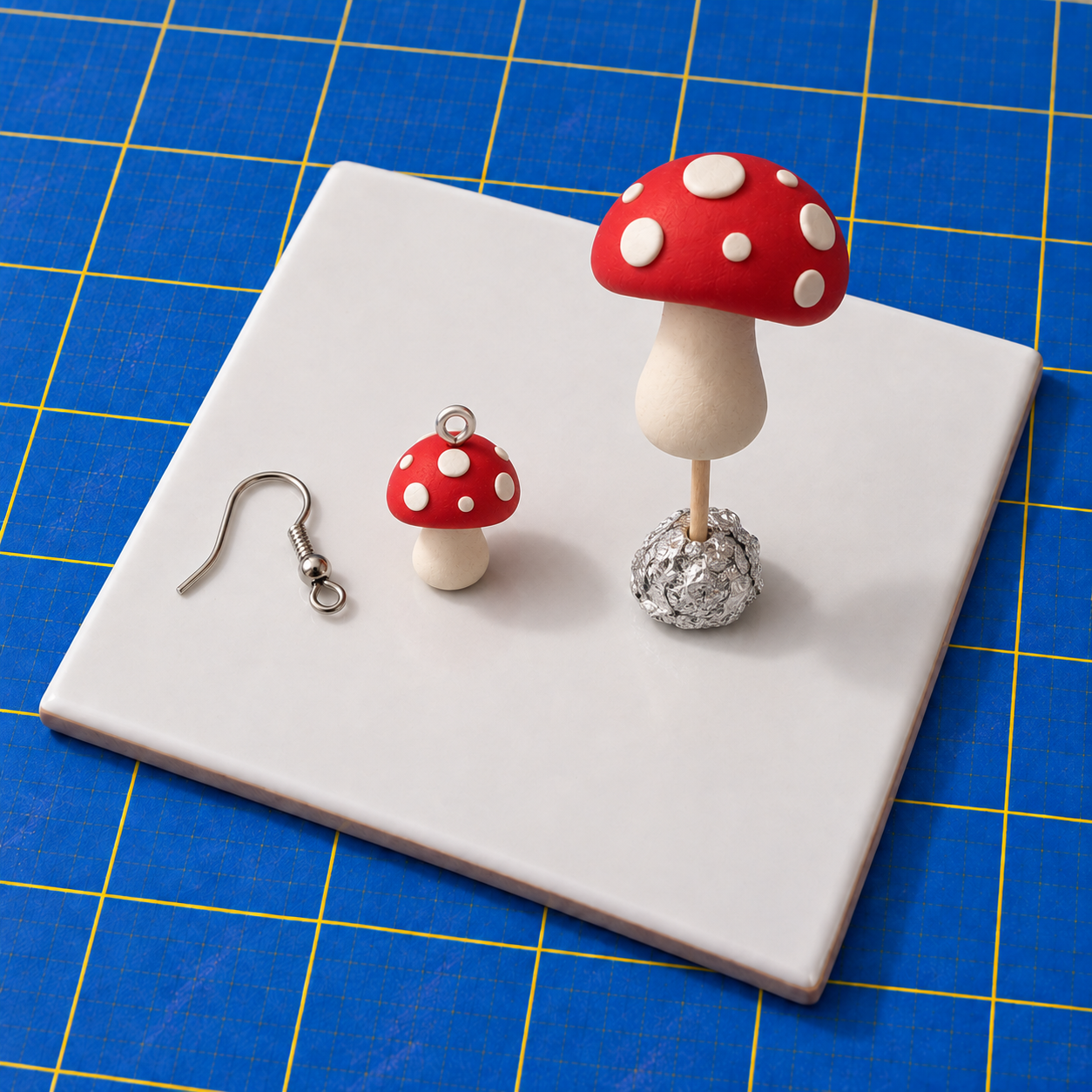
For a pair of earrings, both mushrooms need the same amount of clay. Sculpey's way to make uniform pieces is to roll an even log, measure its diameter with a ruler, and cut it into equally measured slices, or to weigh the portions on a small digital scale (search Amazon for small digital scales for clay portions). Cut four equal slices from one log, two for the caps and two for the stems, and roll each into a ball. Clay Bake Studio's Sphere and Cylinder Bead Roller Set, which rolls matching balls from 2 to 12 mm, is coming soon to the tools page as a digital download to print on a 3D printer or through a print service.
Clay choice matters more once a mushroom hangs from an ear. Sculpey's earring guide describes Premo as strong and flexible and able to hold small detail, and Soufflé as lightweight. A Soufflé multipack keeps a pair of mushroom charms light.
Shape the cap, socket and stem exactly as for the desk mushroom, join them, and add the spots. Then set the eye pin:
- Trim the eye pin so it reaches from the top of the cap well down into the stem without poking out of the foot.
- Bend the cut end with pliers so it grips the clay. Sculpey's cupcake earrings trim and bend their eye pins at the bottom so they stay in place after insertion.
- Push the pin straight down through the centre of the cap into the stem, holding the mushroom by the stem so the cap keeps its shape, until only the loop shows.
- Bake the charm with the pin in place, as Sculpey's cupcake earrings do, and let it cool on the tile.
- Open the loop of the ear wire, hook it through the eye pin's loop, and close it.
A standing mushroom has no flat surface for a stud pad or a brooch back, so for those, make a flat-backed mushroom instead: shape the cap and stem as a low half-mushroom lying flat on the tile, bake it, and glue the finding on after baking and cooling. Sculpey glues its rose studs to their posts after baking, and glues its pin backs on towards the top so the piece hangs upright. The guide to stud toppers and flat pads and the guide to attaching brooch backs cover the glue and placement. For other hanging options, such as a jump ring through a hole, see the guide to pendant holes and bails.
How to make a mushroom pick for a plant pot
For a pot pick, bake the mushroom on a wooden toothpick that runs up through the centre of the stem and sticks out below the foot. After baking, the part below the foot becomes the stake.
Sculpey's Bake Shop mushroom does this in a small pot packed with loosely crumpled foil. On a tile, crumple a tight mound of foil instead and push a toothpick into its centre with at least half of it standing up, which is how much Sculpey leaves above the foil. Push the stem down onto the toothpick until it sits on the foil, then push the spotted cap on top. For a mushroom you plan to push into soil, leave at least 3/8 inch (about 1 cm) of toothpick below the foot, as Sculpey does for the mushrooms in its forest scene. Sculpey's FAQ lists thoroughly cured wood among the materials that can go in the oven inside clay.
After baking and cooling, lift the mushroom off the foil. If the stake is longer than the pot needs, Sculpey trims baked toothpicks with wire cutters or heavy scissors. Push the stake into the soil so the foot of the stem sits on the surface.
Baked clay is water-resistant, and Sculpey says that holds even without a glaze. Water-resistant is not waterproof, though, and Sculpey says its glazes do not make a piece waterproof, so water the plant at the soil rather than over the mushroom. For a pot that lives outside, Sculpey recommends Premo or Super Sculpey UltraLight as its strongest clays for outdoor projects, placed out of direct sunlight, because UV light can fade the colour over time. The Bake Shop mushroom project shows Sculpey's finished pot version.
Should you leave the mushroom bare, wax it or glaze it?
Leave it bare unless you want a different sheen. Sculpey says polymer clay does not need a sealer, because baked clay is water-resistant and durable even without a glaze.
- Bare. The finish depends on the clay: Sculpey describes Sculpey III as baking to a matte, bisque-type finish and Soufflé to a suede finish. A bare cap reads as a natural woodland mushroom.
- Wax. For a soft satin glow, Sculpey's sealing guide says to brush the wax on and buff it once it has dried. Use a clear microcrystalline wax such as Renaissance Wax and buff it with a soft cloth.
- Gloss glaze. For the candy-bright look of a kawaii toadstool, brush on a thin coat of a gloss glaze such as Sculpey Gloss Glaze. Its directions say to brush on thin coats, leave 30 minutes between coats and let it air-dry for 24 hours, because a thick coat can peel.
Sculpey says the best sealants for polymer clay are water-based. The polymer clay sealer guide covers which water-based finishes suit clay and which finish types Sculpey warns against, and the sanding and buffing guide covers a smooth bare finish without any coating.
What to do when a mushroom goes wrong
The cap cracked in the oven
Look at where the clay changes thickness. Sculpey names variation in thickness as one of the most common reasons clay cracks, and a thick stem under a thin rim is that shape. On the next mushroom, build a large stem or cap around crumpled foil, knead the clay until it is soft, and check the oven temperature with the thermometer beside the tile. The cracking guide covers what to fill a crack with and how to check the bake.
The mushroom leans or fell over
The foot was too narrow for the cap, or the cap sat off-centre. On the next one, press the foot out until it spreads wider than the stem and check the cap from eye level before baking. Sculpey's gnome-and-mushroom project warns that a lopsided mushroom can tip and fall in the oven.
A spot fell off after baking
If the mushroom is not painted or glazed, stick the spot back with a drop of Sculpey Oven-Bake Clay Adhesive, which Sculpey says bonds raw clay to baked clay, and bake the mushroom again by the packet. On the next mushroom, press the spots into the raw cap harder, or set them on a drop of liquid clay.
The rim of the cap drooped
The overhang had nothing under it while the clay softened in the oven. Rest the rim on a foil ring or fibrefill next time, or shape a thicker dome that overhangs the stem less.
You can see the seam between cap and stem
Smooth the join from underneath before baking, working the clay outward over the top of the stem, and press a thin ring of clay into the join if the line still shows. Once the mushroom is baked, the seam stays; painting a band of colour over it hides it on a finished piece.
The charm is too heavy to wear
Make the next pair from Soufflé, which Sculpey describes as lightweight, use smaller matched balls, or switch to a pinch-pot cap with a thinner rim. For a brooch or stud, the flat-backed half-mushroom is lighter than a standing one.
Mushroom figures and earrings to build next
These lookbook pieces take the mushroom further:
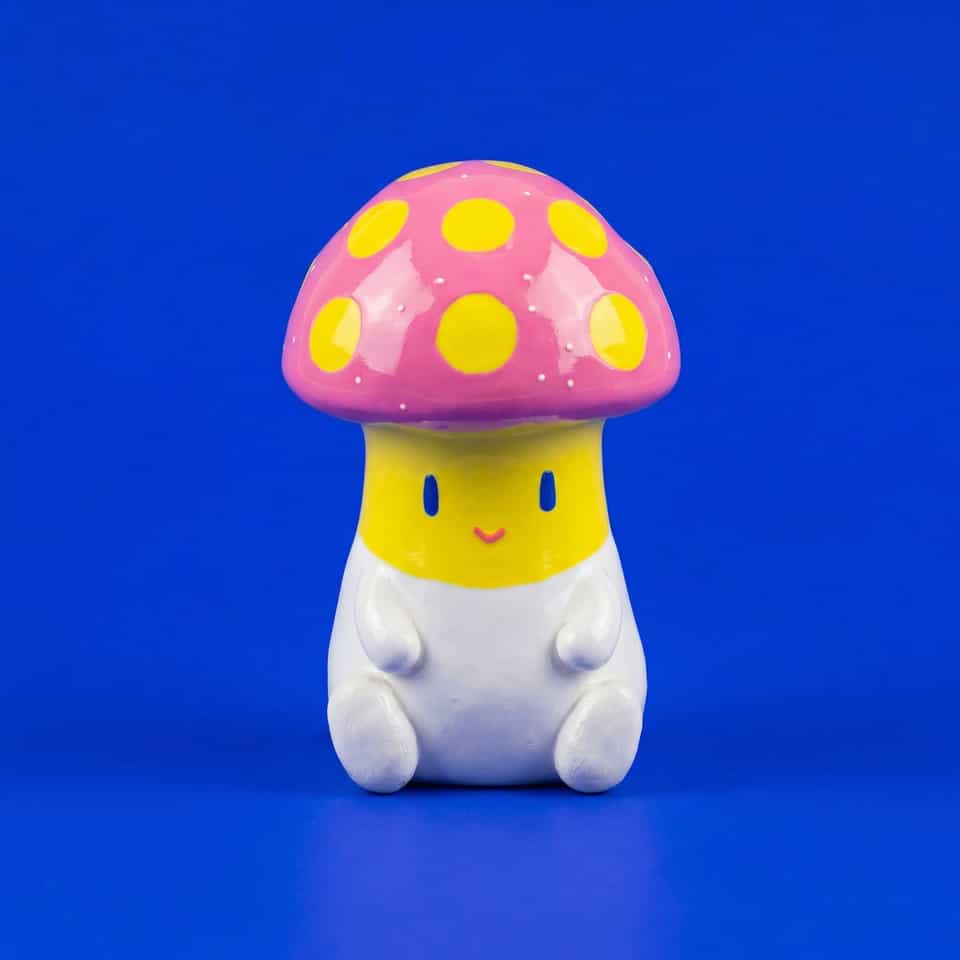
- The glossy pink spotted mushroom figurine has a high-gloss pink cap with inset yellow dots on a chubby white body, a gloss-glaze version of this method.
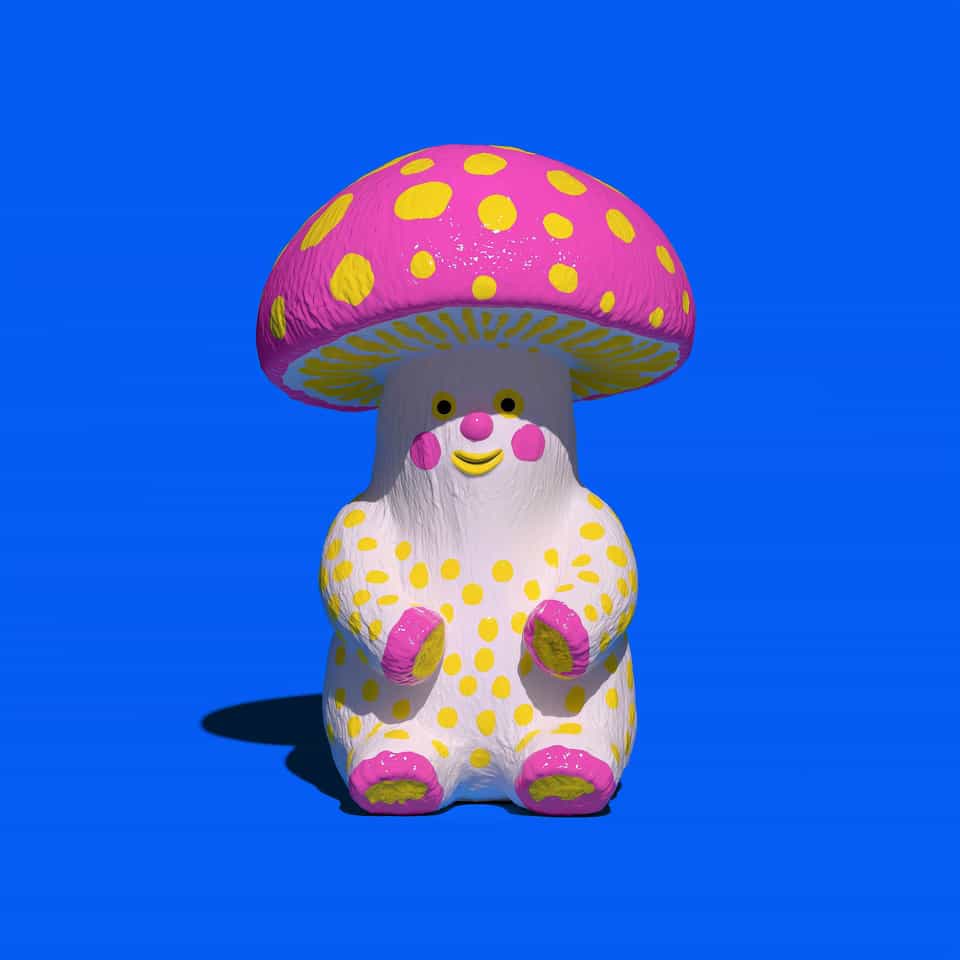
- The kawaii mushroom creature shows radiating gills under a glossy pink cap, with a face on the stem.
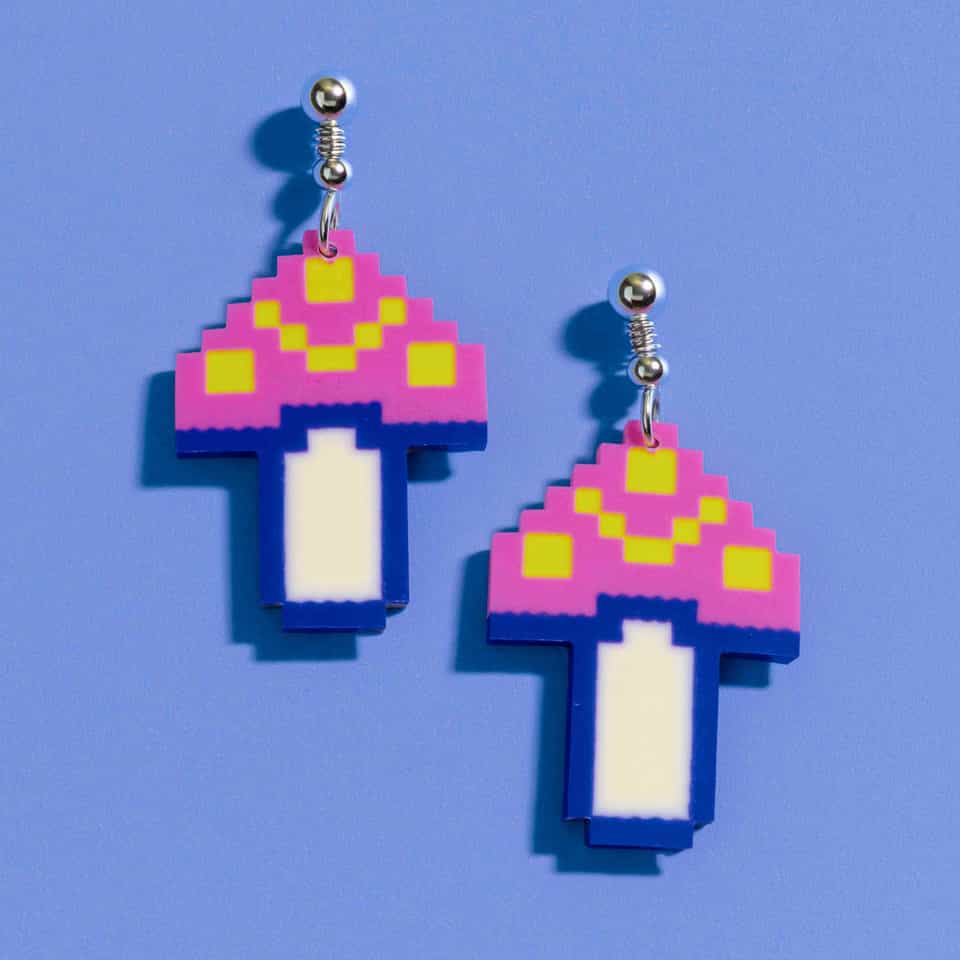
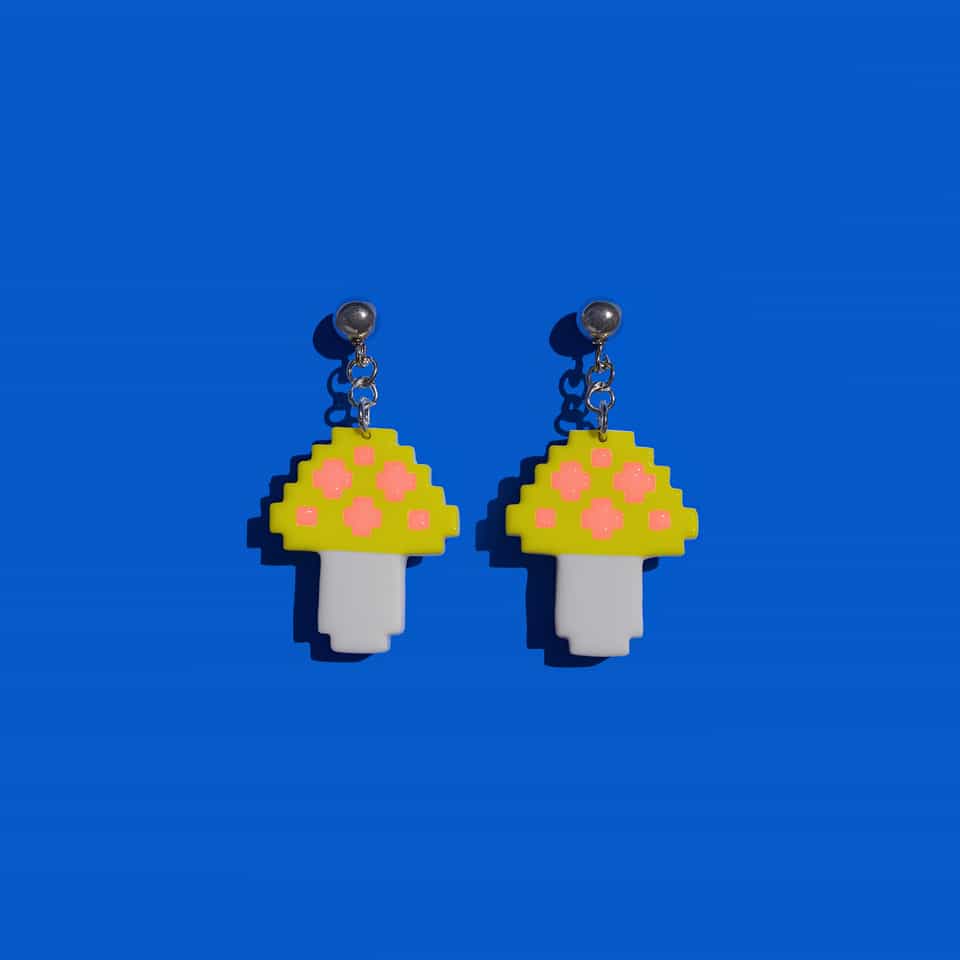
- The retro pixel mushroom earrings and the yellow pixel mushroom earrings are the flat route: a stepped mushroom outline built from square pixels and hung from ball studs. The polymer clay pixel art guide explains how those are made.
- The blue-cap mushroom cat turns the cap into a character's hat.
For bigger characters with arms, faces and heavier caps, the figurine guide covers bases, cores and when to add the face.
Supplies
Supplies mentioned here
Quick links to the materials and tools that fit this article. ClayBake tools stay on our own catalog.
Premo Sculpey Cadmium Red Hue
A red for the classic toadstool cap. A quarter of the 2 oz bar makes one desk-sized cap; the rest makes more caps or charms.
Premo Sculpey White
One bar covers the stem and the spots: a quarter bar for a desk-sized stem and a pinch for the dots.
Sculpey dual-end detail tools
The metal ball end pushes the rounded socket into the underside of the cap; the soft tip smooths the seam between cap and stem.
Sculpey Oven-Bake Clay Adhesive (Bake & Bond)
A drop in the socket or under a spot joins raw clay without pressing the dome flat, and the bond forms in the oven.
Oven thermometer
Stand it on the shelf beside the tile so you bake at the temperature printed on your clay packet, not the one on the dial.
More guides in this path
Open these when the next decision is material choice, attachment, or finishing.
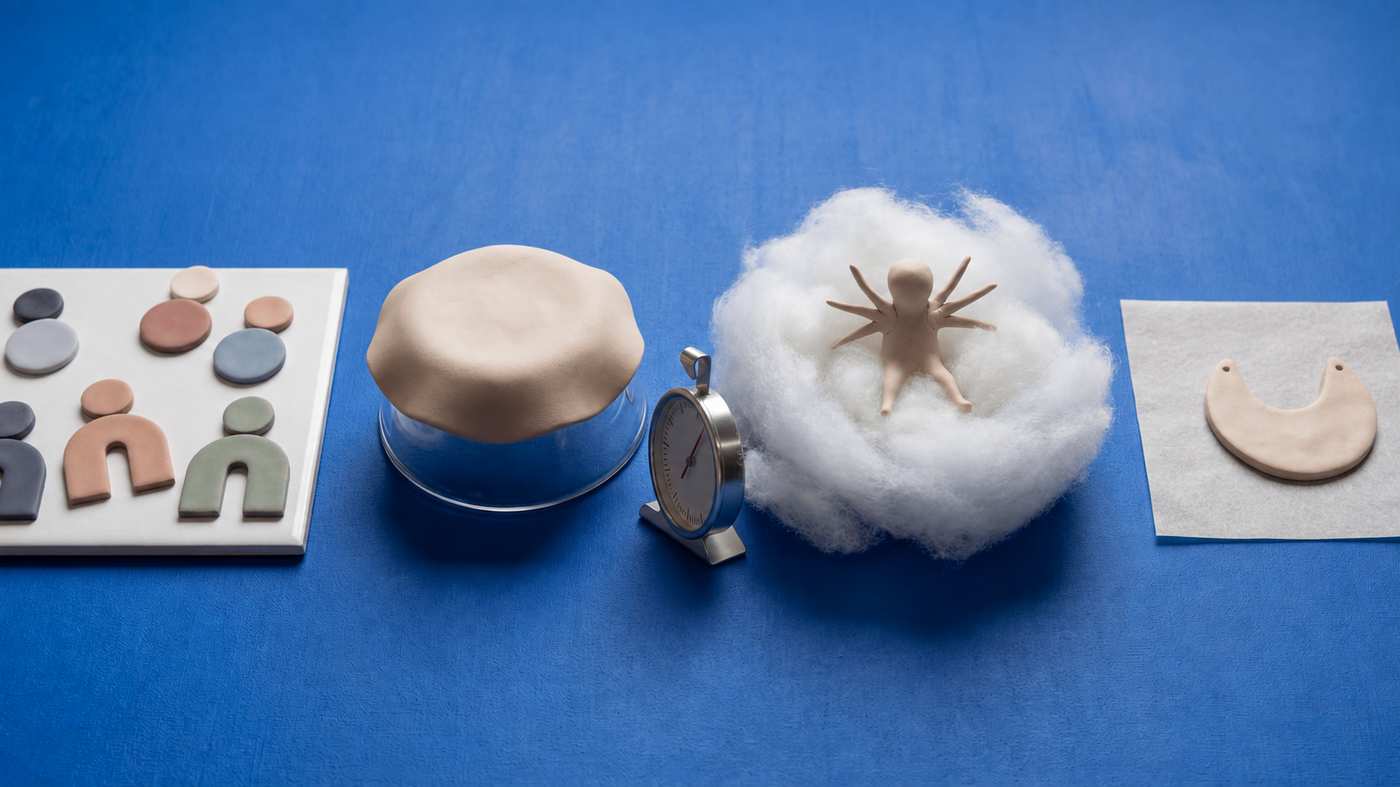
What to bake polymer clay on: tile, card and supports for flat, folded and large pieces
Bake flat pieces on a glossy tile and move them onto plain card only for a matte back. Hold curves, limbs and overhangs with fiberfill, crumpled foil or an oven-safe glass form, bake round beads on skewers, and leave everything on its support until it feels cool.
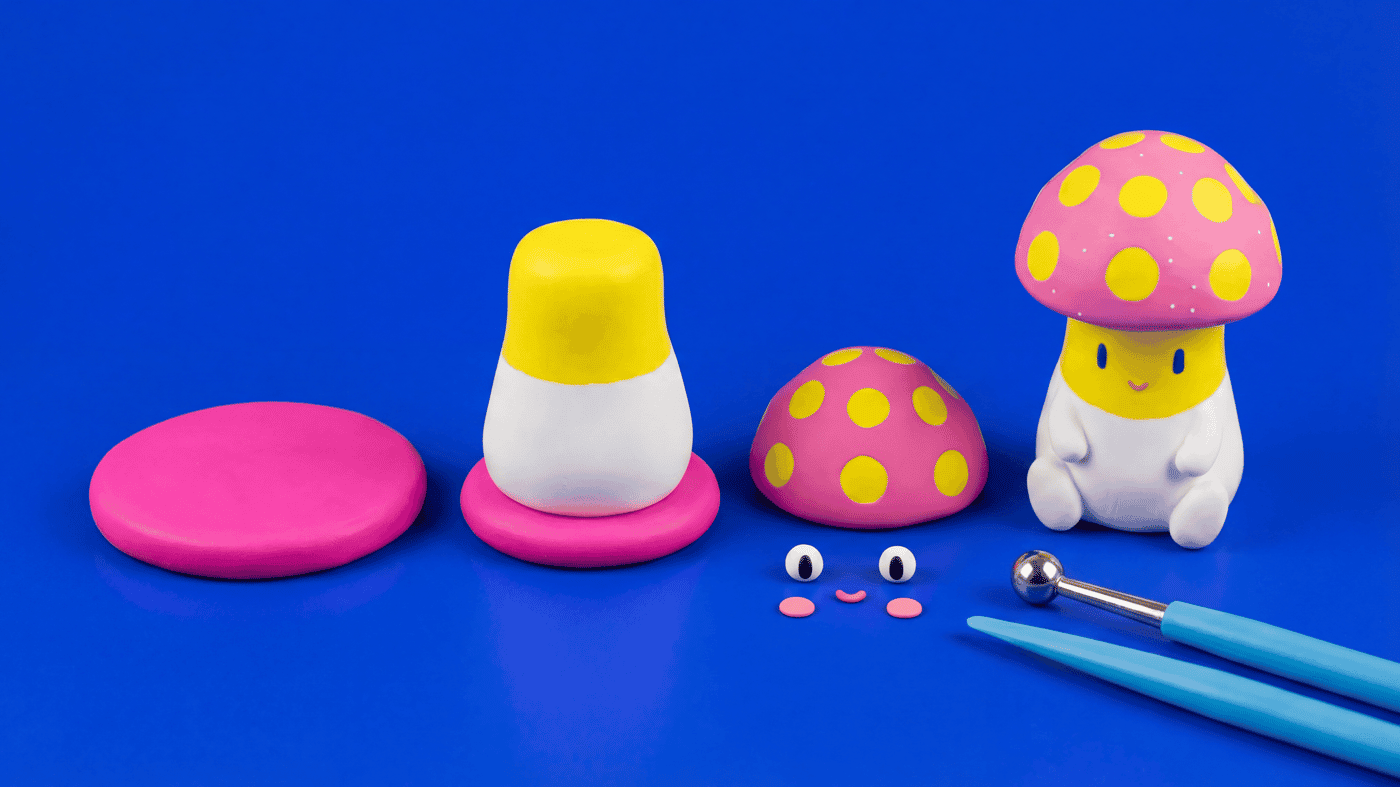
Polymer Clay Figurines: Stable Bases and Clean Features
Small figurines look simple until the base wobbles, the cap droops, or the face gets smudged while you are still shaping the body. This guide covers the order of operations that keeps polymer clay characters stable with cleaner features.
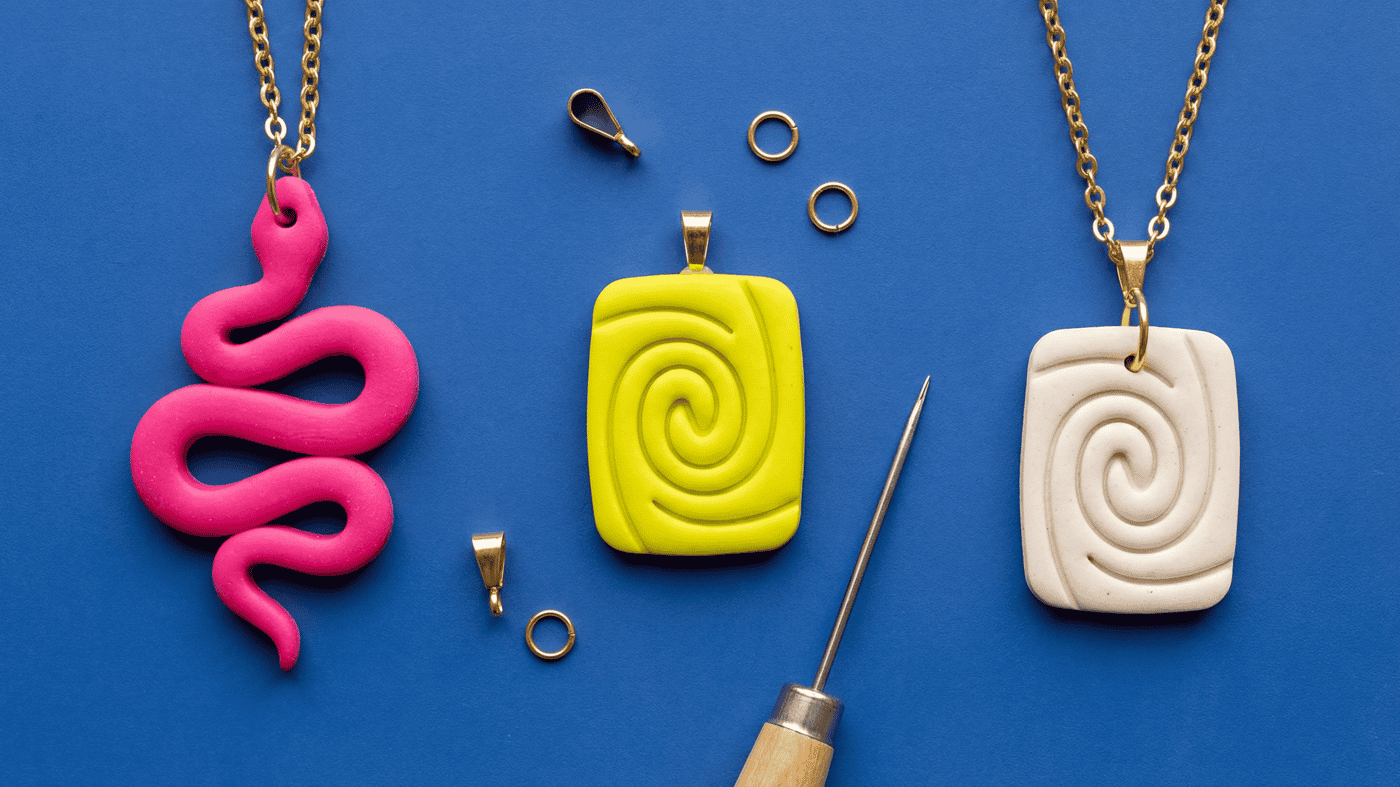
Polymer Clay Pendant Holes, Bails, and Jump Ring Placement
Choose a hole when the top has room for it, or a glue-on bail when you want an uninterrupted front. Position the attachment, leave clearance for the chain, and check which way the finished pendant faces.
Finished examples with related clay decisions
Each piece shows how a material, attachment, or surface choice changes the final form.