How to make a Skinner blend with polymer clay
Make polymer clay fade from one colour into another: the offset layout, the fold rule, how many passes, the no-machine method, cutting an ombre pair, cane plugs and rainbow blends.
Some links on this page are affiliate links. If you buy through them, we may earn a commission at no extra cost to you. As an Amazon Associate I earn from qualifying purchases. Disclosures

In brief
Key takeaways
- Fold the bottom edge up to the top and feed the fold into the rollers first on every pass, with the same colour on each side and the side edges lined up. The fold going in first lets trapped air escape through the open edge.
- Sculpey's instructions repeat the fold and roll about 20 times for two colours and 20 to 25 for a rainbow. Stop when you can no longer pick out separate bands.
- A corner-to-corner cut lets each colour reach the opposite edge at a corner, leaving almost no pure colour at either end. Start the diagonal cut between a fifth and a quarter of the sheet's width in from the top-left corner and end it the same distance in from the bottom-right, a few centimetres on a sheet that fits the rollers, so an equal solid strip of each colour runs down both sides. Most of the mixing then happens between the strips; each pass spreads the blend a little further towards the edges, so without them you lose the full colour at both ends.
- No pasta machine? Make the same folds with an acrylic roller between two equal-height rails or card stacks, rolling from the fold to the open edge until the roller rests on both rails. Ease the side edges in when the sheet spreads.
- Finish blending before you thin the sheet, and feed an edge that holds both colours so the fade stays across the width for cutting a matching pair.
Article contentsOpenClose
To make a Skinner blend, cut a blue and a white sheet of polymer clay on the same diagonal, starting a fifth to a quarter of the width in from the corners rather than corner to corner, join them so a solid strip of each colour, a few centimetres wide, runs down each side, then fold the bottom edge up to the top and feed the fold into the pasta machine first on every pass. Sculpey's own instructions repeat that fold and roll about 20 times for two colours; stop when you can no longer pick out separate bands. No pasta machine? The same folds work with an acrylic roller and two equal-height rails, as the roller method below shows.
The result is a sheet that fades smoothly from one colour into the other, which is how you get an ombre earring with one colour at the top shading into another at the bottom. The technique is named after Judith Skinner, who developed it. This page uses blue on the left and white on the right as the example; with your own colours, the rule is the same colour on the same side, every pass.
What you need, and how much clay
- Two colours of polymer clay from one clay line. Sculpey's instructions use equal amounts, for example 2 oz (about 57 g) of each colour. A light and a dark colour let you see what each pass changes, and colours from one line share the same bake directions. You can search Amazon for Sculpey Premo colours.
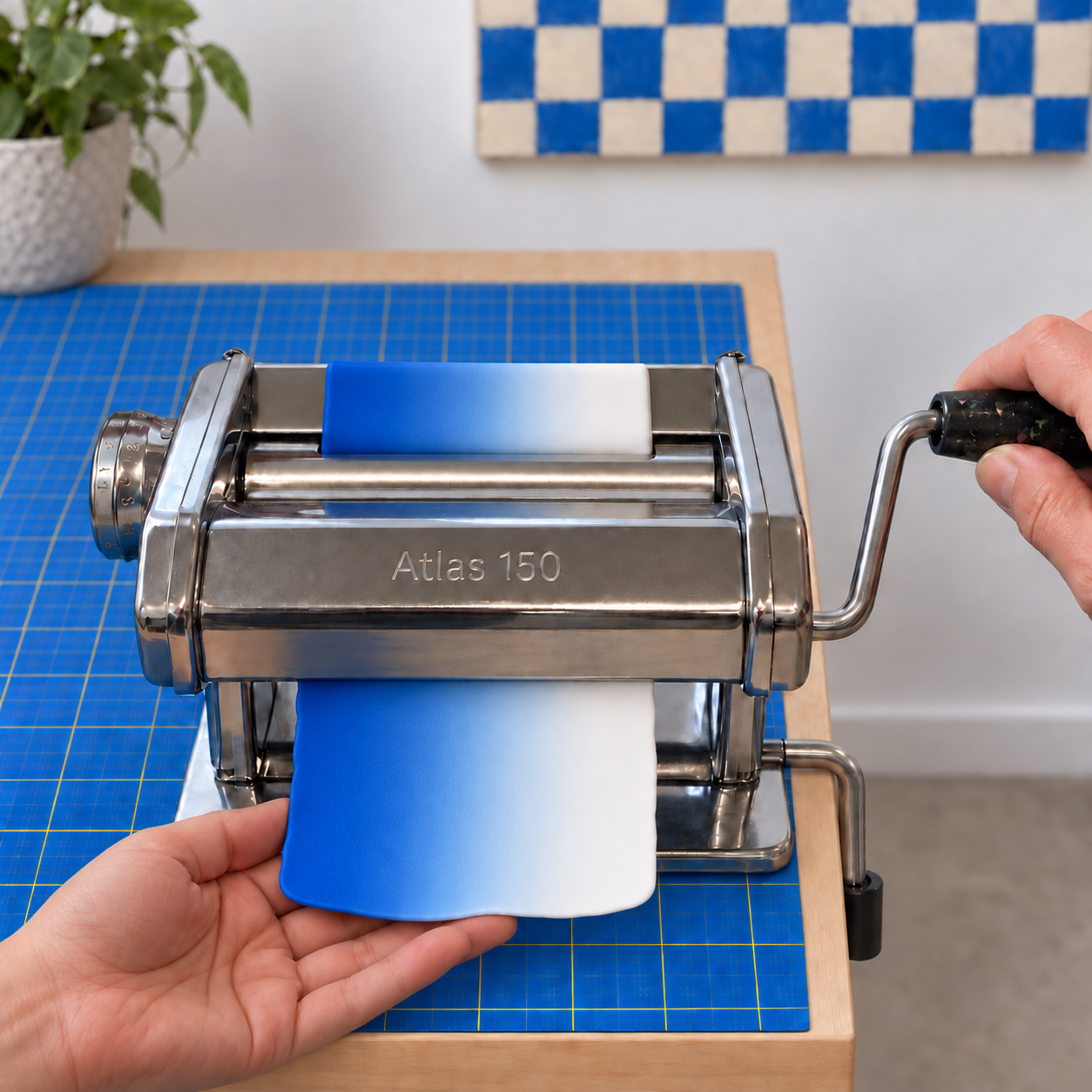
- A pasta machine kept for clay. Your roller width sets the widest blend you can make, because the folded sheet has to fit between the roller ends with room to spread. The Atlas 150 has 150 mm rollers; the Atlas 180 has 180 mm rollers for a wider sheet. The pasta machine guide compares the options before you buy.
- A straight clay blade for a clean sloping cut: search Amazon for a Sculpey blade set with a rigid blade. Handle the cutting edge carefully.
- An acrylic roller. An acrylic roller presses the first join flat and flattens a bulky fold. With no machine, it does the whole blend between two rails; the roller method has the steps.
- A smooth tile or glass mat, kept clean so loose scraps do not get rolled into the white.
- An oven thermometer for baking the pieces you cut at the end; the oven thermometer guide compares them.
How to cut and join the offset layout
For blue fading all the way to white, each side of the sheet needs a strip that holds only that colour. Cutting exactly corner to corner still gives a fade, but each colour then reaches the opposite edge at a corner, so it leaves almost no unmixed colour at the ends. Cut a blue and white blend corner to corner and the white end turns slightly blue quickly: as you fold and roll, the colours soon mix right out to the edges, so the clean white end of the fade is lost. An offset cut keeps a solid strip of each colour at the sides. Start the diagonal a fifth to a quarter of the width in from the top-left corner and end it the same distance in from the bottom-right, so the whole left edge is blue and the whole right edge is white. Most of the mixing then happens between those strips, and the outer edges hold their colour much longer. The strips need to be generous. Leave a few centimetres of solid colour past each end of the diagonal. Each pass through the rollers spreads the blend a little further towards the edges, so without those strips you lose the full blue at one end and the pure white at the other.
- Condition the colours separately. Work the white first, then the blue, and clean your hands, blade and rollers before you handle white again. Both colours should bend without cracking and roll evenly; the conditioning guide explains how to soften a firm block.
- Roll two equal rectangles at the thickest setting. That is setting 1 on Sculpey's machine, the setting Sculpey's instructions start at, and 0 on an Atlas. Make each rectangle as wide as you want the blend, with a margin at each side of the rollers for the sheet to spread, and tall enough to fold in half comfortably. The width runs along the rollers on every pass, so on an Atlas 150, with 150 mm rollers, keep the sheet about 12 to 13 cm wide.
- Cut the diagonal well inside the corners. Start the cut on the top edge between a fifth and a quarter of the sheet's width in from the top-left corner, and end it on the bottom edge the same distance in from the bottom-right corner. On a sheet about 12 cm wide, that is a few centimetres, roughly 2.5 to 3 cm, in from each corner. Keep the two distances equal so both solid strips start the same width. Stack the two rectangles and cut through both at once so the slopes match.
- Join the blue left piece to the white right piece. Fit the two pieces together along the diagonal: butt the cut edges together with no gap and no raised ridge, and roll the join flat with the acrylic roller. The joined sheet has a blue section about a fifth of the width along its top edge and a white section the same length along its bottom edge. The two spare pieces make a second blend with the colours swapped.
- Check both side strips. Follow the left side from top to bottom: a band of solid blue a few centimetres wide should run the whole way. Do the same on the right with white, and check the two bands are the same width. The join must stop well short of both side edges.
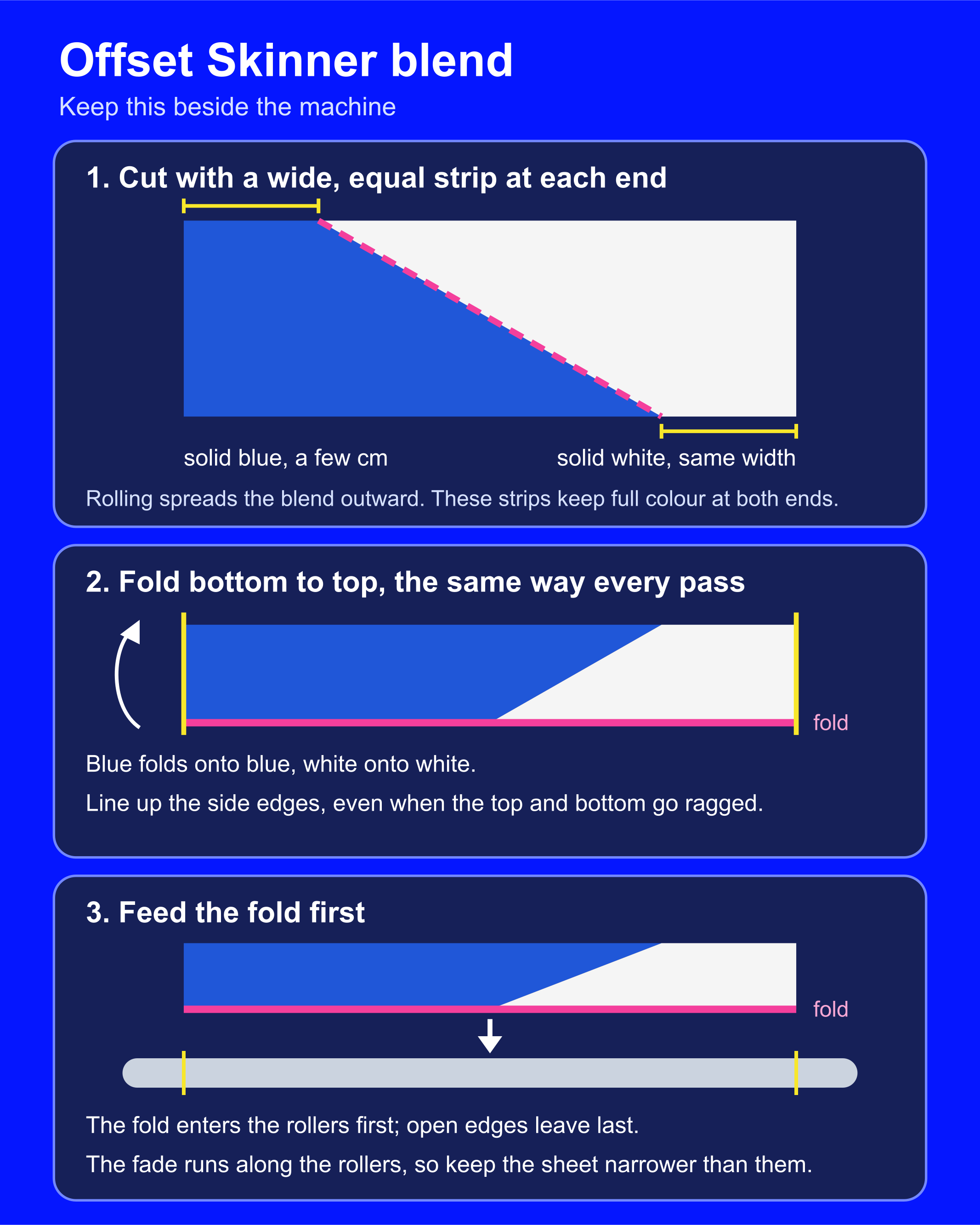
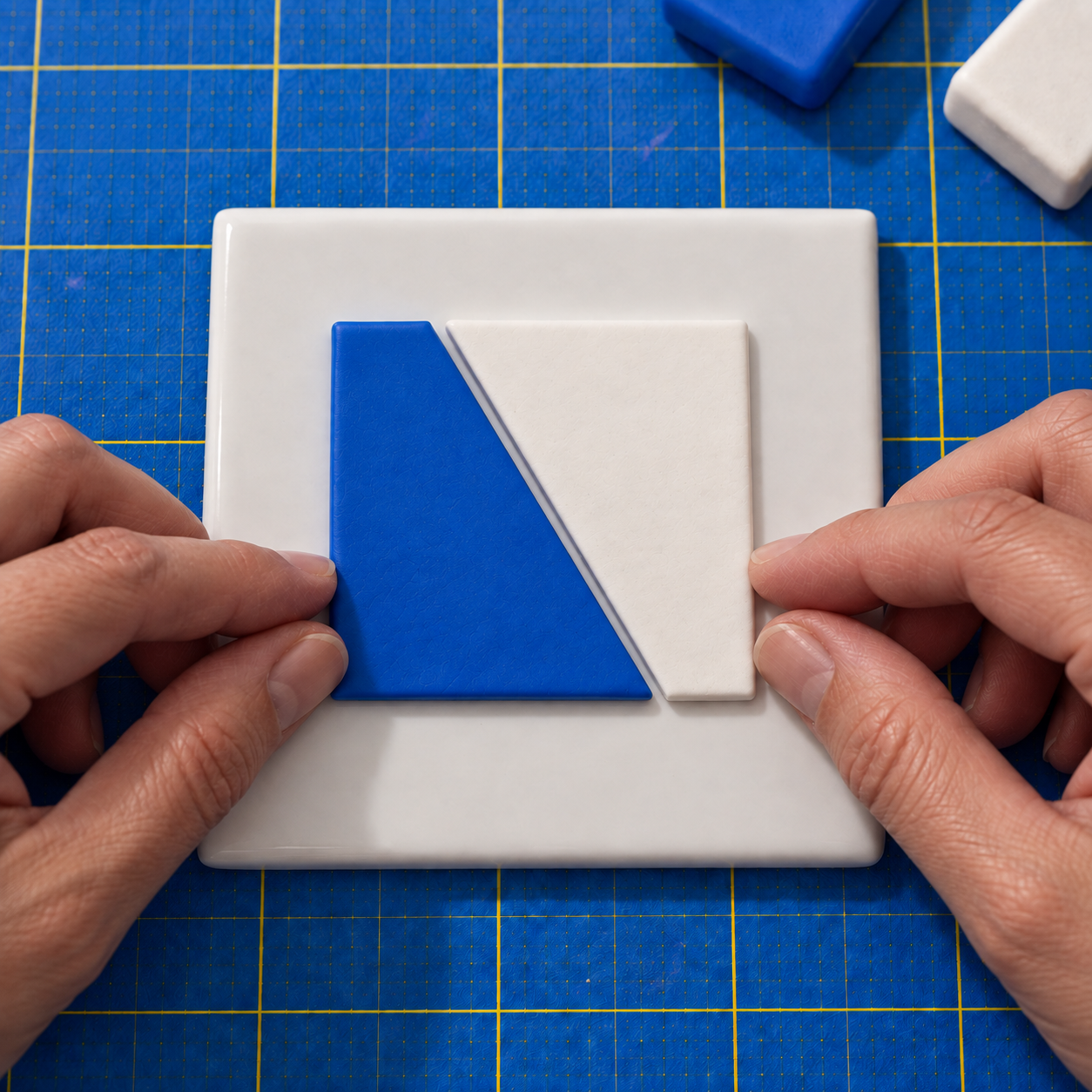
The offset sets the balance between solid colour and fade. Cut between a fifth and a quarter of the width in from each corner and the fade spreads across roughly the middle half of the sheet, with a wide solid band on each side. Each pass spreads the blend a little further towards both edges, so start the solid bands wider than you want them to finish. A wider offset gives more solid colour and a shorter, steeper fade; a much narrower one gives a longer fade but loses the pure ends.
Why the fold direction matters: imagine narrow strips running from the top of the sheet to the bottom. One near the blue side holds mostly blue, one in the centre holds both colours equally, and one near the white side holds mostly white. Folding bottom to top mixes the clay within each of those strips, never between them, so each strip becomes one even shade and the strips side by side make the fade.
One layer of each colour, or two?
One layer is enough. Stacking two layers of each colour gives you more clay, so the finished sheet is longer at the same width, but it does not stop the sideways spread covered below: the rollers press the clay back to the same gap on every pass. If you do stack, flatten the joined clay with the acrylic roller until it feeds without forcing the handle.
The fold rule: bottom to top, fold first, every pass
Make the first pass unfolded: feed the joined sheet with both colours meeting the rollers side by side. Keep fingers, loose sleeves and hair clear of the rollers. Then, before every pass after that:
- Lay the sheet down the way it came out of the rollers, blue on the left and white on the right.
- Lift the bottom edge and bring it up to meet the top edge. Blue folds onto blue and white folds onto white.
- Line up the two side edges so they sit exactly on top of each other. After a few passes the top and bottom edges go ragged; ignore them. Matching ragged top corners instead of the sides skews the fold, and a skewed fold smears colour across the middle.
- Feed the folded edge into the rollers first, at the same thickest setting.
The fold goes in first so that air can escape. As the rollers close on the fold, air caught between the two halves is pushed towards the open edge and out, instead of being sealed inside where it would become a blister. The conditioning guide's air bubble section shows how to release one that does get trapped.
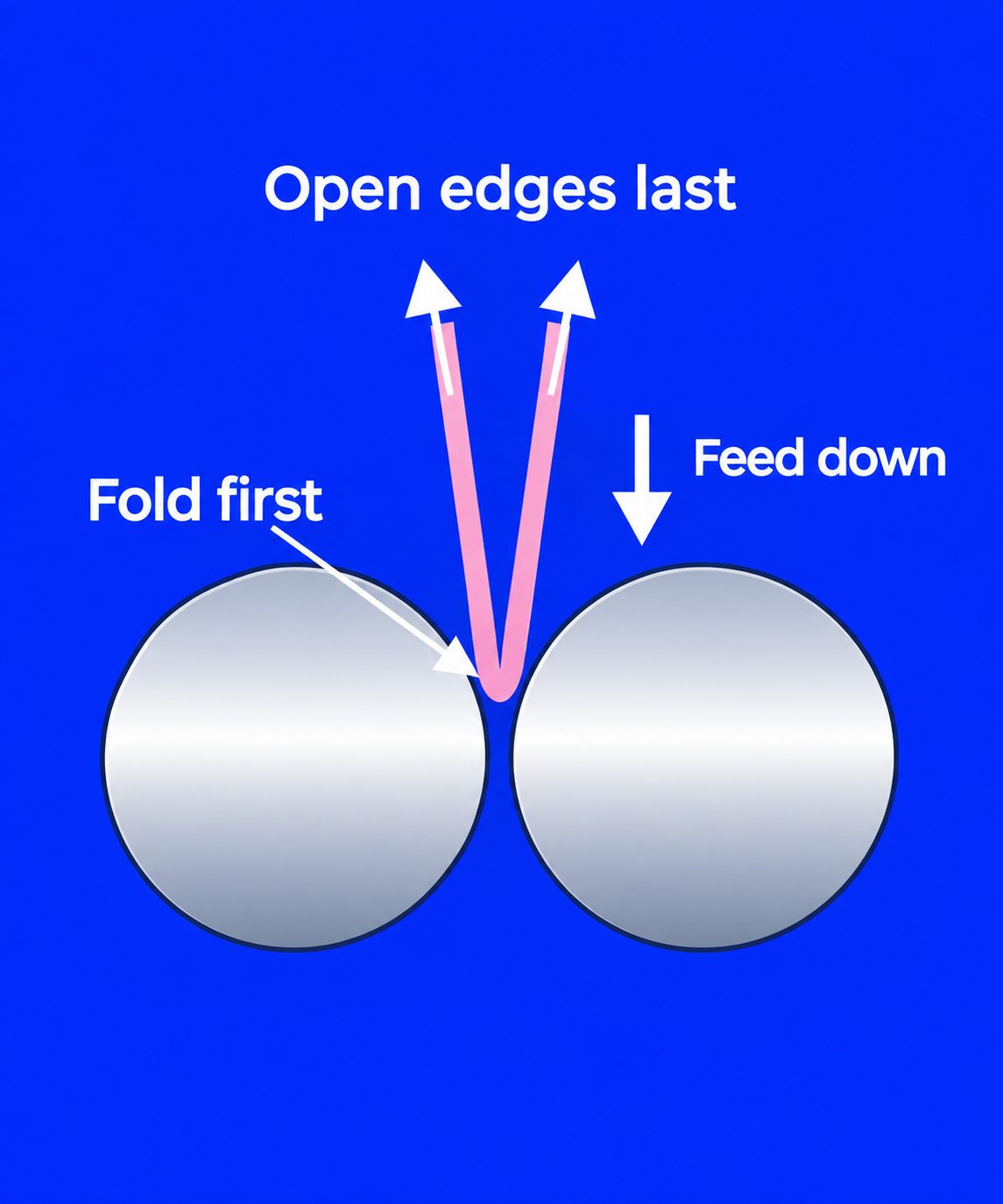
The folded sheet goes in at double thickness and comes out at the roller gap again. If it resists, flatten the fold a little with the acrylic roller rather than forcing the handle.
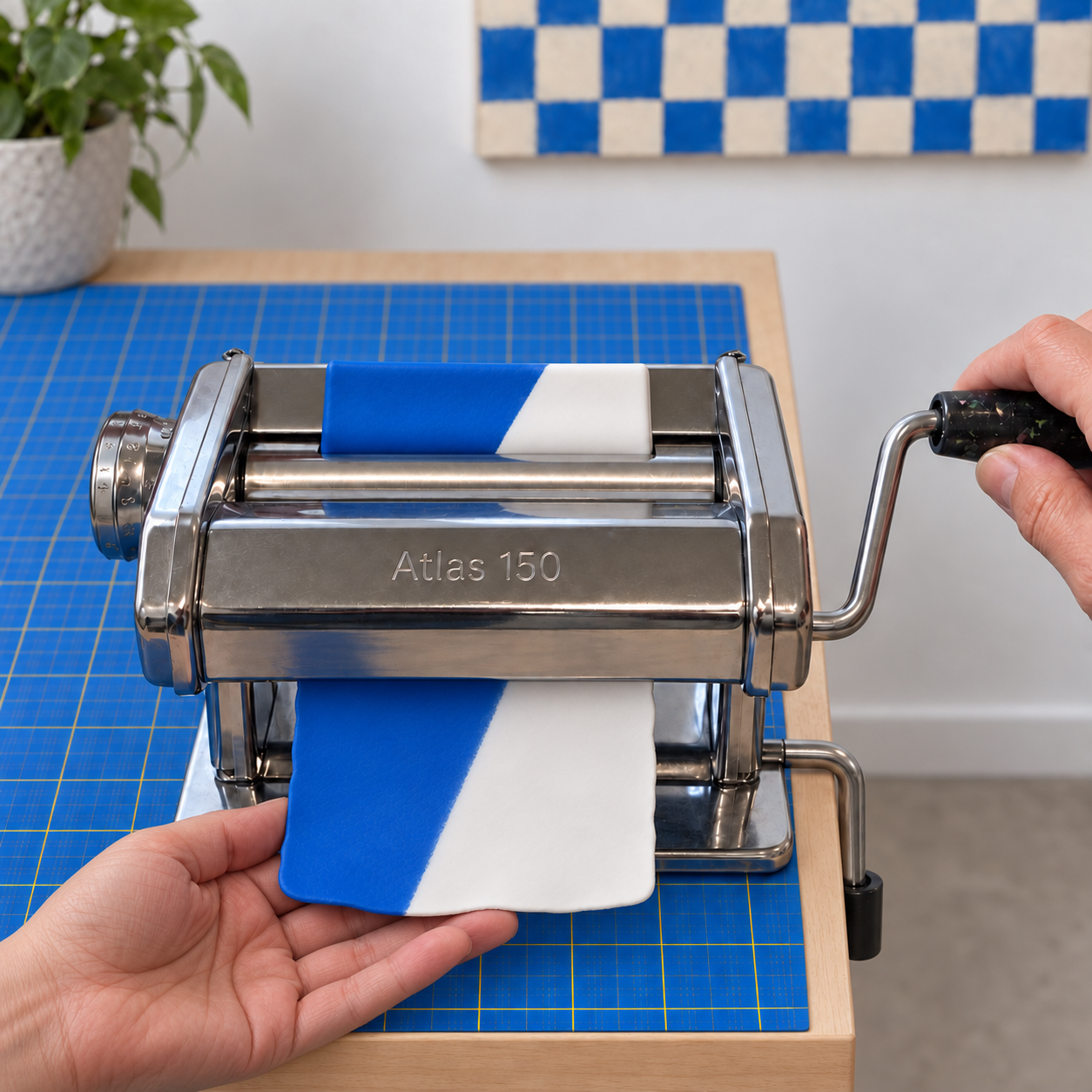
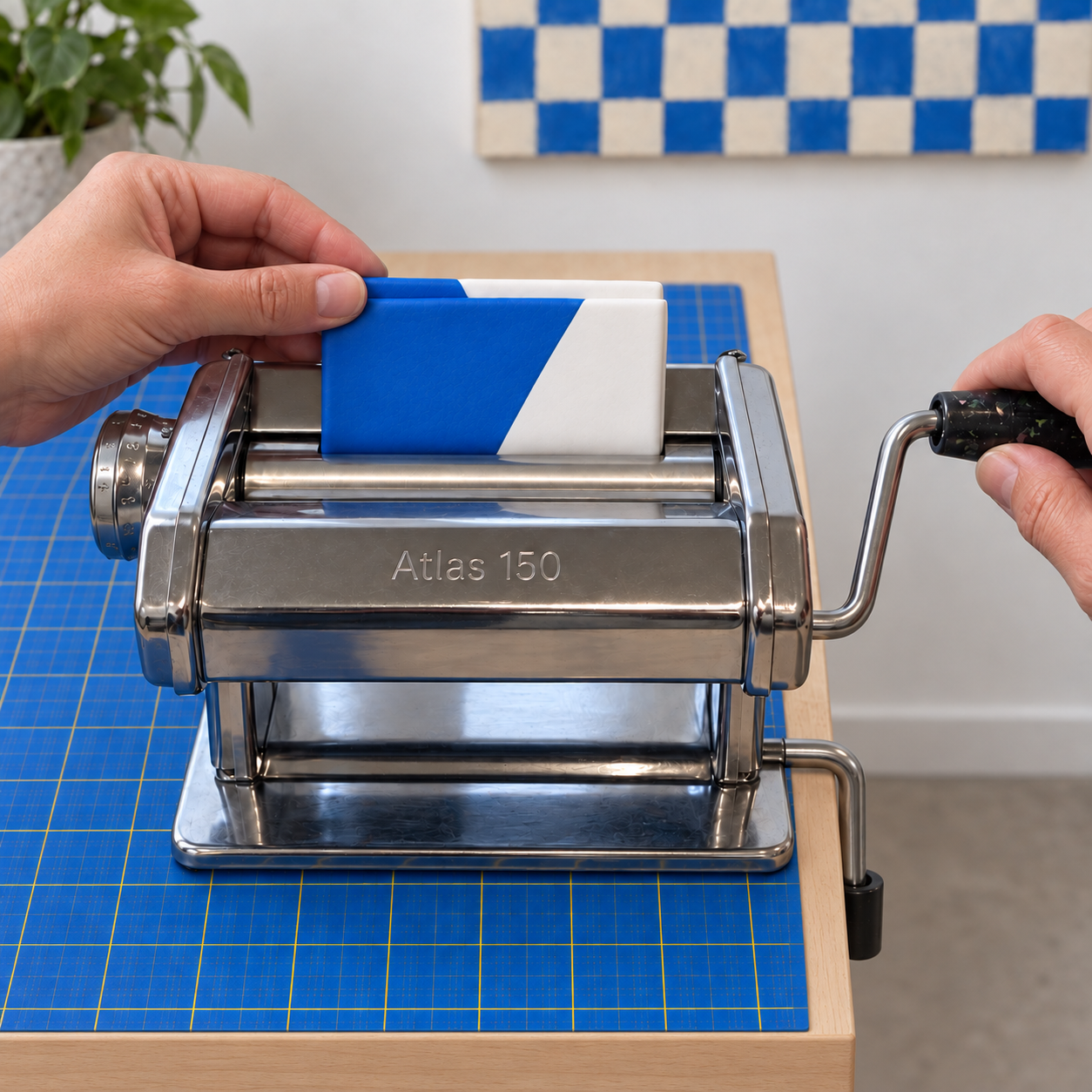
After the first fold, the half you folded up shows the join sloping the opposite way to your original cut, and the two faces of the sheet can look different early on. That is normal: the lines break into bands that soften with each pass. Turning the sheet a quarter turn, or folding blue onto white, mixes the colours across the whole sheet instead of shading each strip, so keep the orientation the same every time.
How many passes, and when to stop
Sculpey's instructions repeat the fold and roll about 20 times for a two-colour blend, and about 20 to 25 times for a rainbow. Treat 20 as the point to start judging, not the finish line. Another polymer clay manufacturer's instructions set no number at all, because it depends on the colours, how opaque or translucent the clay is, and how smooth you want the fade.
Expect distinct stripes after the first few passes, then narrower bands that start to merge in the middle of the sheet. Stop when blue passes through pale blue into white with no line you can point to. Extra passes in the same orientation keep smoothing the fade without making it muddy, as long as the side edges stay lined up, but each one spreads the blend a little further into the solid strips. Stop earlier on purpose if you like the striped look. If you want colours that swirl rather than fade, the marbling tutorial covers that.
The same blend with an acrylic roller and rails (no pasta machine)
You can make the whole blend with an acrylic roller and two rails of equal height. The layout, the fold rule and the finished fade stay the same; the roller replaces the machine on every pass, and the rails keep the sheet one thickness. Expect it to take longer, with more effort on each pass, because you are pressing a doubled sheet back down by hand.
Put one rail on each side of the clay and roll with the roller spanning both. Once the roller rests on both rails along the whole sheet, the clay is the same thickness as the rails everywhere. Start with rails about 3 mm tall; what matters most is that both rails are the same height. Three ways to get a pair:
- Playing cards. Count the same number of cards from one deck into two stacks, and check each stack against a ruler until it reaches about 3 mm. Keep both stacks neat so they stay the same height.
- Ready-made rails. Search Amazon for ready-made metric thickness guides and choose a pair labelled with the thickness you want.
- Printable rails, coming soon. Clay Bake Studio's slab height guide kit, a set of rails in labelled thicknesses, is listed on the tools page as coming soon. It will be a digital download, so you will need a 3D printer or print service to make the rails.
- Roll both colours between the rails. Roll each conditioned colour until the roller rests on both rails, then cut and join the offset layout exactly as above.
- Flatten the join. Roll across the joined sheet, rails beside it, until the join lies flat and the roller reaches both rails along the full length.
- Fold bottom to top with the side edges lined up, as in the fold rule.
- Roll from the fold towards the open edge. Start on the fold and push towards the loose edges, so air leaves through the open side for the same reason the machine takes the fold first. Roll until the roller rests on both rails again, keeping the sheet on the surface so you do not stretch one corner.
- Check and repeat. If the sheet has spread too wide for the rails, ease the side edges in as the next section describes before you fold again. Keep the same rails for the whole blend and change height only when you roll to project thickness.
After each pass, check that the roller rests on both rails along the whole sheet. If it rocks, or touches one rail and not the other, that part of the sheet is still thicker than the rails, so roll it again.
Keep the blend inside your roller width
Folding and rolling back to the same gap pushes some clay sideways on every pass, so the sheet tends to grow wider rather than longer. Start a blend from thin sheets and it keeps getting wider on every pass until it is too wide for the machine. Correct it early:
- Feed the fold straight, with both ends of the fold reaching the rollers together. Feeding one corner first drags the sheet out of square.
- Alternate the edge against the machine side. Run the blue edge beside the left end of the roller opening for one pass, then slide the sheet across so the white edge runs beside the right end on a later pass. The fold still enters first.
- Ease the sides in along their whole length. With the sheet folded, press each side edge inward with your finger pads in small moves from top to bottom. Squeezing only the corners leaves a wide bulge in the middle; flatten any bulge with the acrylic roller before feeding.
- Switch to the roller if it still will not fit. Finish the blend between rails as described above, rather than trimming off the solid strips you set out to keep.
Roll the finished blend to project thickness without losing the fade
Finish blending first, then thin the sheet. Feed an edge that holds both colours, so the fade keeps running across the sheet from side to side.
- Lay the sheet flat with blue on the left and white on the right, and move the machine one setting thinner.
- Feed the top or bottom edge, the one with blue at one end and white at the other, so both colours enter the rollers side by side. Do not fold between these passes.
- Support the sheet as it comes out so its weight does not stretch it, and go down one setting at a time until you reach the thickness your project needs.
- Check the thickness before cutting. Setting numbers differ between machines, so measure what each setting rolls on yours or compare the sheet with the thickness guides your project uses. If you came from a build kit, your kit guide lists the slab thickness.
With an acrylic roller, swap to a pair of rails at your project thickness and roll the unfolded sheet, colours still side by side, until the roller rests on both rails.
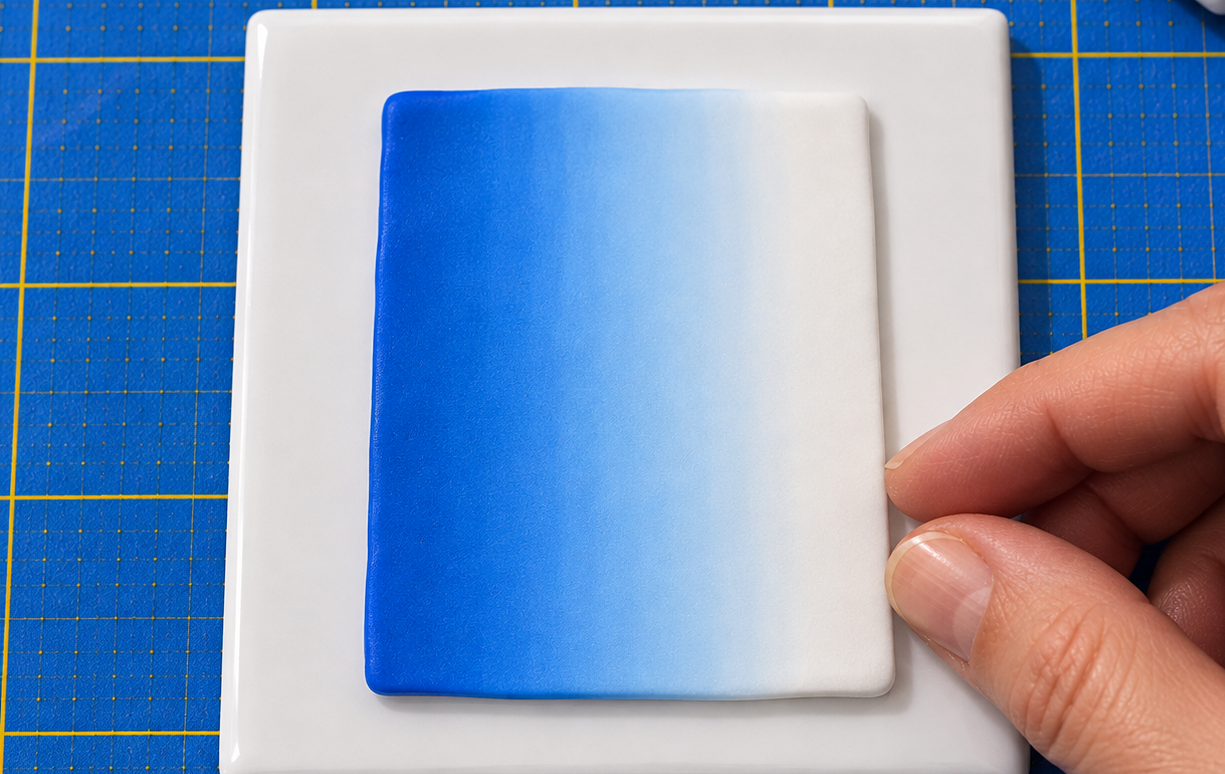
For a squarer sheet: each thinning pass lengthens the sheet from top to bottom, so a wide, short blend gets squarer as you thin it. Stop at your project thickness. If the sheet is already thin enough, ease the sides in instead, or trim a square that still includes the colour range you want. A large, thick square needs more clay at the start; changing the fold cannot make one from a small amount.
Cut an ombre pair or a graded set
Place every cutter before you press any of them, so each shape spans the part of the fade you want. A cutter sitting wholly in the solid white strip gives a plain white piece, not an ombre one.
- Matching pair. Turn the sheet so the fade runs from top to bottom. Place both shapes side by side with their tops at the same height, so each earring shades the same way.
- Mirrored pair. For a fade that runs across each earring from side to side, keep the fade running left to right and place the two shapes one above the other, in line, so each spans the same part of the fade. Turn one piece over after cutting. In a finished blend the colour runs through the full thickness, so the turned piece shows the fade running the other way.
- Contrast pair. Cut one shape from the blue end and one from the white end.
- Graded set. For a multi-link piece, cut the links in order along the fade: the top link nearest the blue end, each link below it a step further along, and the drop nearest the white end. For a pair of earrings, lay the two runs side by side so each link has a twin at the same point in the fade. The Go-Go linked dangle earrings build kit suggests a gradient from disc to drop as one colour swap; its cutters are a digital download that needs a 3D printer or print service.
The arch and hoop guide covers shape and connection choices, and offcuts suit smaller shapes. Bake by the directions on your clay's packet, check the oven with a thermometer beside the tile, and let the pieces cool before assembly.
Turn the blend into a long strip or a plug for canes
For canes, you stretch the fade along a long strip instead of keeping it across the sheet, then fold or roll the strip into a block or log.
- Stretch the fade into a strip. Feed one solid-colour side edge first, unfolded, and go down the settings one at a time. Each pass lengthens the sheet in the direction the fade runs, so blue at one end and white at the other become a long ribbon. One long-running cane tutorial works from the thickest setting down to about the third-thinnest.
- Fold it into a plug. Fold the strip back and forth like a fan, the same width each time, from one end to the other. Press the stack together into a block, which pushes out air between the layers. The block's colour now runs from blue on one face to white on the opposite face.
- Check for air. Cut the plug in half. If you see gaps or bubbles between the layers, press it together again.
- Or roll a bullseye log. Instead of folding, roll the strip up tightly from the end whose colour you want in the centre. Sculpey's instructions start the roll with a thin log of clay in that end colour, roll very tightly, then reduce the cane gently, working from the middle out to the ends.
The cane guide walks through a first small patterned cane.
Three colours, a rainbow, and fading to white or black
More colours change the layout, not the fold rule. Lay tall triangles of each colour side by side in the order you want across the sheet, alternating point up and point down so they fit together into one rectangle. Each colour touches only its neighbours, so the sheet fades from one to the next. Square off the ends by cutting a triangle in half down its middle, as Sculpey's rainbow layout does. Fold bottom to top and feed the fold first exactly as before; Sculpey's rainbow takes about 20 to 25 passes.
Check what each neighbouring pair makes before you commit whole blocks. Mix a pea-sized piece of each colour together. Colours opposite each other on the colour wheel, such as purple and yellow, mix to a dull brown, and that brown will sit in the middle of their fade. If a test comes out dull, put a bridging colour between them that mixes cleanly with both, such as red between purple and yellow. The colour-mixing swatch guide shows how to mix and compare small test amounts.
Fading a colour to white gives a run of paler tints of that colour; fading to black gives darker shades. Black and other strong, dark colours change a mix a lot, so they can take over the fade. Mix a pea-sized test first, and if the midpoint is much darker than you want, move the sloping cut towards the strong colour's side so its piece is smaller.
Fix a Skinner blend: symptom, cause and fix
| Symptom | Likely cause | Fix |
|---|---|---|
| Muddy, grey or brown middle | The two colours mix to a dull shade, as colours opposite each other on the colour wheel do; or the side edges slipped out of line, so the folds were skewed. | Line up the side edges on every fold and ignore a ragged top edge. For the next blend, mix a pea-sized test first and add a bridging colour if it comes out dull. |
| Air bubbles or blisters | Air caught in the fold, for example when the open edge went into the rollers first or the fold was not pressed closed. | Slide a needle or pin into the side of the bubble at a shallow angle, press the air out towards the hole and roll again. Feed the fold first on every pass. |
| Streaks or bands that will not soften | Not enough passes yet, or the sheet was turned or folded blue onto white. | Lay it down with the same colour on each side, fold bottom to top and keep going. Early bands are normal and are not a reason to start again. |
| A hard line where the fade meets a solid end | A very wide offset, a third of the width or more, squeezes the whole fade into a narrow middle, so the colour starts changing sharply at the edge of the solid strip. | Shift one or two folds slightly sideways towards that end to soften the edge; this moves a little colour into the solid strip. Next time, start the cut between a fifth and a quarter of the width in from each corner. |
| White end turning blue | No solid-white strip in the layout (a corner-to-corner cut), a strip too thin to last through the passes, folds slipping sideways, or blue residue on the rollers or your hands. | Start the diagonal cut a fifth to a quarter of the width in from each corner so a solid strip of each colour, a few centimetres wide, runs down both sides, line up the side edges on every fold, and clean the rollers and your hands before handling white. |
| The middle looks mostly blue | The blue is stronger than the white, so equal amounts do not give a balanced midpoint. | Mix a pea-sized test of equal blue and white. If it is much darker than the midpoint you want, move the sloping cut towards the blue side so the blue piece is smaller. |
| Sheet too wide for the rollers | Clay spreads sideways a little on every pass. | Feed straight, alternate the edge against the machine side and ease the sides in, as in the roller width section. If it still will not fit, finish between rails. |
| Clay sticks or smears | The clay is too soft or warm. | Stop rolling so you do not keep smearing the sheet; the soft and sticky clay guide explains how to firm it up. |
More guides in this path
Open these when the next decision is material choice, attachment, or finishing.
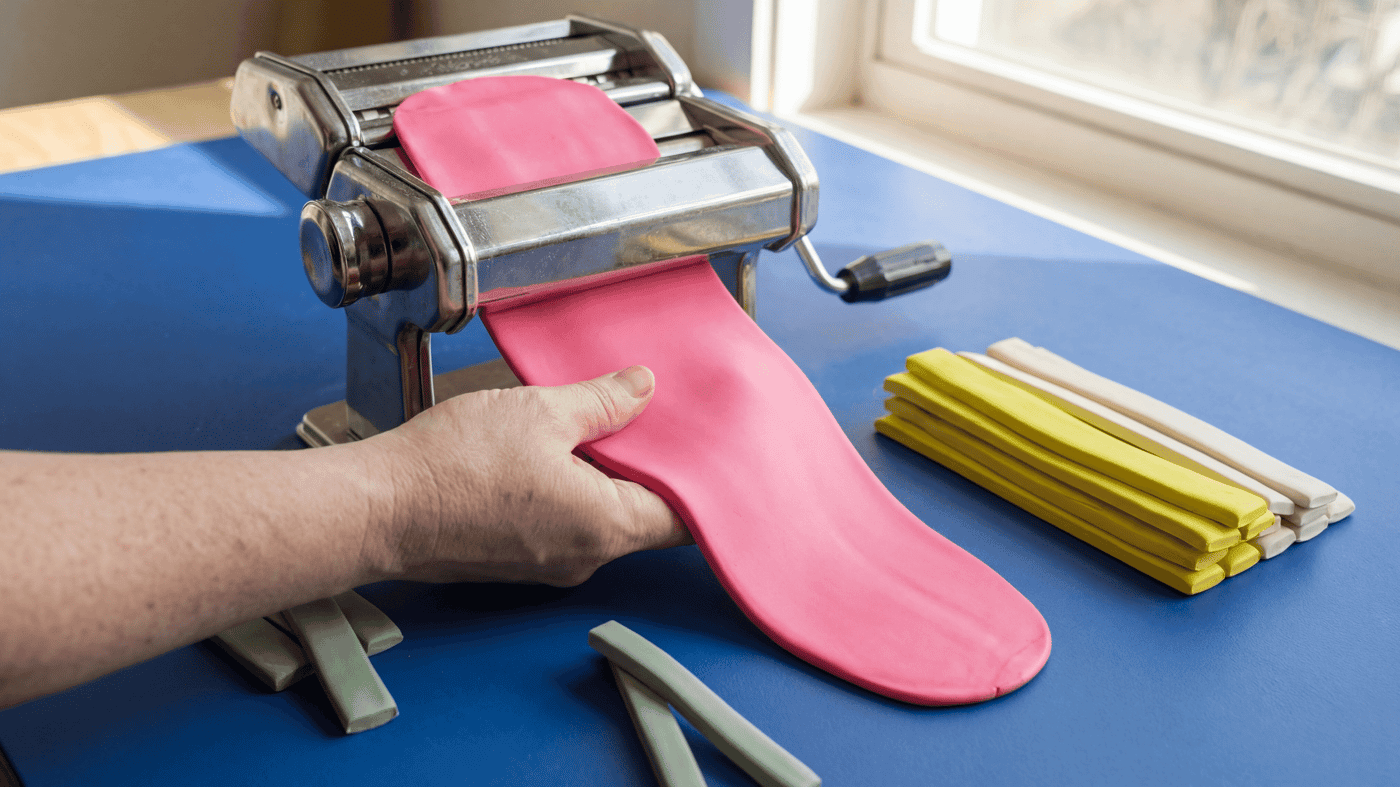
How to condition polymer clay and roll an even slab for cutters
Get every clay colour to the same softness, roll each layer to its measured thickness on a tile, and let warm clay firm up before you cut.
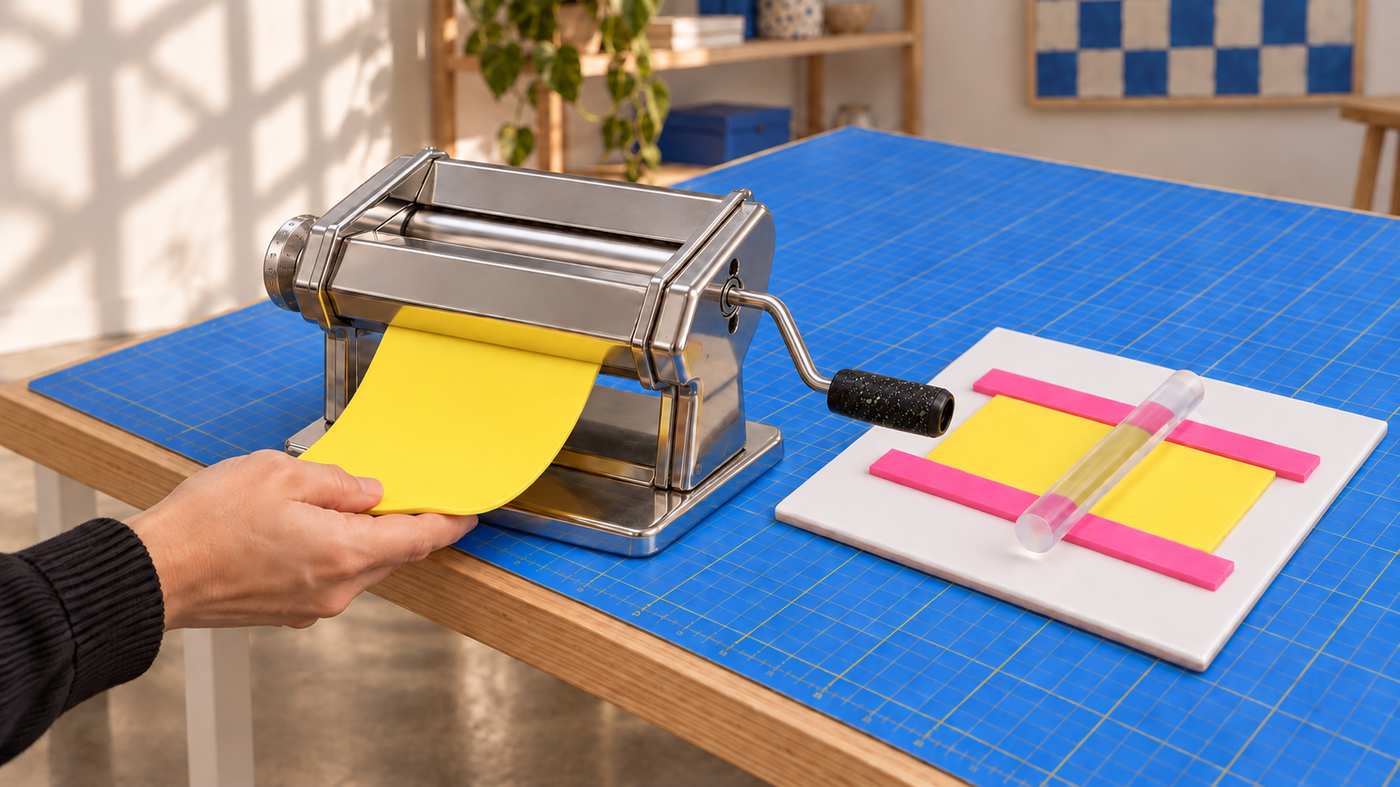
Best pasta machine for polymer clay: Atlas, Sculpey, Makin's or a roller
Buy the Marcato Atlas 150 for earring slabs and blends, or the Atlas 180 for slabs over 14 cm wide. Measured widths, thickest settings and lower-cost machines, compared.
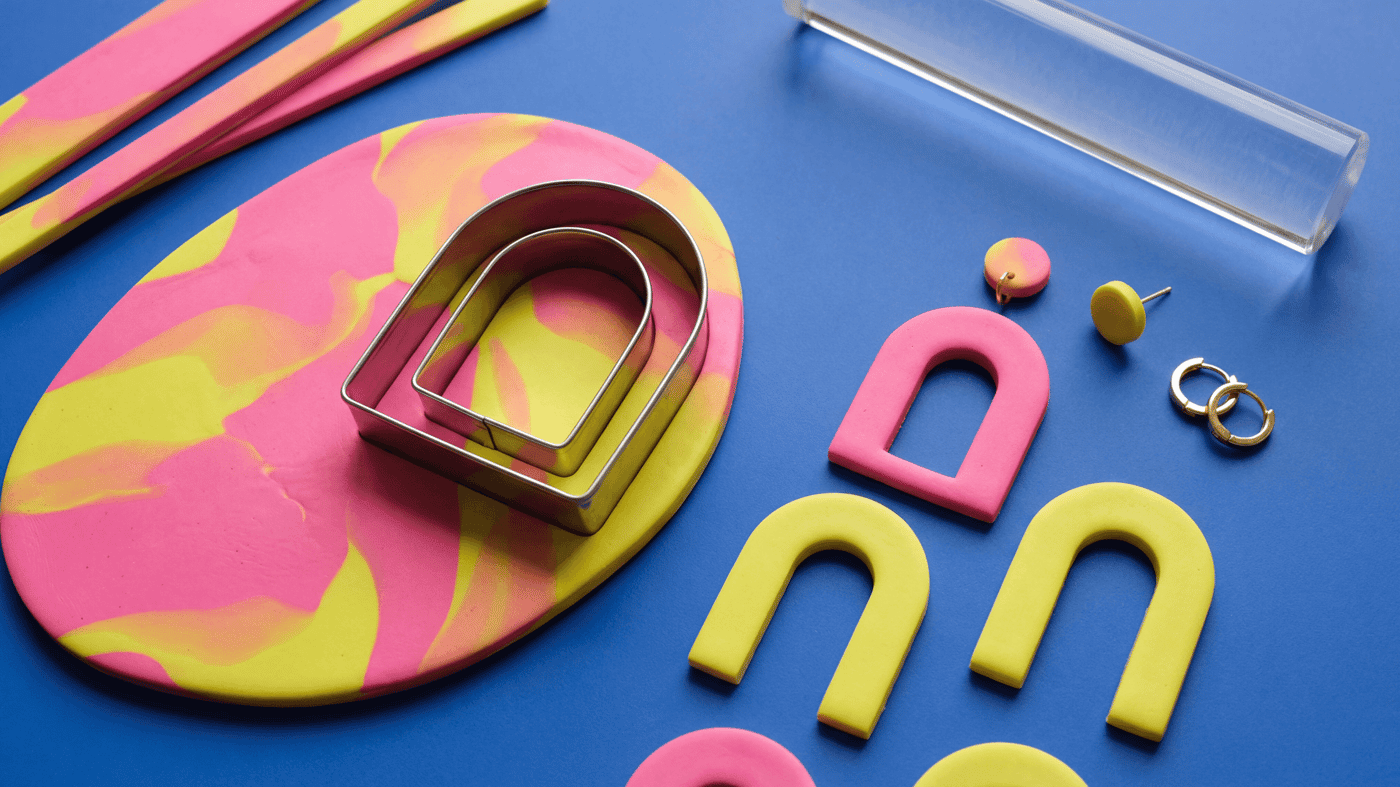
Polymer Clay Cutout Arch Earrings and Hoop Drops
Cutout arches and hoops work best when the wall width is even, the inner opening matches the outer curve, and the hardware choice is made from the finished front view.
Finished examples with related clay decisions
Each piece shows how a material, attachment, or surface choice changes the final form.