Layered cutters
14 3D-printable filesThree matching cutters build each layered flame.
- Four sizes from 32 to 48 mm, plus a two-cutter 22 mm stud set.


View all 5 tool previewsShow fewer tool previews


3D print the tools. Make it in clay.
3D print the cutters, then cut and stack polymer clay into Pixel Flame earrings, keychains, pendants, magnets, brooches and wall art.
Digital download: STL files to 3D print, plus a PDF guide. Requires a 3D printer or 3D printing service.


24 3D-printable STL files, an illustrated maker guide and the Maker Licence.
Three matching cutters build each layered flame.
The outline and flame steps in one slab.


An 85 mm flame for wall art or an earring display.


Sizes name the height, from the top pixel to the base. Dimensions are the clay flame's width and height at 100% print scale, not the cutter's outside dimensions.
20 mm at the outlines' scale. Not an actual-size template.
Every layered cutter and the relief cutter comes in all four flame sizes. Relief flames make 22 mm studs, pendants, charms, magnets and brooches, never drop earrings or dangles. The 22 mm studs have their own simpler cutters: two layers, or one relief slab.
| Outline to scale | Size | Clay outline (W x H) | Methods | Use it for |
|---|---|---|---|---|
| 22 mm | 20 x 22 mm |
| Stud earrings on flat-pad posts (their own two-layer or relief cutters) | |
| 32 mm | 29 x 32 mm |
| Light drop earrings or ball-post dangles (layered), pendant, charm, magnet or brooch | |
| 36 mm | 32 x 36 mm |
| Everyday drop earrings or ball-post dangles (layered), pendant, charm, magnet or brooch | |
| 40 mm | 36 x 40 mm |
| Bold drop earrings or ball-post dangles (layered), pendant, charm, magnet or brooch | |
| 48 mm | 43 x 48 mm |
| Statement drop earrings (layered; weigh them), pendant, charm, magnet or brooch | |
| 85 mm76 x 85 mm |
| Wall art display, with a pair of 32 mm drops or on its own | ||
Making methods
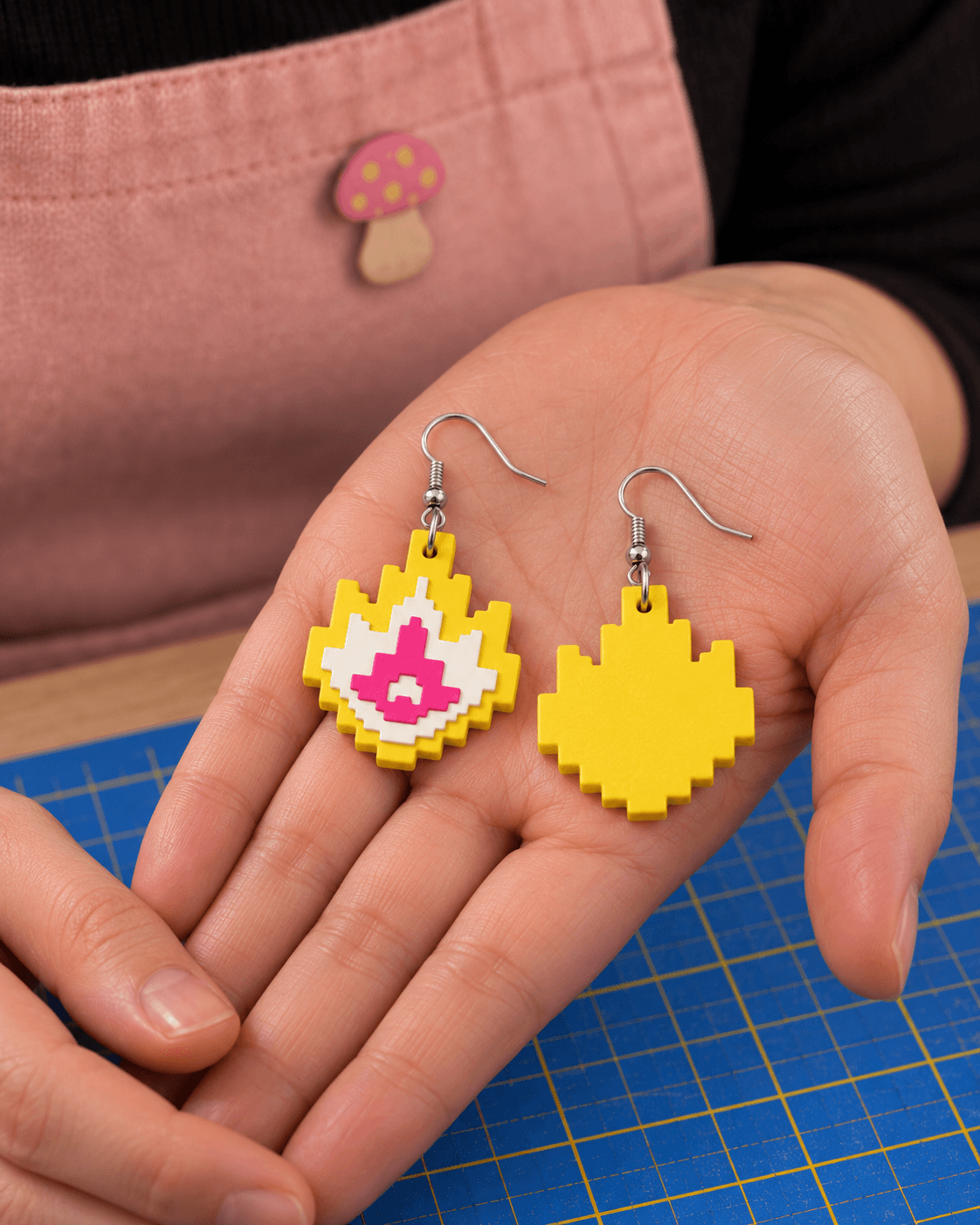
Make a matching pair (not mirrored), with yellow, white and magenta layers positioned by hand. The hanging hole goes through the flame's own top pixel. The separate relief cutter presses the whole flame into one slab of one colour.
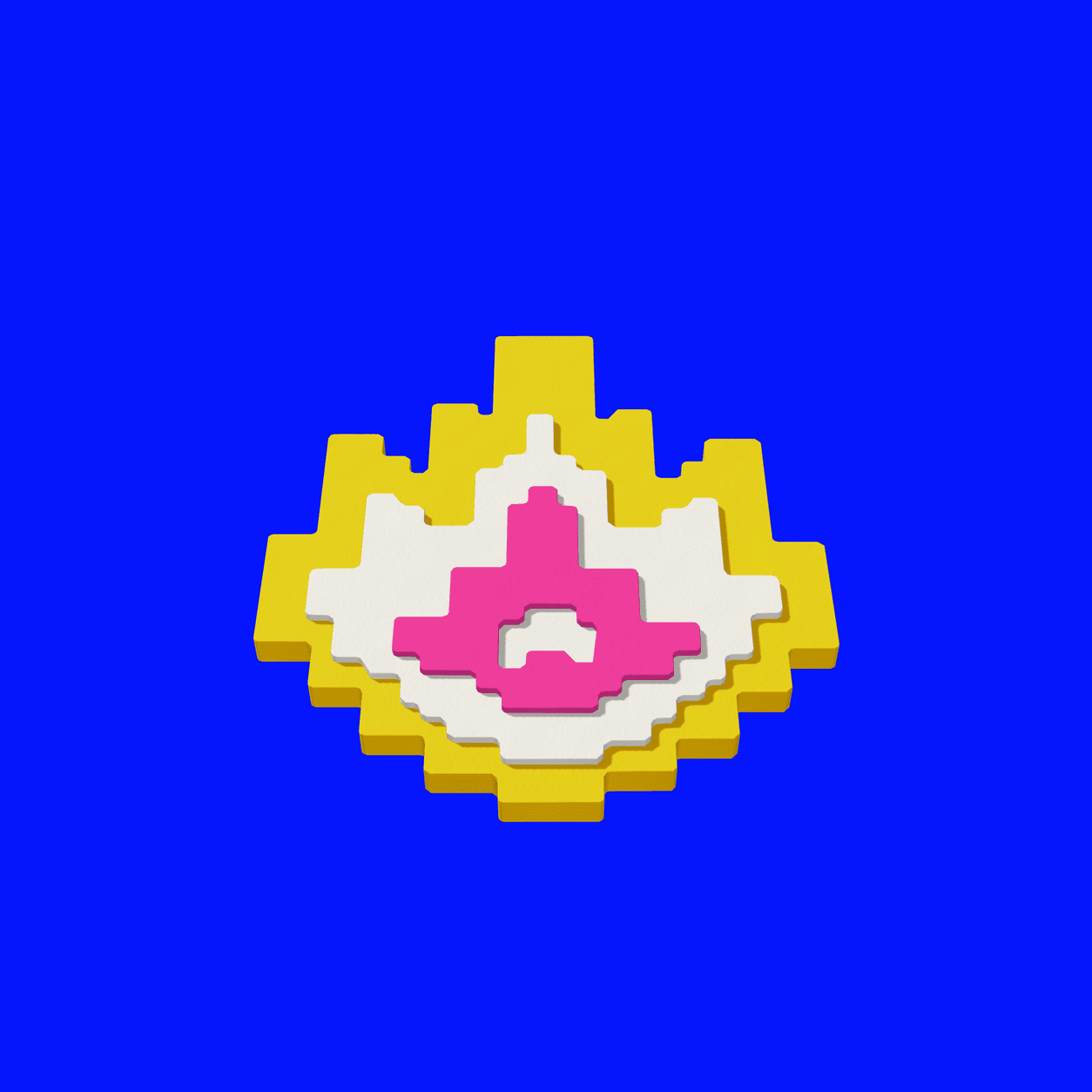
Three cutters make the 32 to 48 mm flames and the 85 mm wall display: cut the base, white field and windowed core from separate clay slabs, then stack them. The 22 mm studs use two cutters, for a base and core.
See the yellow base, white field and magenta core after cutting, then the three-layer Flame. The small core window is shown with its plug retained and cleared, followed by earring, pendant, brooch, keychain, magnet and wall art finishes. Follow the PDF guide for the full making method.
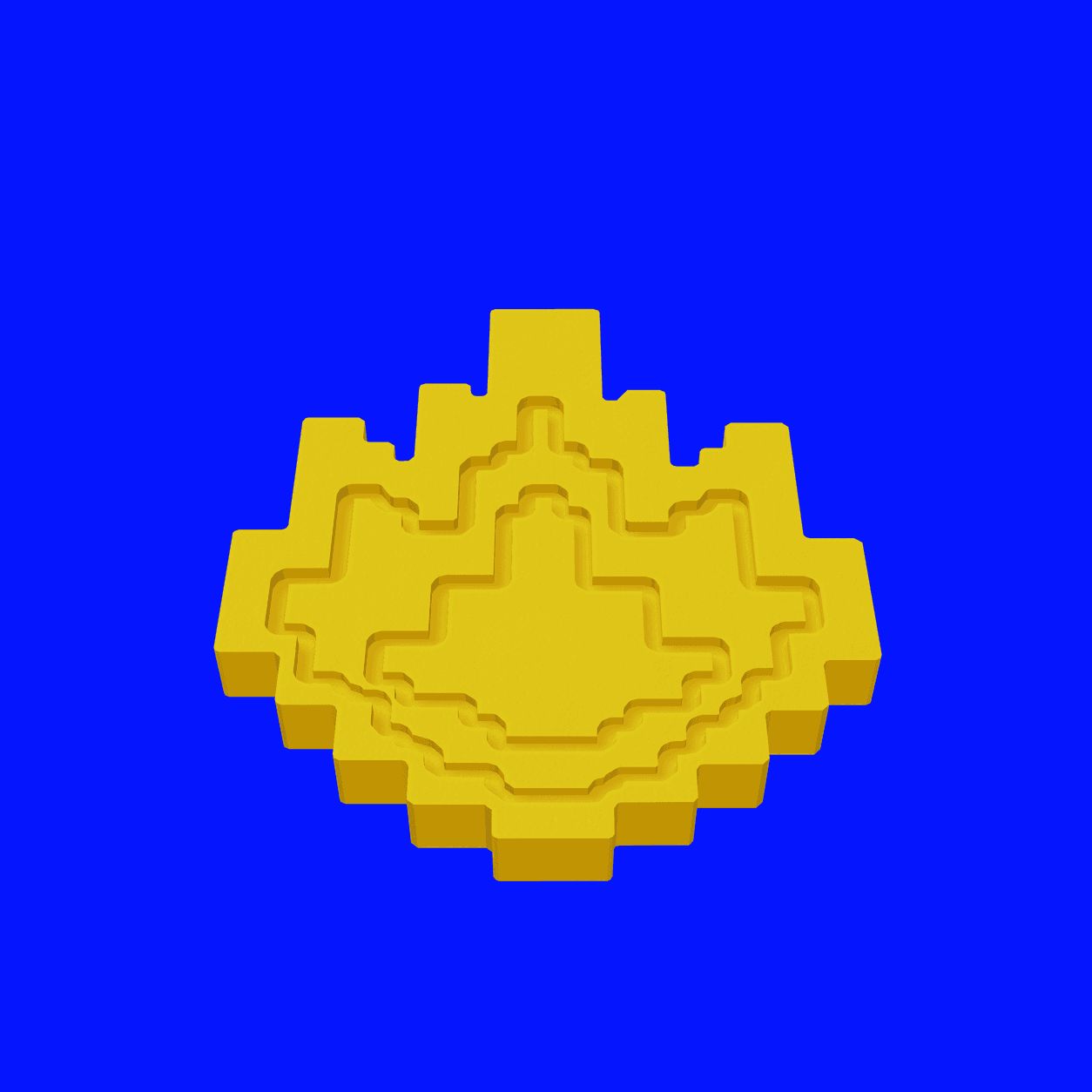
One cutter cuts the outline and presses the flame steps into a single slab of one clay colour. Paint the baked flame if you like. Suits 22 mm studs, a magnet, brooch, pendant, keychain or display piece.
See the Flame detail impressed in one clay slab and the outline after the surrounding waste is cleared. Relief pendant, keyring and magnet examples follow, then a separate layered wall art display. Follow the PDF guide for the full making method.
Your first piece
Print only the files for the piece you are making; the rest are there when you want another size or method.
A single press cuts the outline and presses the flame steps into one slab. Leave it one colour or paint the recesses after baking.
See what you needBoth flames are cut the same way round, so the pair matches rather than mirrors. About 4.5 g per earring with its ear wire and jump ring (an estimate; weigh each finished earring).
See what you needThe same stacking method in a slightly smaller flame. About 3.8 g per earring with its ball post and jump ring (an estimate).
See what you needWall art display
Cut, stack and bake the same three layers at 85 mm tall and the flame becomes wall art that holds a pair of 32 mm drop earrings. Make it in any colours.
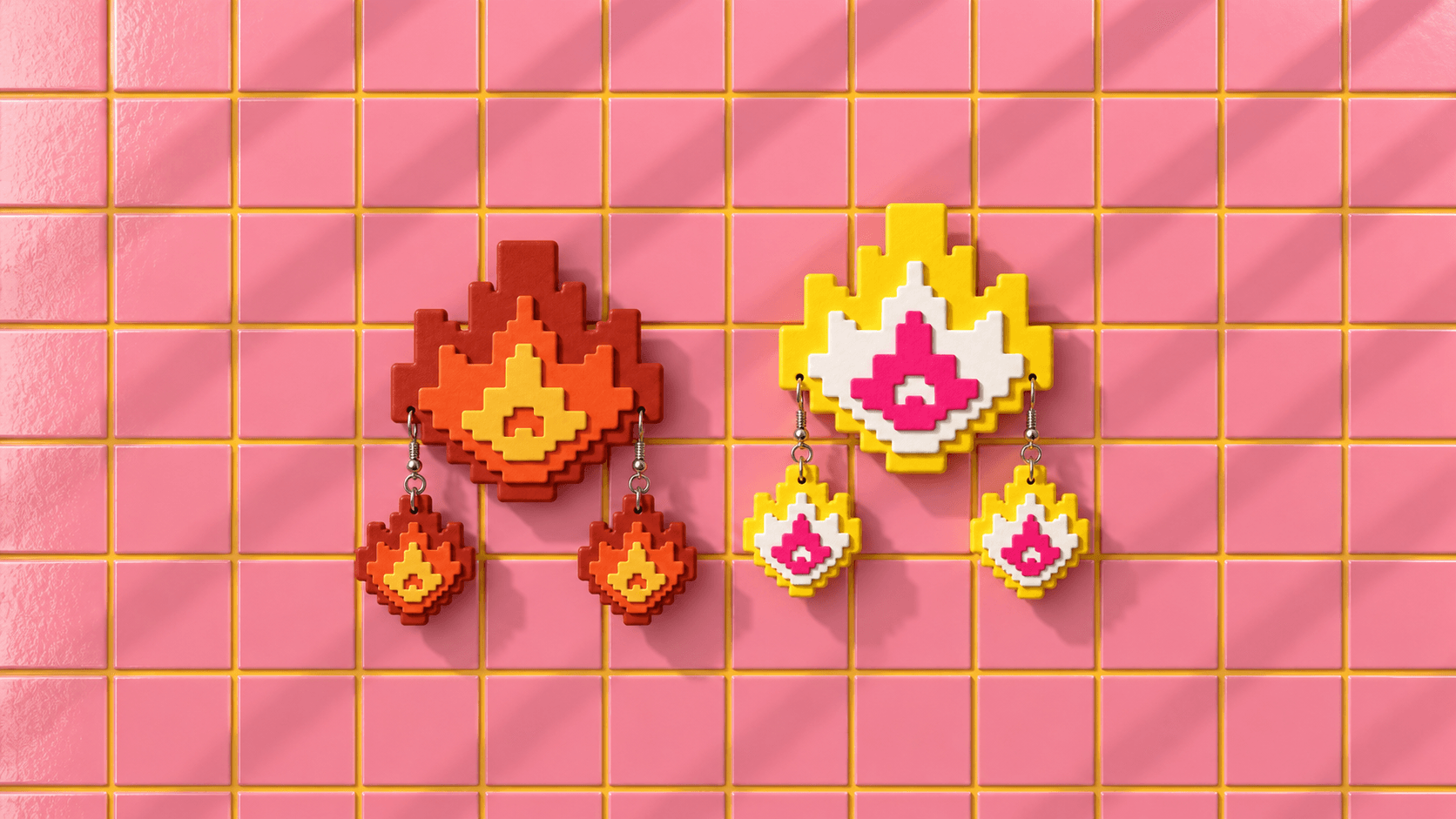
Cut and layer each flame, make its hanging hole, then bake and connect the findings. The guide gives the full method, layer placement and attachment instructions.

Step 01
Cut two yellow bases, two white fields and two magenta windowed cores from one printed size. Keep these stepped outlines crisp: test a very light cornflour dusting on scrap if needed, rather than rounding the edges with cling wrap.
The yellow base sets the outside shape of each flame.
Step 02
Place the white field over the yellow base, lift the small window plug out of the magenta core, then set the core on top.
Core C with its small window plug removed.Help with this step

Step 03
Mark the hole while the clay is raw. The 32 mm layered flame's hole is punched in raw clay; never drill it. The 36, 40 and 48 mm flames can be punched raw or drilled after baking and full cooling, with the back supported. The guide gives the hole and ring for each size.
The hanging hole goes through the top of the yellow flame base.Help with this step

Step 04
Join each flame to an ear wire or a looped ball-post earring with a jump ring, or glue on a post, pin, bail or magnet for the other pieces. Make one complete pair, then check that it hangs straight, swings freely and feels comfortable before you wear it.
The jump ring connects the flame to the ear wire or ball-post loop.Help with this step
What you will need
Use the tools you already own. Choose your piece to see its findings, then check the shared materials below. Some linked hardware packs contain enough for many pieces.
Links marked "Affiliate link" may earn us a commission at no extra cost to you. Check sizes and materials before checkout.
What are you making?
Ear hooks, silicone backs and open jump rings in one kit, enough for many pairs.
Join each flame to its ear wire with a ring in 0.8 mm wire: 9 mm outside for the 32, 36 and 40 mm flames, 12 mm for the 48 mm flame. The gold-tone link is 9 mm. The 10 mm sterling link also fits the three smaller flames, and the 12 mm sterling link is for the 48 mm flame.
Only if the piece hangs sideways: add a 5.5 mm ring in 0.8 mm wire between the first ring and the ear wire to turn it to face forwards.
Two pairs open and close jump rings without scratching them. This kit adds a starter set of findings.
The flame hangs from the loop under a ball post, so it swings just below the lobe.
A ball post with a small loop below it. A jump ring joins the loop to the flame. Pick a finding material that suits your ears.
Join each flame to its ball-post loop with a ring in 0.8 mm wire: 9 mm outside for the 32, 36 and 40 mm flames, 12 mm for the 48 mm flame. The gold-tone link is 9 mm. The 10 mm sterling link also fits the three smaller flames, and the 12 mm sterling link is for the 48 mm flame.
Only if the piece hangs sideways: add a 5.5 mm ring in 0.8 mm wire between the first ring and the ball-post loop to turn it to face forwards.
Two pairs open and close jump rings without scratching them. This kit adds a starter set of findings.
Plus glue from the core kit below.
Glue one flat-pad post to the flat back of each 22 mm stud. This assortment includes the guide's pad size and others.
Plus glue from the core kit if you use a bail.
Ready-made chains with clasps, so the pendant is finished as soon as it hangs.
A ring through the flame's hole joins it to the chain. The guide gives the ring for each size.
Two pairs open and close jump rings without scratching them. This kit adds a starter set of findings.
A small relief flame hangs from a bail glued to its flat back instead of a hole.
Keep it decorative: hold the metal ring when you pull out your keys, not the clay.
A split key ring for keys, or a snap clasp that clips to a bag strap. This pack has both.
A ring through the flame's hole joins it to the key ring or clasp. The guide gives the rings for each size.
Two pairs open and close jump rings without scratching them. This kit adds a starter set of findings.
Plus glue from the core kit below.
Glue one to the flat back once the piece has baked and cooled. Never bake a magnet.
Keep loose and finished magnets away from young children and pets; a swallowed magnet can cause serious internal injury, so get medical help straight away. Keep magnets away from pacemakers. Selling magnets? Check the magnet safety rules where you sell.
Plus glue from the core kit below.
A glue-on bar pin that sits fully on the flat back: 12 mm for 32 and 36 mm flames, 15 mm for 40 mm and 18 mm for 48 mm.
The pair you hang on it uses the drop earring supplies.
One nail or small screw carries the display through the printed keyhole hanger. Its flat head must be about 8 mm across: a 6 mm head slips through the 6 mm slot. Leave the head 4 mm from the wall, as the guide shows, and choose a fixing suitable for your wall.
For the no-nail route: it sticks the printed stud to the wall. Thin tape keeps the display hanging flat.
Glues the printed hanger to the back of the baked, cooled display. Keep it out of the slot and let it cure fully.
Drills the two earring holes in the baked, cooled display. The guide gives the bit size.
Most makers already own some of these; the rest is your shopping list.
Three colours for the layered flame (shown: yellow, white and magenta), or one colour for the relief flame.
Rolls even slabs between thickness guides.
Use guides for the thicker slabs. For thin colour layers, make matching card or plastic strips and check them with calipers, as shown in the making guide.
Checks each layer's thickness against the guide.
Lifts thin cut shapes off the surface without stretching them.
The pins, hollow punches and marking guide come from the free ClayBake hole punch set; with no set, mark the centre with a ruler. Punch the 32 mm layered flame before baking. The 36, 40 and 48 mm flames can be punched raw or drilled after baking and full cooling, with the back supported.
Supports the piece while you press the layers together and bake.
Checks the real oven temperature against your clay packet.
Smooths the edges and back of the baked piece, from 400 grit up.
Glue stud posts, brooch pins, bails or magnets to baked, cooled clay. Jump rings through holes do not need glue. Follow the adhesive label and let it fully cure.
For dry sanding and drilling baked clay.
For drilling and sanding.
Conditions clay and rolls even slabs far faster than a hand roller. Keep it for clay only.
Drills hanging holes and sands edges quickly across a batch of baked pieces.
A dab helps a lifting raw layer stick to the base.
Prints the cutter files. If buying, compare models for your budget and workspace, and ventilate while printing.
The guide gives the nozzle, layer and support settings. Match the filament diameter to your printer.
Make it your own
See how each piece is finished, then shop only what it needs. The guide covers the sizes and attachment steps; clay and hardware are not included.

Hang each flame from an ear wire on a jump ring through its hanging hole. The guide gives the hole, ring and estimated weight for each size.
See what you need
Cut a 22 mm stud with the two stud cutters, or press one with the relief stud cutter, then glue a flat-pad post to the flat back.
See what you need
Hang the flame from a necklace chain on a jump ring through its hole, or glue a bail to the back of a small relief flame.
See what you need
Hang the flame from a split key ring, a lobster clasp, or a snap clasp on a bag strap. Keep it decorative: lift your keys by the metal ring, not the clay.
See what you need
A layered Pixel Flame charm hanging from a snap clasp.
See what you need
Glue a magnet to the flat back for a bright fridge decoration, then check that it holds on your fridge.
See what you need
Glue a bar pin to the flat back once the flame has baked and cooled. Dry-fit it first and let the glue cure fully.
See what you need
Press one slab with the relief cutter for a one-colour flame. Leave it plain or paint the recesses after baking.

Show your pairs on clay display cards made with the display card cutter kit, or on a printed stand at a market stall or in product photos.
See the display card kit
Pixel Flame drop earrings hanging from a printed T-bar display stand.
See the single-pair T-Bar kit
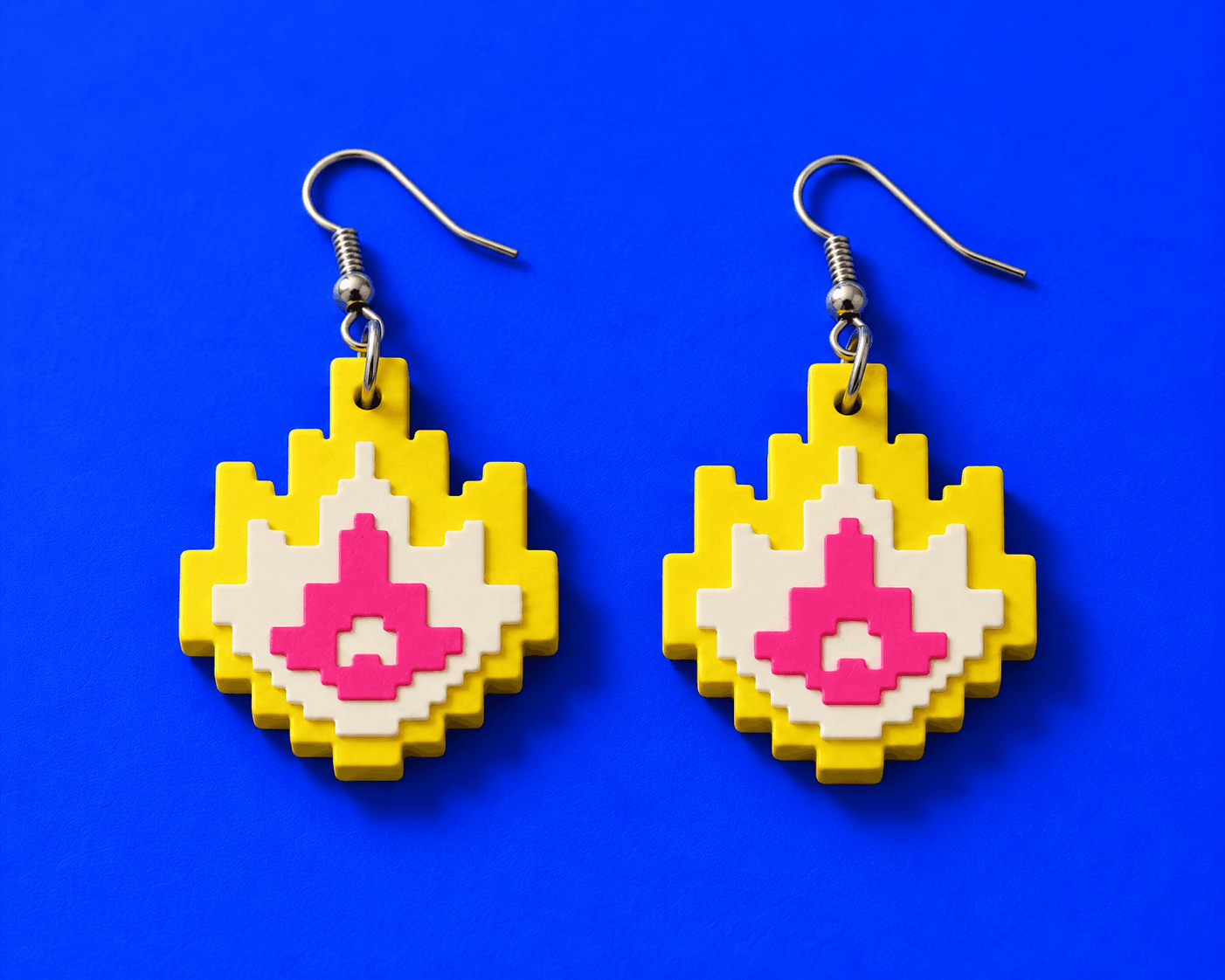
A matching pair of yellow, white and magenta flame drops on ear wires.
See what you need
Flame studs and dangle pairs in contrasting colourways, arranged across pink backing cards.

Layered and relief Flame studs above matching layered dangle pairs on pink backing cards.

Colourway
Keep the same three cutters and swap the clay colours, one for each layer of the flame.

Colourway
A Pixel Flame in Candlelight colours: a gold base, a white field and a red core.
Hang each flame from a looped ball-post earring on a jump ring, so it swings just below the lobe.
Cut the same three layers at 85 mm for wall art that holds a pair of drop earrings.
See the wall art displayYou may sell the finished polymer clay pieces you make. You may not sell, share or redistribute the digital files or 3D-printed tools. See the included Maker Licence for the full terms.
If a file is missing, won't open or doesn't match the listing, message us through Etsy messages with the build kit name and filename, and we'll put it right.
Message us on Etsy