The creative side hustle guide

Polymer clay jewellery as a side hustle: what to plan before selling
Thinking of selling polymer clay jewellery? What it costs to start, how to price a pair, where to sell and what to photograph before your first order.
Some links on this page are affiliate links. If you buy through them, we may earn a commission at no extra cost to you. As an Amazon Associate I earn from qualifying purchases. Disclosures
Selling polymer clay jewellery asks you to repeat a design, price all the hours it takes and help buyers picture wearing it. Start with a pair you can make consistently, then cost a small collection before committing to more stock.
New to making polymer clay jewellery?
What skills do I need?
For a simple first pair, learn to soften and prepare the clay, called conditioning, roll an even sheet, cut clean shapes, bake by the packet directions and smooth the edges. The metal parts that make a piece wearable, such as hooks, posts and connecting rings, are called findings.
The beginner guide covers the making; the findings guide explains the hardware. Before you sell a design, make it several times, until you can spot and fix rough edges, underbaked clay and loose attachments.
What equipment do I need?
For Pixel Cherry drops: clay in four colours, a roller, a clay blade, the printed Cherry cutters, a needle for tidying holes, findings and two smooth-jaw pliers. A simpler first pair can be cut around a paper template instead of a cutter. You'll also need an oven, a work surface kept for clay, such as a glazed ceramic tile (bake on it only if the seller says it's oven-safe at your clay's temperature) or baking parchment, and an oven thermometer to check the temperature where the clay bakes.
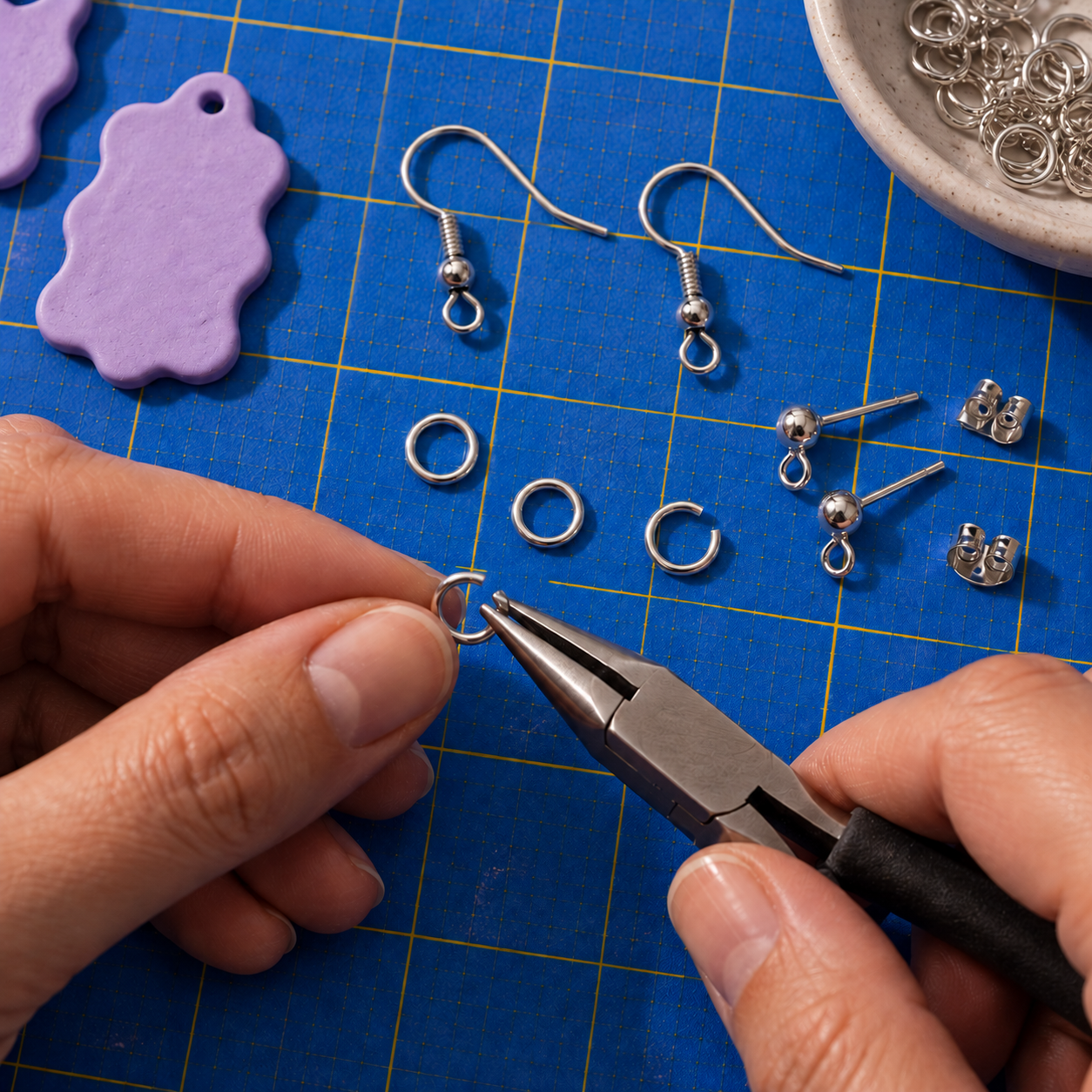
Jump rings, centre: the small rings connect the clay to a finding.
Looped posts, right: the straight posts go through the ears, with a loop below each ball for a drop.
Keep clay tools separate from food tools, ventilate the room and follow the manufacturer's baking and safety instructions. Sculpey's FAQs cover its products.
How much might starting cost?
About AU$97, excluding delivery, for tools, clay and stainless findings for Pixel Cherry drops, using the pink supply list below. Add the Cherry kit and printing at your own cost. It assumes you already have an oven and somewhere to work.
Reusable tools account for about AU$59. Clay and findings need restocking: the four 57 g blocks cost AU$22. A 36 mm Cherry drop allows AU$0.38 of clay, including offcuts; the yellow block limits the set to about 8 pairs. Add the kit and printing at your own cost.
How long does making a pair take?
It depends on the design. Sculpey estimates 90 minutes to make and bake its Premo gradient earrings. That is one project estimate; your first attempts also include learning time.
Count hands-on time separately from waiting for baking, cooling or glue to cure. The batch production guide shows how to group those stages when you make several pairs at once.
Can I sell jewellery made using Clay Bake build kits?
Yes. The included Maker Licence lets you sell finished polymer clay pieces you make using a kit. It's non-exclusive, so other makers can use the same design too. The kits are digital tool files and guides; you'll need compatible filament printing access, your own clay and findings.
Files, modified files and standalone printed tools or display aids cannot be shared or resold. A printed part designed to belong to a finished piece may go to the buyer only while attached to it. A print service can print for you but cannot reuse or share the files. The Licence.pdf included with your kit contains the terms; our licence summary explains the main permissions.
Find a style people will recognise
A first collection works best when someone who likes one pair wants to look at the rest. Start from the part of making you'd happily repeat fifty times, then build outwards in one of two ways:
- Colour-led. One simple outline, such as an arch, in three palettes that share one accent colour.
- Shape-led. One outline in a drop, a stud and a smaller companion, all in the same two or three colours.
Then choose one kind of wearer for the first collection. Small studs suit someone who wears earrings every day; long, light drops suit someone dressing up. That one choice settles the size, the findings, the price range and the photos you'll need.
One idea can become a whole collection
Pixel Cherry shows the shape-led route: the same motif as drops, small studs, little flower studs and a piece for the wall.
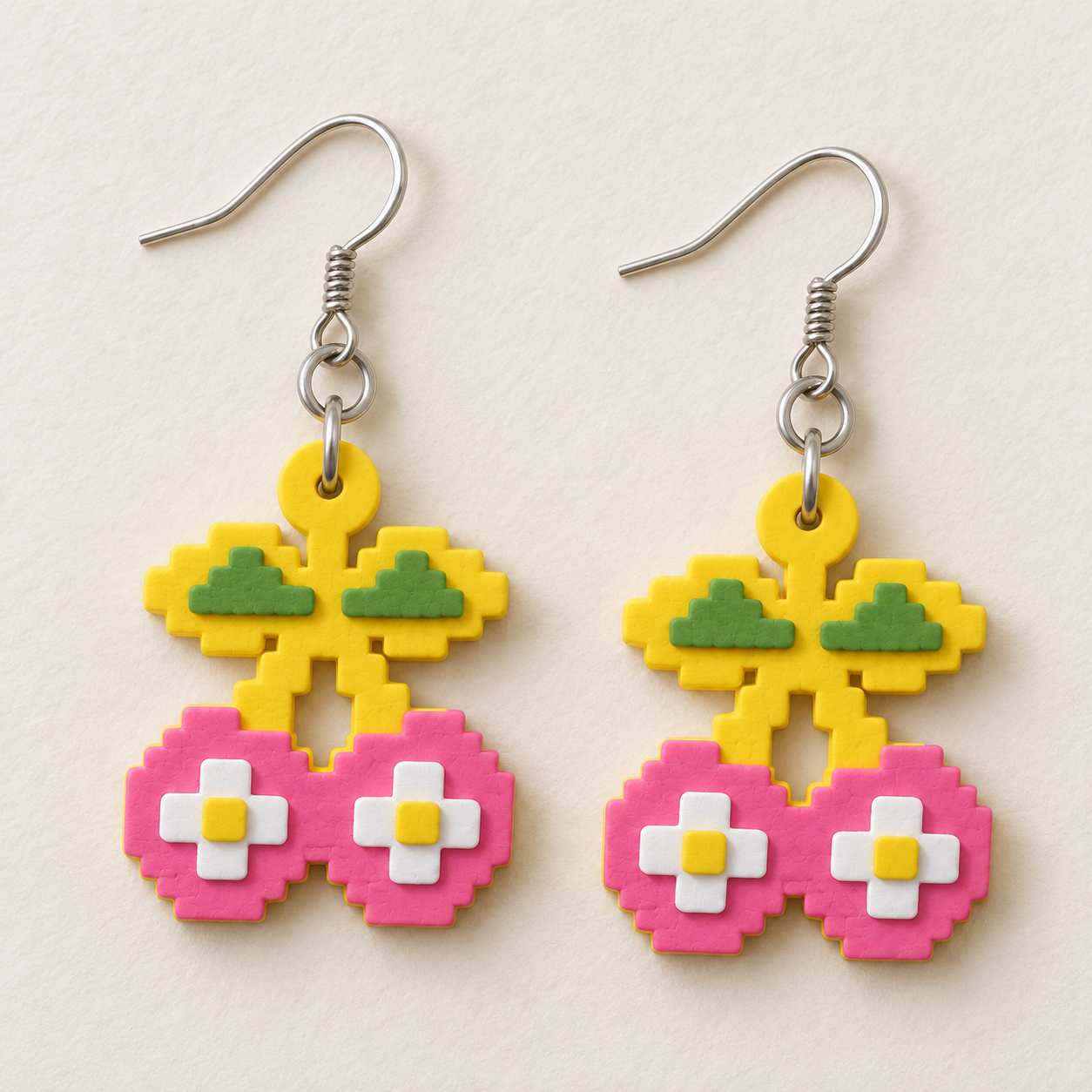
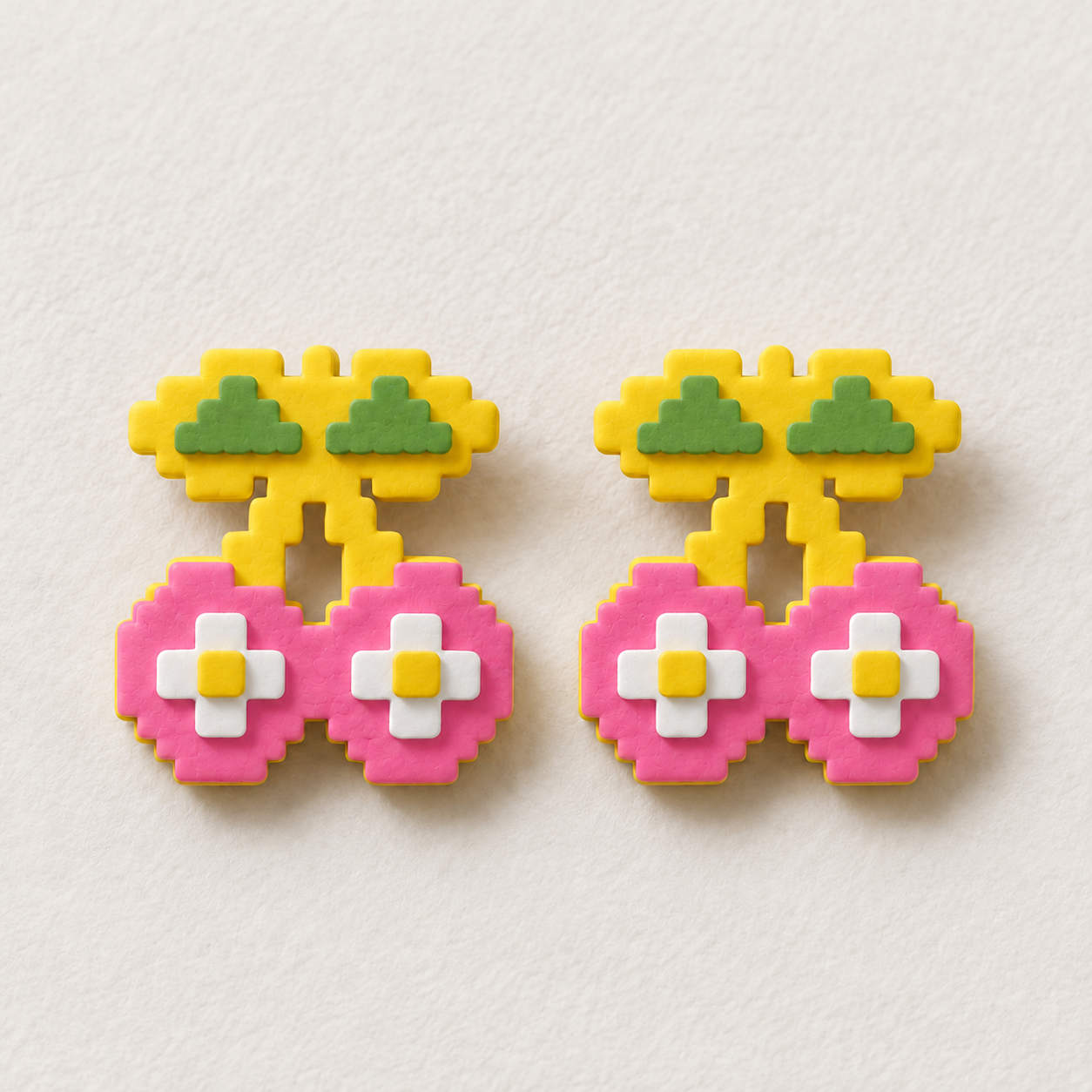
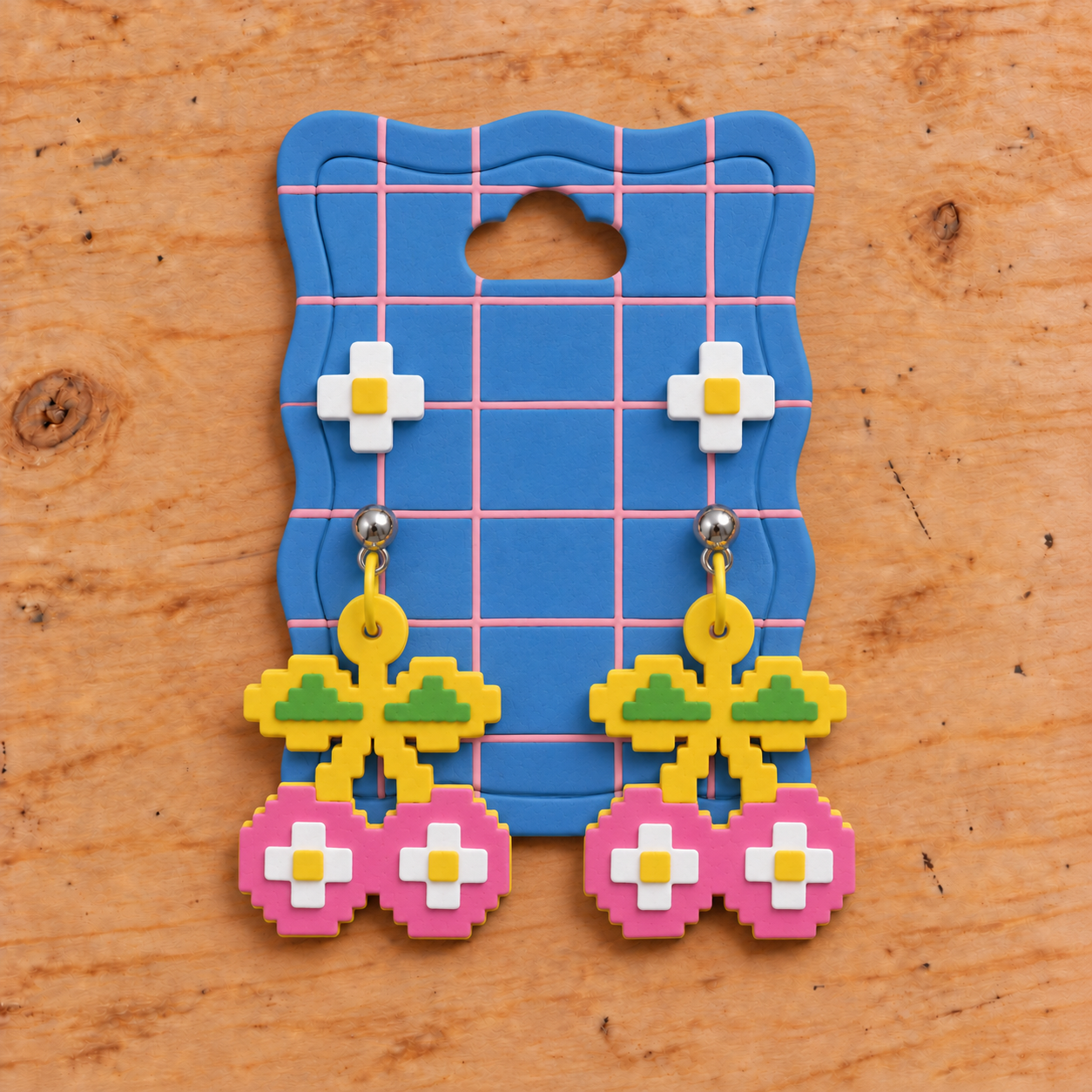
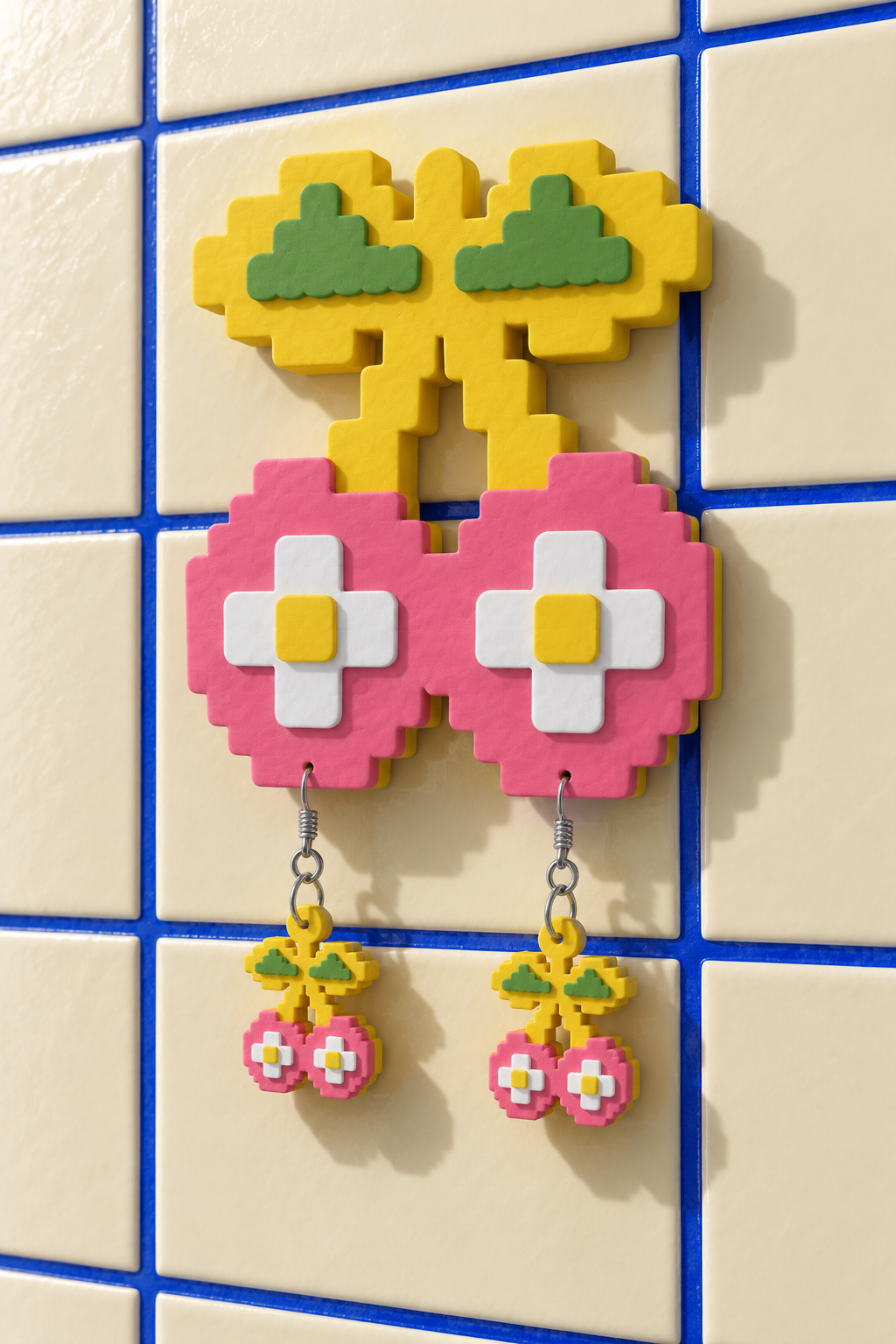
A smaller pair, a gift or a wall piece lets you build on one idea across several listings.
A note on sizes, tools and the display card
These views aren't to the same scale. The kit guide gives a separate cutter set and attachment method for each size. The flower studs reuse the flower and square-centre cutters from the 44 mm set. The blue display card is a separate styling accessory, not part of the Cherry download.
The Pixel Cherry build kit is digital: 3D-printable cutter files and a making guide for intermediate makers, plus a Maker Licence to sell the clay pieces you make. You'll need a filament 3D printer or print service, clay and findings.
Name each piece the way a buyer would describe it to a friend. “Pink and yellow polymer clay cherry drop earrings” tells a shopper far more than a collection name alone. Keep the collection name you love and put the plain description beside it.
In Etsy's Shop Manager on the web, open Stats, then Marketplace Insights. Try “polymer clay drop earrings” or “geometric clay earrings” to see search and listing counts from the last 30 days. Those counts can help you choose words, but do not predict sales for your design.
Decide how many options to offer
Every option multiplies the work. Three palettes, two sizes and two finding choices make twelve combinations to make, describe and photograph. A buyer can choose between two clearly photographed colourways more easily than among twelve they have to imagine, so start with two or three.
Patterned work needs one extra decision. With marbling, keep the outline, thickness, hole positions and findings the same while the swirls vary, and tell buyers whether they're getting the exact photographed pair or another pair in the same colours. If patterns vary, show several examples. The free printable hole punch set makes clean holes of the same size on every pair.
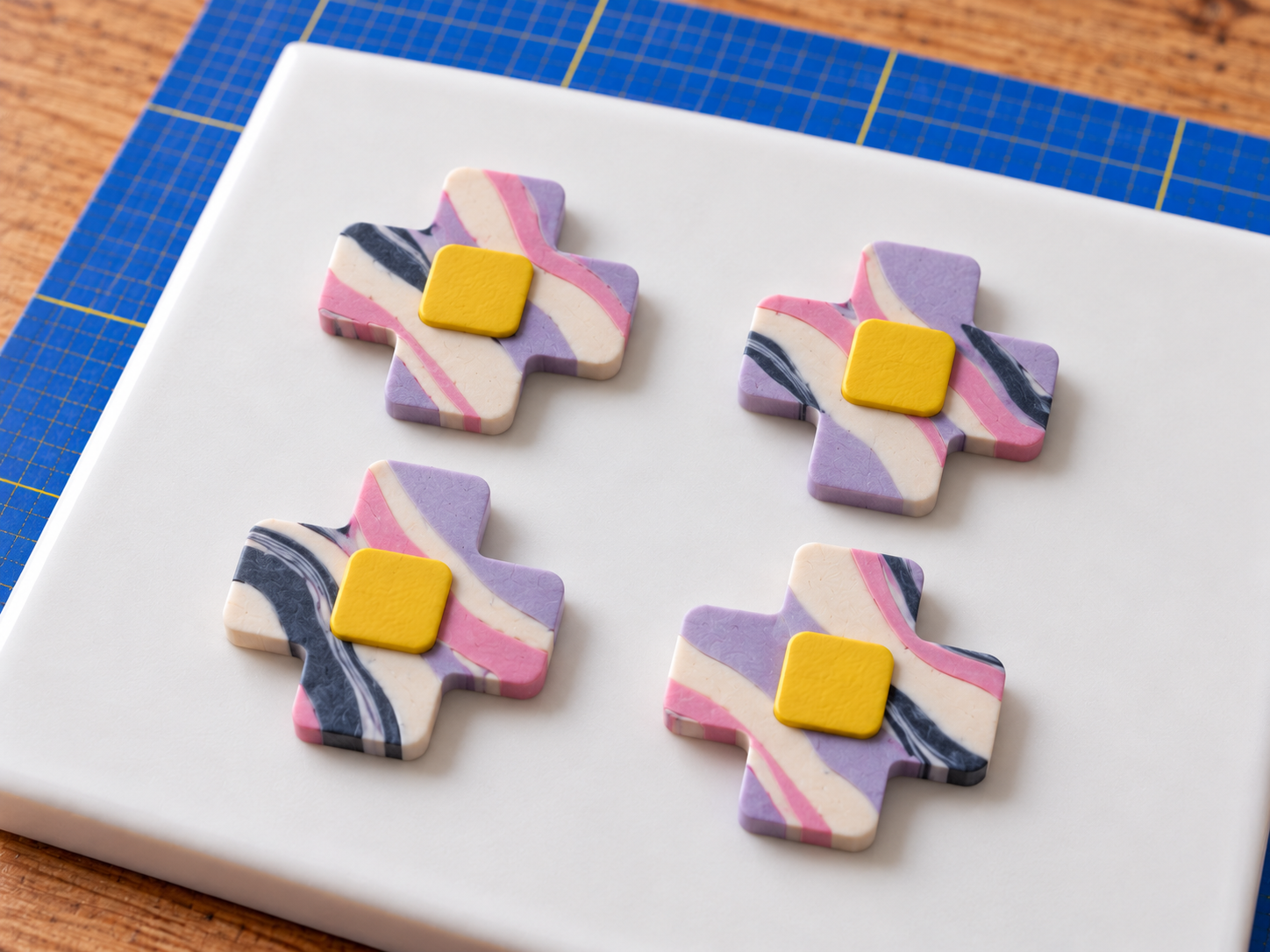
Matching the blue in someone's dress is a different job from offering palettes you've already worked out. Treat it as a custom order: agree the colour reference, what's included and how the buyer will approve the colour before you make it. Etsy's personalisation guidance explains variations and custom listings.
Set a price that makes the work worthwhile
Your price has to cover more than the clay: findings, packaging, selling fees, pieces that don't pass inspection, and your time. That time includes photographs, listing, answering messages and posting orders, not only making.
Here is a planning example for one Pixel Cherry range. Clay amounts come from each piece's shape and thickness, with a cautious allowance of 1.7 grams per cubic centimetre, plus 25% for offcuts. That density is a planning buffer, not a measured Premo density; weigh the clay you use for your own pieces. Prices are Australian, checked October 2026. Making times are estimates, not timed production results: replace them after timing your own work.
One Cherry range, costed
| Item | Make | Clay each, with offcuts | Findings and glue each | Making time each | Price |
|---|---|---|---|---|---|
| 36 mm layered drops | 10 pairs | 7.9 g | AU$0.36 | 40 min | AU$45 |
| 44 mm relief drops | 6 pairs | 9.8 g | AU$0.36 | 25 min | AU$33 |
| 24 mm layered studs | 10 pairs | 3.9 g | AU$0.16 | 30 min | AU$37 |
| Flower studs | 10 pairs | 0.7 g | AU$0.16 | 15 min | AU$26 |
| 36 mm layered pendants | 6 pieces | 3.9 g | AU$1.07 | 25 min | AU$37 |
| 52 mm layered keychains | 6 pieces | 8.2 g | AU$0.59 | 30 min | AU$40 |
| 140 mm layered wall art earring hangers | 2 pieces | 133.2 g | AU$3.30 | 90 min | AU$91 |
Spent before anything sells
AU$100Clay, findings, oven and a fifth of your tools
Take-home if 80% sells
AU$1,102For about 40 hours, before tax
See the clay, fees and hours
| Colour | Needed | 57 g blocks | Spent |
|---|---|---|---|
| Yellow | 438 g | 8 | AU$44.00 |
| Pink | 54 g | 1 | AU$5.50 |
| Green | 9 g | 1 | AU$5.50 |
| White | 22 g | 1 | AU$5.50 |
The two wall pieces use 51% of all the clay, almost all of it yellow, so one 454 g block (about AU$40) would be cheaper than 8 small ones. Packaging is AU$1.75 an order. Selling fees allow 6.5% on the item and postage, Australian domestic processing at 3% plus AU$0.25 per order, and AU$0.31 per sale for listing fees: about AU$170 across 37 sales. Etsy lists its fee in US dollars, so the AU$0.31 is an editable allowance. Setup fees, initial or unsold listing charges, taxes on fees, advertising and extra cushioning are not included. Check Etsy's fees policy and processing rates for your situation; Australian international orders have a higher processing percentage. The hours are 40 in total: making every attempted piece, 45 minutes to photograph and list each design, and 15 minutes per order.
The money that's left pays for your time first. The AU$26.44 an hour used here is an allowance you've chosen, not an hourly wage you've earned, and take-home is not net profit: tax, insurance and anything not listed still come out of it.
Work back from AU$1,000
Say you want AU$1,000 for your time and profit together. Start with the time: this range holds about 40 hours of work. At AU$26.44 an hour, the Australian minimum wage used here as a reference point, that time alone is worth AU$1,049.
So the prices have to pay for those hours and the materials, then leave a little over. The prices in the table add a 20% margin to each piece's costs and time, after fees. With those prices you reach AU$1,000 once 75% of the saleable pieces sell. At 80% you take home about AU$1,102, or AU$27.79 an hour. If only half sells, take-home falls to AU$703, about AU$19.18 an hour with the same making work but fewer orders to pack.
The margin is extra money above each piece's costs and time. Unsold stock can use it up because you have already paid for making those pieces. A 36 mm Cherry pair uses AU$0.76 of clay and AU$0.36 of findings, against about AU$29 of your time. If the numbers fall short, try higher prices or leave the slowest items out of your next range.
Then check your prices against the market. Look at ten listings for pieces like yours, with a similar size, number of layers and findings metal, and note what they cost including postage. If yours sit well above them, the fix is usually in the design or the time each piece takes, not a lower hourly rate.
Pricing calculator
What should your batch pay you?
Try your time, prices and sales. Starts with the Pixel Cherry example. Nothing you enter is saved or sent.
Australian starting prices, checked 20 October 2026, including GST. Currency changes symbols only. Enter your local costs.
Your prices stay fixed. The needed price shows what your time and margin would require.
Your range
Quantities count pairs for earrings, single pieces for everything else. Times are estimates.
| Item | Make | Min each | My price |
|---|---|---|---|
| 36 mm layered dropsper pair · Need AU$44.11 (−AU$0.89 vs my price) | |||
| 44 mm relief dropsper pair · Need AU$32.83 (−AU$0.17 vs my price) | |||
| 24 mm layered studsper pair · Need AU$36.75 (−AU$0.25 vs my price) | |||
| Flower studsper pair · Need AU$25.55 (−AU$0.45 vs my price) | |||
| 36 mm layered pendantsper piece · Need AU$36.33 (−AU$0.67 vs my price) | |||
| 52 mm layered keychainsper piece · Need AU$39.73 (−AU$0.27 vs my price) | |||
| 140 mm layered wall art earring hangersper piece · Need AU$90.49 (−AU$0.51 vs my price) |
All prices in AUD. Needed prices include materials, rejects, time, shared costs, your margin and selling fees. Unsold pieces can still leave hours unpaid.
More settings Clay, rejects, packaging, fees, tools and oven
Spend on tools the same way. When hand rolling is limiting a batch, a pasta machine can help condition clay and repeat sheet thicknesses; the pasta machine guide compares the options. Printed cutter sets make every pair the same outline without a paper template.
Where should you sell your jewellery?
Start where you can meet buyers in a way you enjoy, face to face or through photos.
If you take an order through messages, agree the piece, price, payment method and dispatch date in writing before you take payment.
How do you find your first customers?
If you're booking a market, ask whether the organiser shares stallholders' work. Send a clear jewellery image with the date and stall location so visitors can find you.
Online, lead with something specific: an unexpected colour combination, a playful outline or a marbled pattern.
- Show a little of the making. A short clip of cutting, layering or assembling a pair gives you something to share before you have a large collection.
- Show the finished piece being worn. It shows the size beside a face.
- Tell people what they can buy. Link to the pair, say whether they'll receive the exact pair shown or a handmade variation, and give the price.
A technique clip attracts makers; a worn view helps someone choose earrings; presentation and delivery details help a gift buyer. Link each post to the pair or information it shows.
Help people picture themselves wearing your jewellery
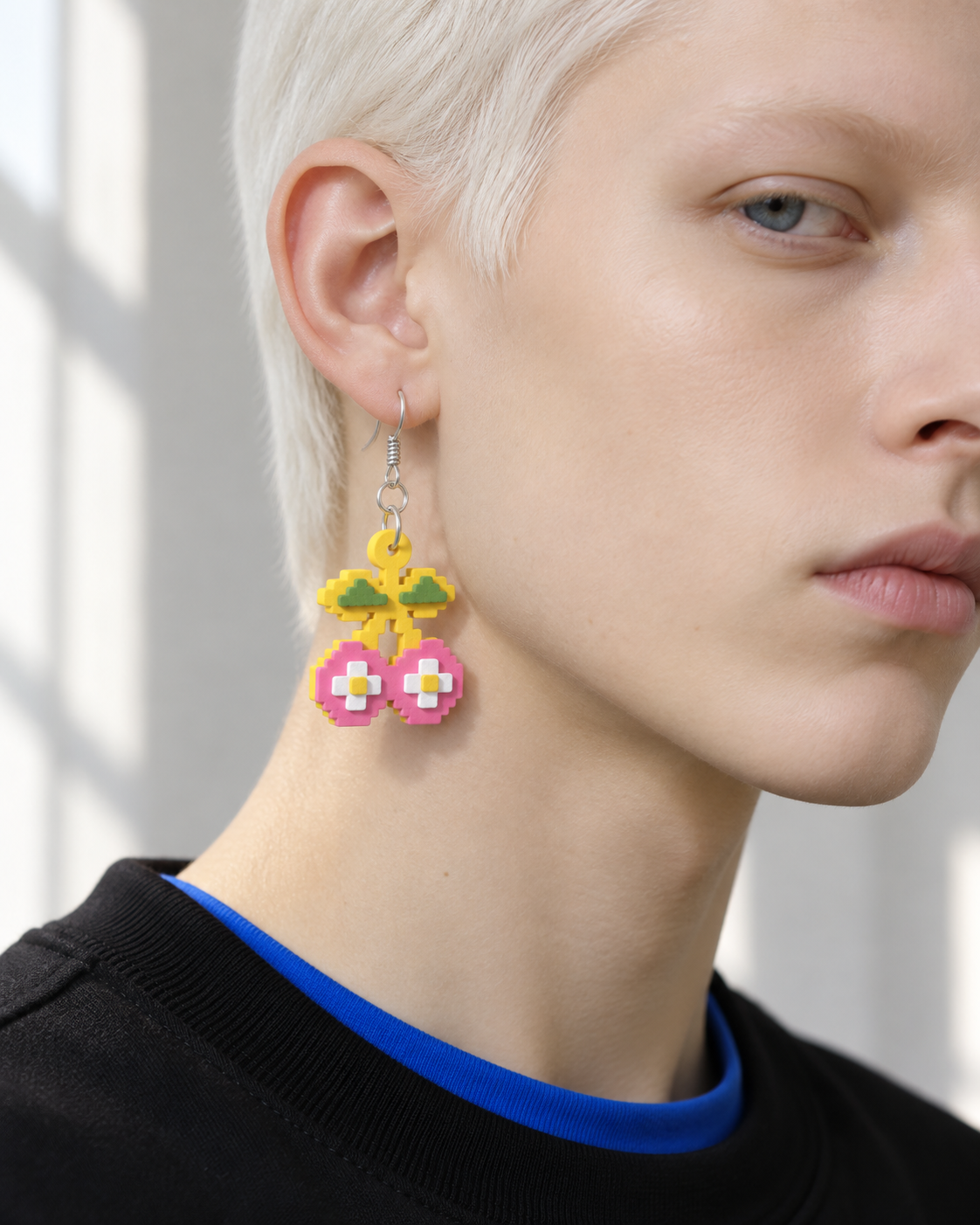
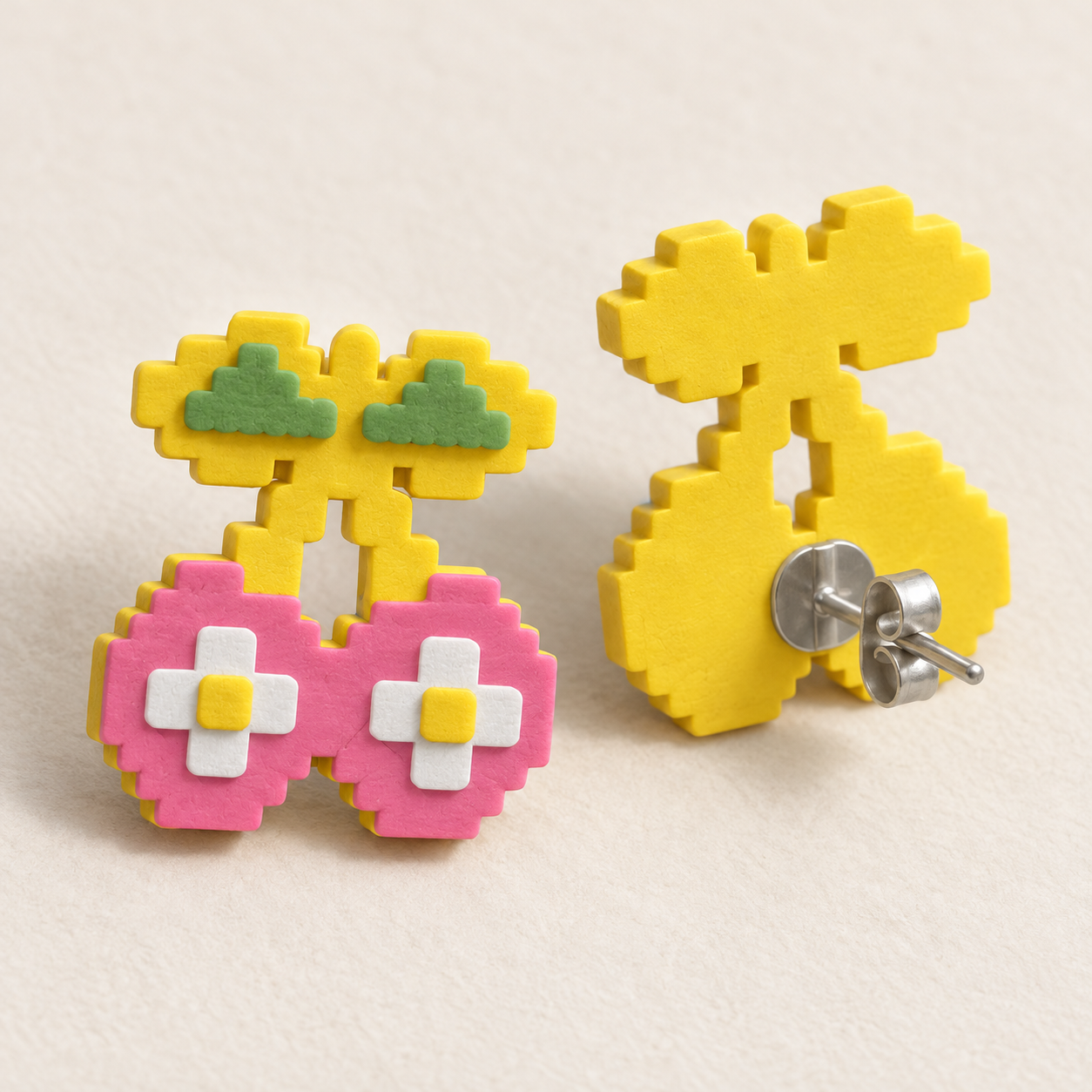
A pair looks very different lying flat and being worn. Buyers want to know where the drops sit, how bold they look and whether the colours suit something they already wear.
For each design, photograph the whole pair, the finish, the back and metal parts, a worn view and each colour you offer. Write the size in millimetres beside the photos; digital calipers give you a repeatable measurement.
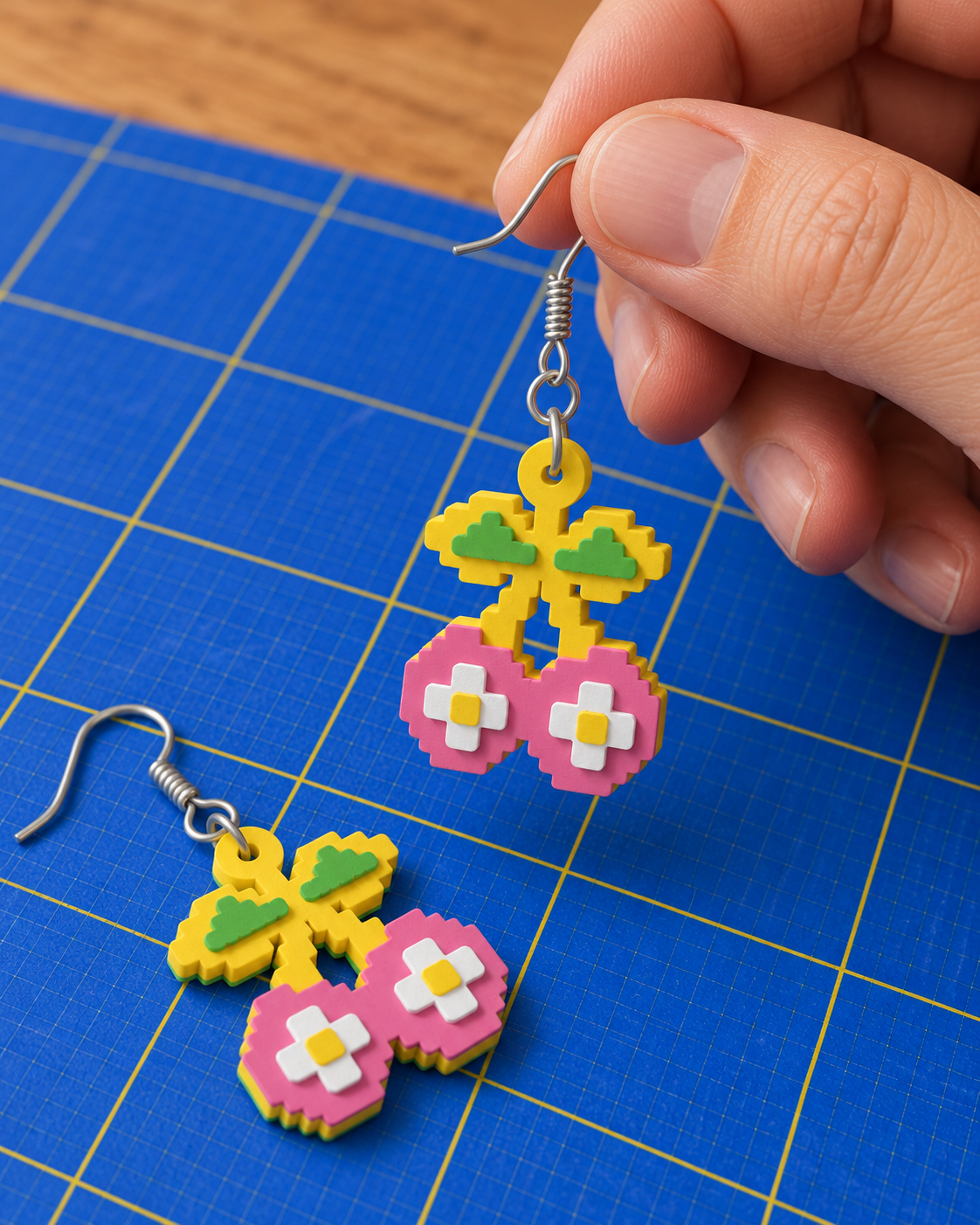
You don't need special equipment. Shoot beside a window in daylight, out of direct sun, and hold a sheet of white card opposite the window to lighten the shadows. Turn off filters and beauty modes, and check the colours on screen against the real pair. Etsy's seller handbook has more on lighting product photos.
For longer drops, a short clip with a gentle head turn shows how they move. Etsy's listing video guidance recommends worn jewellery to show scale and movement.
Keep the buying details next to the pictures: the clay and the metal of each finding, the size, what's in one order, the price, the choices and when you'll send it. For marbled work, say whether the photo shows the exact pair or an example of a pattern that will vary.
Get ready to send your first orders
Choose whether to make stock ahead or wait for orders.
For a first collection, make a small batch ready to sell: real pairs to photograph, checked to your standard, with no deadline. If you take made-to-order work, set a dispatch time with room to remake a pair.
Pack for what could move. Mount the pair on an earring card or your own clay backing card, so the findings can't knock against the clay, then put it in a small rigid box with cushioning inside a strong outer pack or small carton. A card presents the pair well, but it doesn't protect it on its own.
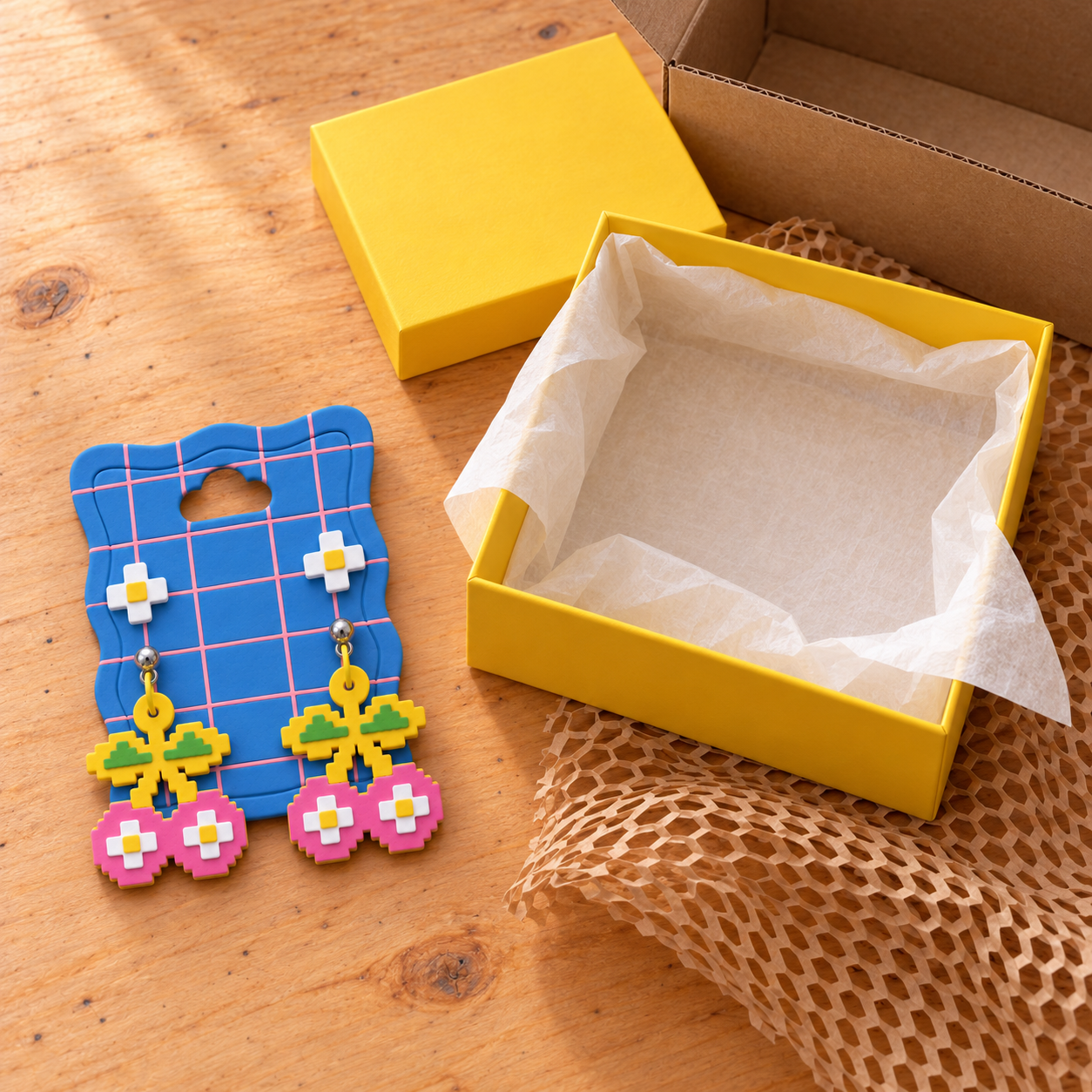
Weigh and measure the packed order, not just the earrings, before you choose a postage rate. A small digital scale is enough. In Australia, a large letter can be up to 260 × 360 mm, 20 mm thick and 500 g, according to Australia Post's size guidelines; a rigid box can easily push a parcel past 20 mm. The batch production and packing guide helps when several orders go out together.
Tell buyers when you'll hand the order to the carrier. That's the dispatch time; the delivery estimate is when it should arrive. Give an estimate for their destination and make it easy to contact you if an order is missing, damaged or wrong.
Take care of the business basics
Before taking payments, check what applies where you live and where you sell: business or hobby status, tax and records, product safety, consumer rights, insurance and market rules. If you receive benefits or support payments, check how self-employment affects what you report.
Two examples of thresholds worth knowing. In Australia, you must register for GST once your business's GST turnover reaches AU$75,000 a year, according to the ATO; whether your selling is a business at all is a separate question, which business.gov.au's business or hobby guide covers. In the UK, HMRC treats selling things you make as trading, and the first £1,000 of trading income in a tax year is covered by the trading allowance; HMRC's online selling guidance explains when to tell them.
Name the metal in every finding. Buyers often ask whether earrings contain nickel. Practise on cheap plated findings, then sell with parts whose metal the supplier states, such as titanium posts, surgical steel ear hooks or unplated stainless steel jump rings. Describe each part in the supplier's words, for example “ear wires: 316L stainless steel”. Stainless steel still contains nickel, so don't call a pair nickel-free or hypoallergenic on the strength of a metal name. “Gold-tone” tells someone the colour, not the metal underneath. The findings guide explains the grades and nickel limits.
Sell your own designs. Characters, logos and brand names belong to their owners, and handmade copies can still infringe copyright or trade marks. Sell original designs, or designs a licence lets you sell, such as finished pieces from a Clay Bake kit under its Maker Licence. The Australian Government's copyright basics explain who owns what.
Decide how buyers can contact you about a fault, and keep that separate from your policy for someone changing their mind. Handmade and made-to-order pieces can still come with consumer rights.
Official business and consumer guidance by location
- Australia: consumer guarantees, self-employment reporting and Self-Employment Assistance. Programme and financial support conditions apply.
- UK: returns, refunds and cancellations, sole trader registration and records and the business support finder.
- US: the IRS self-employed tax centre and SBA local assistance.
For other locations, start with the relevant local business, tax and consumer authorities.
Let your first customers help you choose what to make next
Buyers' questions show what your photos and descriptions missed. Use them before remaking the collection.
If rust sells while blue stays in stock, check how each was shown. A colour hidden in a dropdown has had less chance than one in the first image. Give blue its own clear photo and worn view. Etsy's shop Stats show visits to a listing, but not which colour option someone noticed.
What could you try when sales feel slow?
Match what you're noticing to the place to look first. The same symptom can have more than one cause.
| What you're noticing | What to look at |
|---|---|
| Hardly anyone views the listing | Can people find it using words that describe the piece? Check search terms and where you've shared the link before changing the jewellery. |
| People view but don't buy | Look at the whole buying decision: photographs, price, delivery cost, dispatch time and what comes in the order. Ask someone unfamiliar with the piece what they'd still want to know. |
| People like the posts but don't visit the shop | Can viewers tell the jewellery is for sale, and find the product link? They may be watching to learn the technique. Show the finished piece and make the buying step easy to find. |
| People keep asking about size | Add a wearing view and easy-to-find dimensions. Show where the drops sit beside the face. |
| One colour sells better | Check whether each colour had its own clear image and a similar chance to be seen. A colour hidden in a dropdown hasn't had the same introduction. |
| Orders take longer than you expected | Notice where the time goes: making, finishing, answering questions or packing. Group similar tasks where it helps, and revisit your dispatch time and price. |
| You keep remaking pieces | Look for the step that's going wrong, such as rough cutting, baking or loose attachments. Practise and resolve it before offering more of that design. |
Judge regular prices from full-price sales, separately from gifts and discounts. Before repeating the batch, ask whether you enjoyed making it and whether the money left after costs paid for the work.
In brief
Key takeaways
- Build a first collection around one idea and one kind of wearer, with two or three colourways rather than every combination.
- Cost a whole range, not one pair. In the Pixel Cherry example about 40 hours of work and AU$100 of materials take home AU$1,000 only once 75% of the pieces sell; the margin is what covers the ones that don't.
- Photograph every design from the front, the back and worn, write its size in millimetres, and say whether buyers get the exact pair shown.
- Sell with findings whose metal the supplier names, pack so nothing can move, and measure the packed order before choosing a postage rate.