Faux Stone and Translucent Effects With Cernit Tests
Faux jade or opal that comes out cloudy or flat usually traces back to a few fixable things: bake temperature drift, sanding pressure on curves, trapped air, or contamination. Test each recipe on a small domed cabochon first, and change one thing at a time so you can see what helped.

In brief
Key takeaways
- 1Read the Cernit package directions for the exact line, and put an oven thermometer at tray height before comparing notes from other brands
- 2The clearest translucent effects come from a controlled bake, then progressively finer wet sanding and a light buff on a test chip first
- 3Let the sample chip decide how far to sand. There is no fixed grit ladder that works for every translucent piece
- 4Jade, agate, opal, and amber-style looks can all start from Cernit Translucent, but each mix and finish still wants its own scrap test
Faux jade and opal in Cernit translucent come out flat or cloudy more often from the bake temperature and finishing than from the clay itself. Dial the bake to your Cernit line, sand only as far as the test chip keeps improving, and test one structure per cabochon. Cernit translucent is a favorite for faux-stone depth, porcelain-like glow, and light-passing cabochons once those three things are controlled.
Cernit is a Belgian polymer clay brand with translucent lines that commonly cure in the 110 to 130°C range. Follow the package instructions for the line you are using and verify your real oven temperature with a thermometer before baking the batch.
Cernit translucent pieces often look clearer after careful wet sanding and buffing, but there is no single guaranteed grit ladder. Start with the lowest grit that removes the marks you actually have, then refine upward on a test chip until you like the clarity and sheen.
When Cernit Translucent Is Worth Choosing
Cernit translucent lines are commonly chosen for faux-stone, porcelain-like, and light-passing effects when the bake and finish are controlled on test pieces.
Results vary by line and project, but many makers get clearer samples when they:
- Follow the instructions for the Cernit line you are using. See Cernit's official FAQ for details.
- Wet sand with progressively finer grits only as far as the piece keeps improving
- Buff when the sample benefits from more shine
Cernit Bakes Cooler Than Sculpey, So Verify The Temperature
Many Cernit lines publish a lower-temperature range than common Sculpey lines. Follow the package line instructions, verify the real oven temperature, and test small samples before you assume a new setup is dialed in.
Recipe 1: Faux Jade (Green Nephrite)
A common faux-jade starting mix is four parts Cernit Translucent with a small amount of green and a tiny touch of black, then enough finishing to see whether the sample reaches the depth you want.
This gives you a way to compare a deeper green faux-stone look, not a promise of natural-jade realism.
Materials:
- Cernit Translucent (White/Colorless): 4 parts
- Cernit Number One (Green): 1/4 part
- Cernit Number One (Black): tiny speck for depth
Process:
- Mix the green into the translucent until nearly uniform, leaving slight streaks.
- Add the tiniest amount of black, just enough to give depth without muddying the mix.
- Roll into a slab, fold, and twist slightly to create internal variations.
- Shape or cut, then bake by the instructions for the Cernit line you are using.
- Wet sand with progressively finer grits until the sample reaches the clarity you want.
- Buff with a cotton wheel if the piece benefits from more shine.
Recipe 2: Faux Agate (Banded)
One common faux-agate path uses stacked thin slabs of differently tinted Cernit Translucent, sliced in cross-section to reveal glowing banded layers.
Materials:
- Cernit Translucent: 6 parts total
- Cernit Number One: your choice of 3 to 4 colors in the same family
- White clay: small amount for contrast bands
Process:
- Tint separate portions of translucent with each color (keep mixtures subtle).
- Roll each tinted portion into thin slabs (pasta machine setting 4-5).
- Stack in gradient order from light to dark.
- Add thin white bands between some layers for authentic banding.
- Compress the stack gently, then slice thin cross-sections.
- Apply slices to a base shape or use as-is for cabochons.
- Bake by the instructions for the Cernit line you are using, then refine the surface only as far as the sample keeps improving.
Recipe 3: Faux Opal (Fire Opal Effect)
One faux-opal path is to layer interference mica powders between folds of Cernit Translucent clay, then test the bake and finish on small samples until the color shift reads the way you want.
This can create a color-shifting faux-opal look when the layers stay thin and patchy.
Faux opal effects in polymer clay rely on interference mica powders sandwiched between layers of Cernit Translucent. Interference micas flash one color head-on and a different one at an angle, which is what reads as opal play-of-color. The trick is patchy placement: dab different micas in uneven spots across three or four folds so it never looks like a printed pattern.
Materials:
- Cernit Translucent: base
- Interference mica powders (green-gold, blue-violet, pink-gold)
- Opal flakes/chips (optional; they add bright color flecks to the faux opal)
Process:
- Roll a thin slab of translucent clay.
- Apply interference mica powder in patches (not uniform).
- Fold the slab, capturing the mica inside.
- Roll thin again, apply different mica color, fold.
- Repeat 3-4 times with different colors.
- If using opal flakes, embed them in the final fold.
- Shape, bake by the package line instructions, then sand and buff if the sample still improves.
Recipe 4: Faux Amber
A faux-amber test can start with Cernit Translucent Amber plus a tiny amount of brown and optional ink-like inclusions.
Keep the brown to a speck; amber that goes muddy almost always has too much brown, not too little.
Materials:
- Cernit Translucent assorted pack: use the translucent tones as a base, or tint clear translucent with orange or gold for faux amber
- Burnt Sienna or Brown: tiny amount for depth
- Alcohol ink in brown: optional for inclusion effects
Process:
- Mix amber translucent with a tiny touch of brown for depth.
- For "inclusions," drop alcohol ink onto raw clay, let it spread organically.
- Fold the clay to trap the ink patterns inside.
- Shape into domed cabochons or beads (rounded shapes show translucency best).
- Bake, then wet sand and buff as needed to see how clear the sample becomes.
| Faux Stone | Base Mix Ratio | Bake Note | Difficulty | Best Shape |
|---|---|---|---|---|
| Jade | 4 parts translucent + 1/4 green + speck black | Follow the Cernit package line instructions | Beginner | Cabochons, pendants |
| Agate | 6 parts translucent + 3-4 tinting colors | Follow the Cernit package line instructions | Intermediate | Sliced cabochons, earrings |
| Opal | Translucent + interference mica powders | Follow the Cernit package line instructions | Intermediate | Domed pieces, beads |
| Amber | 4 parts amber translucent + touch brown | Follow the Cernit package line instructions | Beginner | Domed cabochons, beads |
Refining Clarity With Test Chips
A common path runs 400 to 2500 with wet-dry sandpaper (400, 600, 800, 1000, 1500, 2000, 2500), rinsing the piece between grits so old grit does not keep scratching.
Stop at whatever grit the test chip stops improving at; you rarely need the whole ladder.
Troubleshooting Translucent Effects
Cloudiness can come from excess heat, residual scratches, air bubbles, or contamination, so check the bake setup and the finish path before changing everything at once.
Common failure points with Cernit translucent samples include temperature drift, scratches left by stopping too early in the finish path, trapped air, and contamination from darker clay. Recheck the package instructions with an oven thermometer, keep finishing changes small enough to notice what helped, and keep translucent clay and tools as clean as possible.
- Cloudy after baking: Recheck the real oven temperature against the package line instructions, and tent the pieces under an inverted foil pan so radiant heat does not scorch or yellow the translucent clay, before assuming the clay is the problem.
- Still cloudy after sanding: Keep refining the surface only if the next finer grit is still improving the sample.
- Air bubbles: Condition clay more thoroughly before using. Work on a smooth surface.
- Dark spots: Contamination from other clay. Clean your workspace and tools before working with translucent.
More guides in this path
Open these when the next decision is material choice, attachment, or finishing.
Sanding and Buffing Polymer Clay: Pressure and When to Stop
Your finish looked streaky or the edges rounded because you used the same pressure on curves as on flat backs. Sand curved surfaces with light pressure and flat areas more firmly. Stop the moment the next grit stops improving the test chip. Always test the finish on a scrap of the exact clay line.

Best Oven Thermometer for Polymer Clay: What To Buy First (2026)
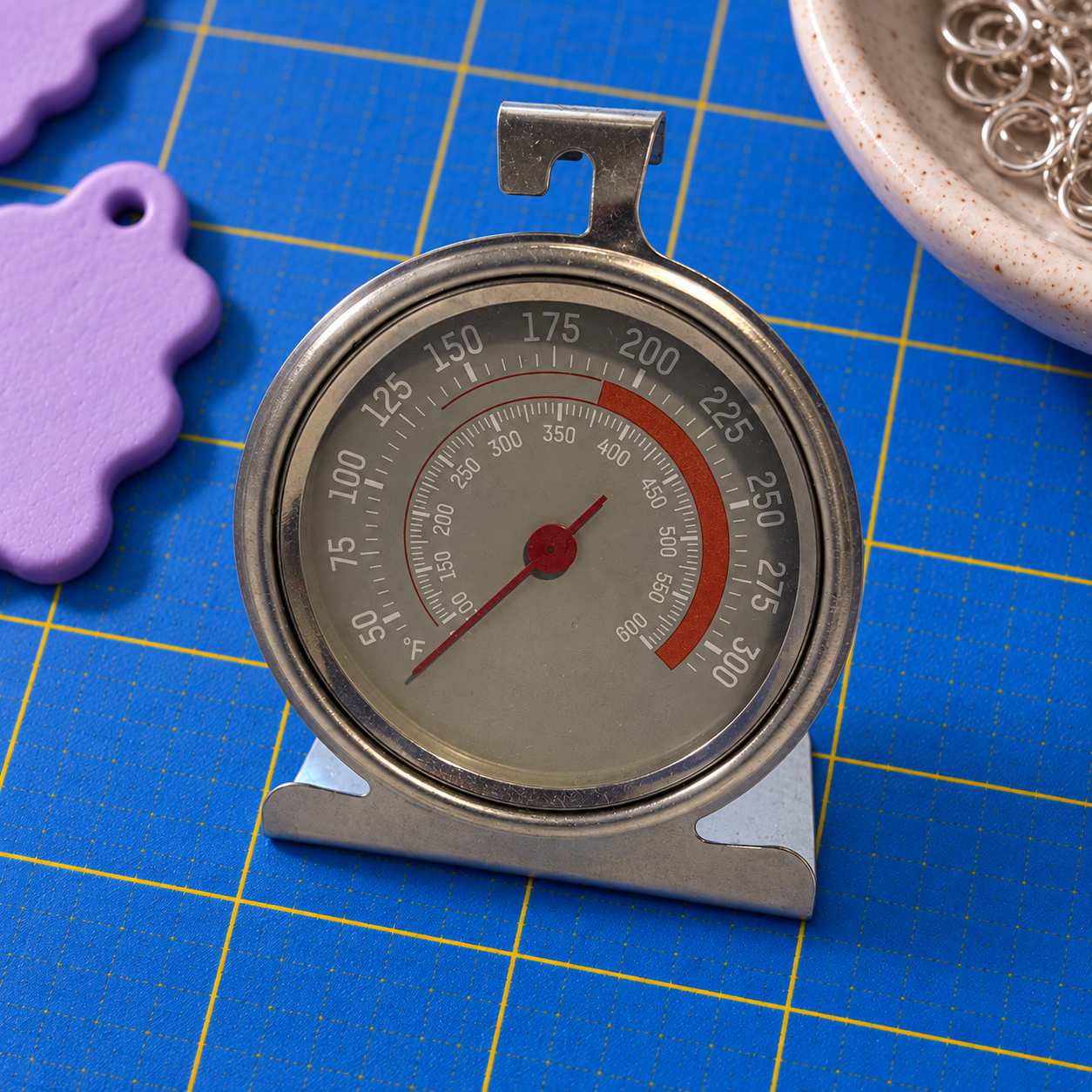
Start with your clay line's package directions, then use an oven thermometer to check whether the shelf near your tray or tile is actually reaching that target. Placement matters more than gadget complexity, and an analog dial is usually enough to start.

Best Polymer Clay Brands for Beginners: Premo vs Soufflé vs FIMO Soft
Premo is a practical first test when you want one clay line for slabs, simple earrings, and general practice. Choose Soufflé when lightweight matte-leaning earrings are clearly the goal, and look at FIMO Soft when a softer conditioning feel matters more than firmer edge retention.
Finished examples with related clay decisions
Each piece shows how a material, attachment, or surface choice changes the final form.