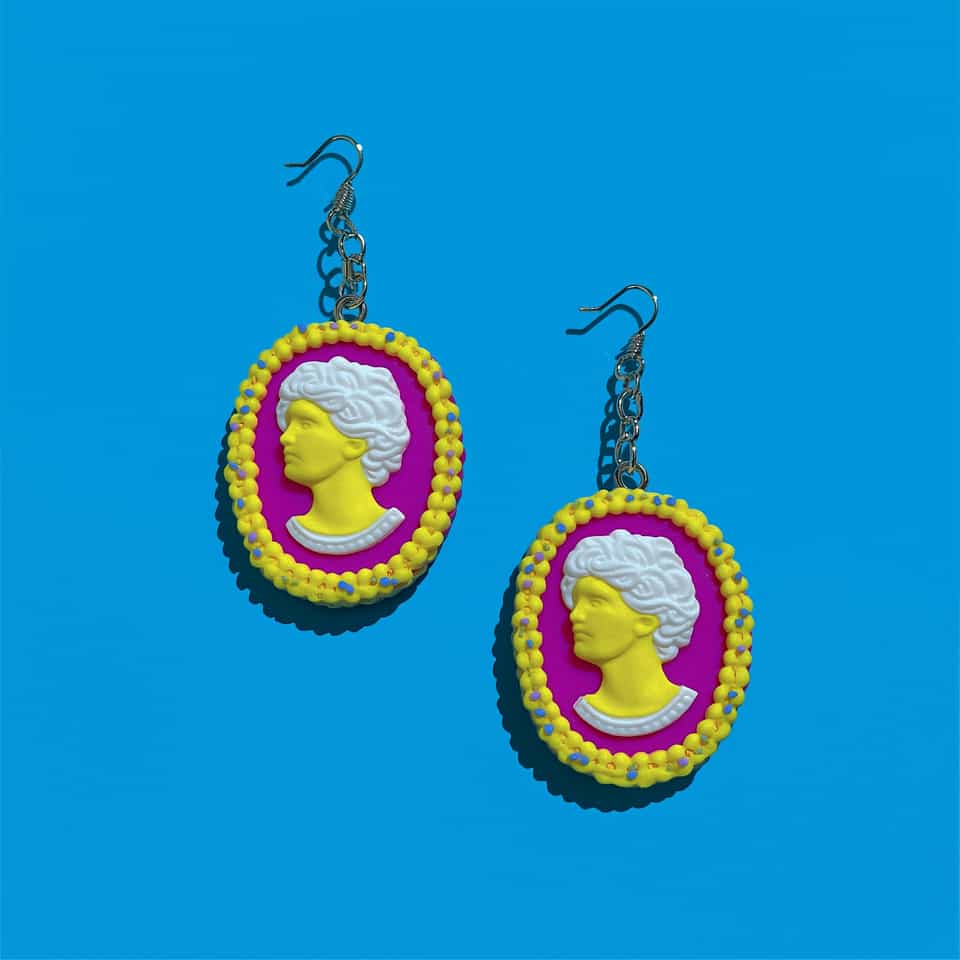
How to choose jump rings for polymer clay jewellery
Learn how to measure jump rings, choose a size that lets your clay earrings swing freely, and open and close the rings with pliers.
Some links on this page are affiliate links. If you buy through them, we may earn a commission at no extra cost to you. As an Amazon Associate I earn from qualifying purchases. Disclosures

In brief
Key takeaways
- A ring advertised as 6 mm may measure 6 mm inside or outside. Check which measurement the seller uses, plus the thickness of the wire.
- Grip an open jump ring beside the cut with two pliers. Twist one end towards you and the other away, then reverse the twist to close it.
- Hold the earring by its hook and gently move the clay. If it catches against the inside of the ring, try a ring with a larger opening.
- Two linked rings hang at right angles to each other, so one extra ring turns a sideways-facing drop a quarter turn to face forward. Compare both earrings for length afterwards.
- Gold-tone means gold-coloured. Check which metal the ring is made from and save that description with its size for your next order.
- Start the hole about 3 mm in from the edge on a 3 mm slab, then choose a ring whose inside diameter clears the clay between the hole and the edge with 1 to 2 mm to spare.
Article contentsOpenClose
A jump ring needs to do two things: pass through the hole and leave the connected pieces free to move. If the wire fits but the clay catches against the inside of the ring, the earring can feel stiff or hang at an awkward angle.
Jump rings are the small metal loops that join a clay pendant to a chain or connect the sections of a dangling earring. To choose a size, you need to know how wide the clay hole is, how thick the clay is, and how far the hole sits from the edge. The sections below explain how those measurements affect the fit.
What size jump ring do polymer clay earrings need?
For attaching an ear hook to a clay piece, use an open jump ring: a metal ring with a small cut that you can open with pliers. Open it with two pliers (the method is in the section after the supply list), thread it through the clay hole and the loop on the hook, then close it. The wire must be thin enough to pass through both holes, and the space inside the ring must be large enough to fit around the clay edge.
Hold the assembled earring by its hook and gently move the clay drop. It should swing without catching on the ring. If it catches, try a ring with a larger opening. Compare the two earrings beside each other as well: a larger ring will show more metal between the sections and may make the earring longer.
Tools and supplies
- Open jump rings: search silver-tone rings on Amazon or search gold-tone rings on Amazon. Compare the materials explained below, then check wire thickness and the stated diameter before choosing a pack.
- Two gripping pliers: one for each side of the gap. The opening method in the next section uses chain-nose and flat-nose pliers, or two flat-jawed pliers from the kit linked in that section.
- The clay pieces and final findings: use the actual ear wire, post loop, bail or chain connection. If you are buying hooks and rings together, the stainless steel ear-hook, silicone-back and open jump-ring kit we use in the studio supplies all three in one box; compare the ring wire thickness and diameter it lists with your clay hole, and check whether that diameter is inside or outside, before a batch. The earring-findings guide helps with the separate choice of hook or post.
- An optional measuring tool: useful when you need to compare an existing ring with a supplier's dimensions. You do not need to buy calipers just to try a small labelled assortment.
How to open and close a jump ring
The Hi-Spec jewellery pliers and findings kit is the set we use in the studio. The twist below needs two pliers with smooth flat gripping faces, so check the plier tips in the kit photos and pair its chain-nose with a flat-jaw pair if the second pair is round-nose. To compare other pairs, search for smooth-jaw chain-nose pliers on Amazon and pair them with a second pair that has flat gripping surfaces. In any jewellery-tool kit, round-nose pliers have round, tapered jaws for forming loops, and cutters cut wire, so neither is the second gripping tool.
- Put the gap at the top. Hold the ring with one pair of pliers just to the left of the gap and the other just to the right. Keep the pliers on the metal, not against the clay.
- Twist the two sides past each other. Move one side towards you and the other away from you. Keep the ring circular as you twist. Pulling the ends directly left and right would stretch it into an oval.
- Thread on the parts. Open the gap just far enough to thread on the clay piece and finding. Pass the ring through the clay hole and add the finding or next link.
- Reverse the twist. Bring the cut ends back into line. Look closely at the join: the ends should touch, with neither end sitting higher or farther forward than the other.
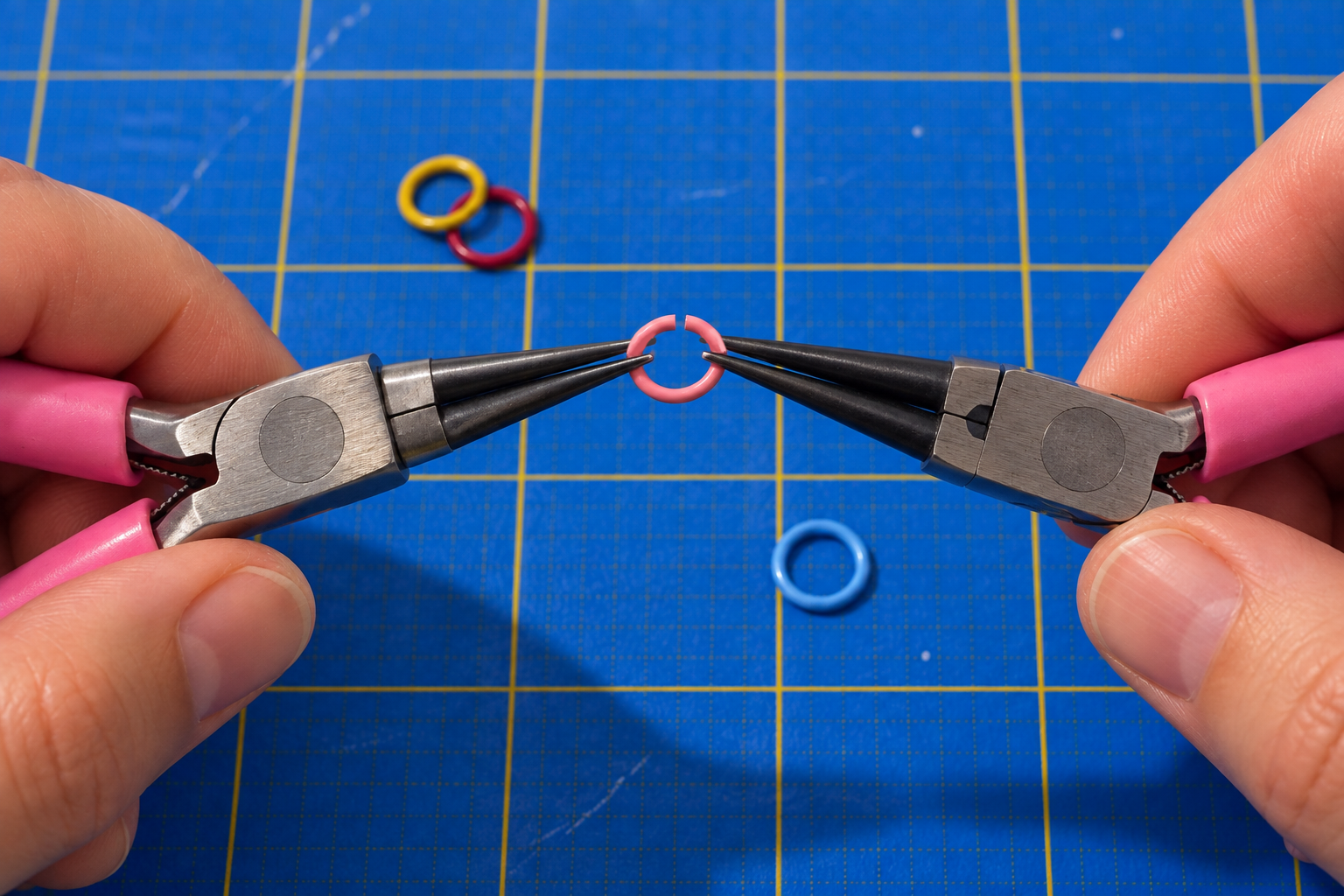
Practise the twist on a spare ring before adding clay. Hold the gap facing you and open it with a small front-to-back movement, keeping the circle the same width. Twist back to close, then turn the ring to inspect the join from the front and side. The cut ends should meet without a visible gap or step; correct their alignment with the pliers before threading a finished piece.
Jump-ring sizes: wire thickness, inside diameter and outside diameter
Wire thickness is the diameter of the metal wire itself. It controls whether the wire can pass through the hole. Inside diameter (ID) is the empty space across the middle of the ring. Outside diameter (OD) includes the wire on both sides.
For example, a round ring measuring 6 mm across its outside edges, made from 1 mm wire, has a 4 mm opening. Subtract the wire on both sides: 6 - 1 - 1 = 4 mm. A different ring advertised as “6 mm” might measure 6 mm across the opening instead, so check whether the seller means inside or outside diameter before comparing packs.
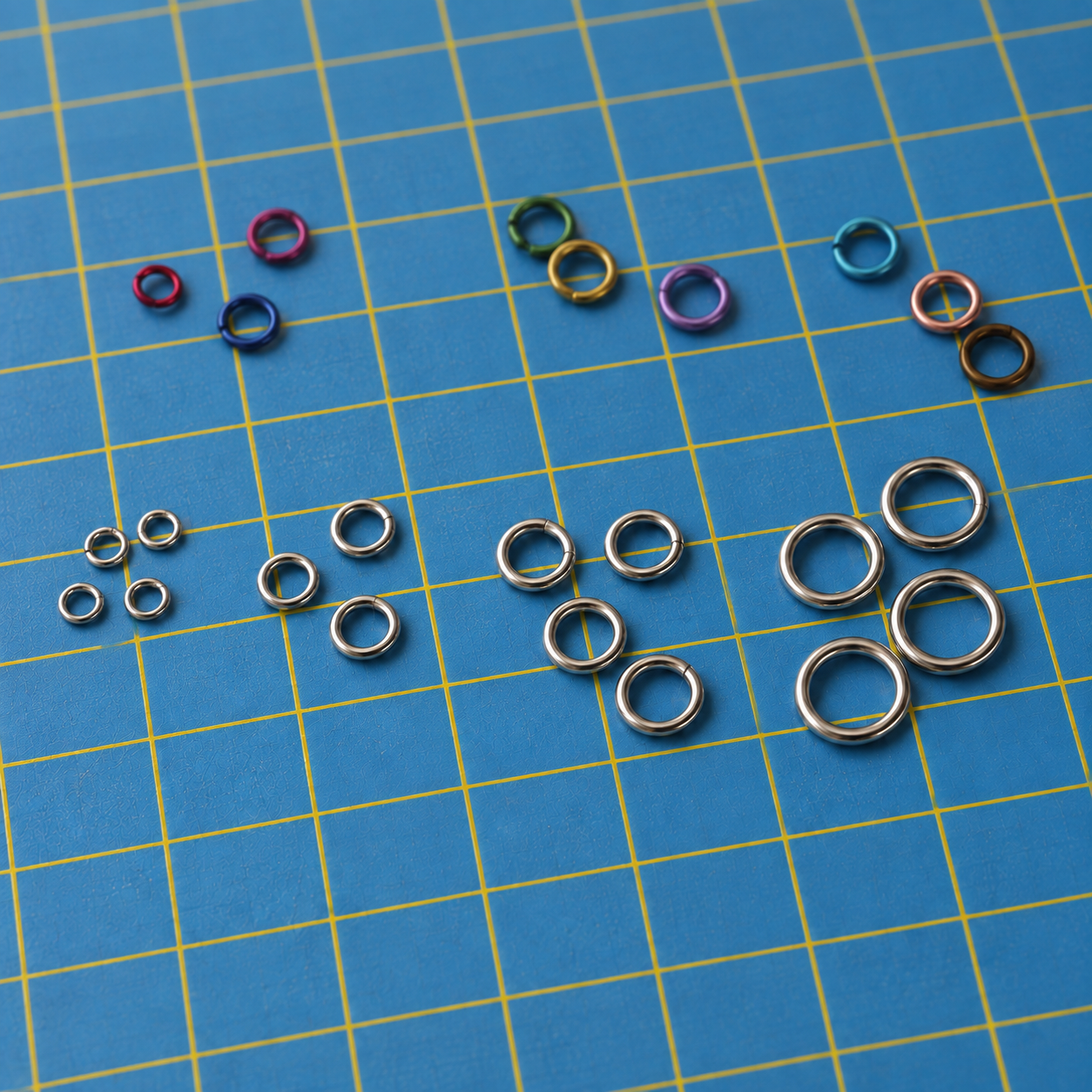
When the listing gives a gauge, find the corresponding wire thickness in millimetres. Gauge systems differ, so convert each supplier's gauge to millimetres before comparing two packs.
If you are measuring a ring you already own, digital calipers can help distinguish the outside diameter from wire thickness. Close the clean jaws and check that the display reads zero, following the caliper instructions. Use the larger outside-measuring jaws across the outside edges of the closed ring for OD, then across one section of wire for wire thickness. For round wire and a round ring, subtract twice that wire thickness from OD to calculate ID. Use light contact so you do not squeeze the ring out of shape. Keep each measurement labelled; “6 mm ring” in a notebook is much less useful than “6 mm OD, 1 mm wire”.
Two numbers on the clay side go with those ring measurements. The clay hole is the size of the drill bit or needle tool you made it with, and the slab thickness comes from your caliper reading or from the pasta machine guide's steps for measuring clay thickness at each setting. The next section combines both with the distance from the hole to the edge to choose the inside diameter.
How far from the edge should the jump-ring hole be?
Start with the hole about 3 mm (1/8 inch) in from the edge on a slab about 3 mm thick, and move it inward on a thin tip or a fragile shape. That is where Sculpey's own earring projects put it: about 1/8 inch from the edge on a sheet about 1/8 inch thick so the clay around the hole stays strong, with one project allowing as little as 1/16 inch provided the clay has not torn between hole and edge. Other makers go to about 4 mm on the same sheet. So 3 mm sits in the middle of a 1.5 to 4 mm range; on a shape that narrows to a point, or a slab thinner than those projects, move the hole inward towards 4 mm.
Two edge measurements matter. The hole-centre distance runs from the centre of the hole to the outside edge; that is the number the projects above give. The remaining clay margin is the clay between the rim of the hole and the edge, and it is what carries the earring: a 1.5 mm hole centred 3 mm from the edge leaves 3 - 0.75 = 2.25 mm of clay outside the hole, and a bigger hole in the same place leaves less. Keep the hole clear of a thin tip or a cracked edge, where that margin is already small.
The same two numbers set the ring size. When the piece hangs, the ring wire presses on the side of the hole nearest the edge and loops over that edge, so the clay between the hole and the edge sits inside the ring, along with the slab thickness. As the drop swings, the wire can slide across to the far side of the hole, so allow for the clay from that far side to the edge. Measure that clay section corner to corner. Example: on a 3 mm slab with a 1.5 mm hole centred 3 mm from the edge, the section is 3 + 0.75 = 3.75 mm long and 3 mm thick, about 4.8 mm corner to corner, so choose an inside diameter larger than about 4.8 mm. Add 1 to 2 mm of clearance so the clay swings, which lands near a 6 to 7 mm inside diameter; on a 2 mm slab the same hole needs about 4.3 mm, so 5 to 6 mm. Compare that with the ring's inside diameter, not its outside diameter: a 6 mm OD ring in 1 mm wire has only a 4 mm opening and would sit tight on this piece. If one ring joins two clay sections, both sections sit inside it, so add the second piece's section too: two 3.75 mm sections need more than 7.5 mm plus clearance.
Before drilling a full batch, bake and cool a spare shape made from the same clay at the same thickness. Mark and drill the proposed hole, then attach the ring and ear hook. Hold it by the hook and gently move the clay to see whether it catches against the ring. If it catches, try a ring with a larger inside diameter before drilling closer to the edge. Also inspect the clay around the hole for cracks and close the ring with the two-plier twist described above.
If there is too little clay near the edge for a hanging hole, see the hole and bail guide for other ways to attach the piece.
Which jump-ring metal should I buy for polymer clay jewellery?
For silver-coloured clay earrings, unplated stainless steel is a useful starting choice: it keeps its steel colour without a silver-plated surface to wear through. Choose anodised aluminium when you want bright coloured connectors, or sterling silver and gold-filled rings to match findings made from those materials. The comparison below explains what each choice means when you assemble and care for the earrings.
| Material | When to choose it | What to consider |
|---|---|---|
| Unplated stainless steel | A practical choice for silver-coloured connectors, especially with stainless steel hooks. Search stainless steel rings. | It takes more effort to open and close than aluminium. Start with a small pack to make sure you can align the ends neatly with your pliers. Stainless steel contains nickel, including the 304 and 316L grades sold for jewellery. When a customer asks, give the exact alloy the supplier states and do not describe the ring as nickel-free. |
| Anodised aluminium | Bright colours and lightweight connectors for statement earrings. Search anodised aluminium rings. | It is light and comparatively easy to work with. The coloured surface can be scratched by steel tools, so use smooth jaws and keep them from slipping across the ring. |
| Sterling silver | Choose sterling silver rings to match sterling silver hooks, posts or chains. Search sterling silver rings. | Sterling is 92.5% silver alloyed with other metal, usually copper. It can tarnish; the cleaning steps below explain how to polish the ring separately from the clay. Check that you can close the ring with its ends touching and aligned. |
| Gold-filled | Matching gold-filled findings for a gold finish. Search gold-filled rings. | A layer of gold is bonded to a base metal using heat and pressure. It is different from both solid gold and thin gold plating. Do not use abrasive polish, which can remove the gold layer. |
| Gold- or silver-plated brass | Coordinating with plated findings when that is the finish you want. Search plated brass rings. | These rings are made from brass with a thin coating of gold or silver. Read the plating description and care instructions, which tell you more about wear than the colour does. Silver plating can tarnish. |
| Raw brass | A warm yellow metal for designs where you like an aged finish. Search unplated brass rings. | Brass is a copper-zinc alloy. Unplated brass has no plating to wear off, but its colour changes as a patina develops. Choose it if that change suits the design. |
How do jump rings get their gold, silver or bright colours?
Some colours come from the metal itself: stainless steel and sterling silver have silver-grey tones, while raw brass is yellow. Plating adds a layer of another metal, such as gold over brass. “Gold-tone” means gold-coloured. Look for the metal in the description, such as plated brass or gold-filled, before buying.
A pink, blue or black ring does not tell you what metal it is made from. Anodised aluminium and plated brass can both add colour, but they behave differently in your pliers and need different care. Read the supplier's metal and finish details separately, especially if you are matching the ring to an ear hook or describing the finished earrings to a customer.
Anodising creates a surface oxide layer on aluminium that can be coloured. Smooth, toothless pliers help protect that finish. Some rings have bare cut ends, while others are coloured after cutting. If a bright silver dot at the seam would bother you, check the close-up photos and supplier description.
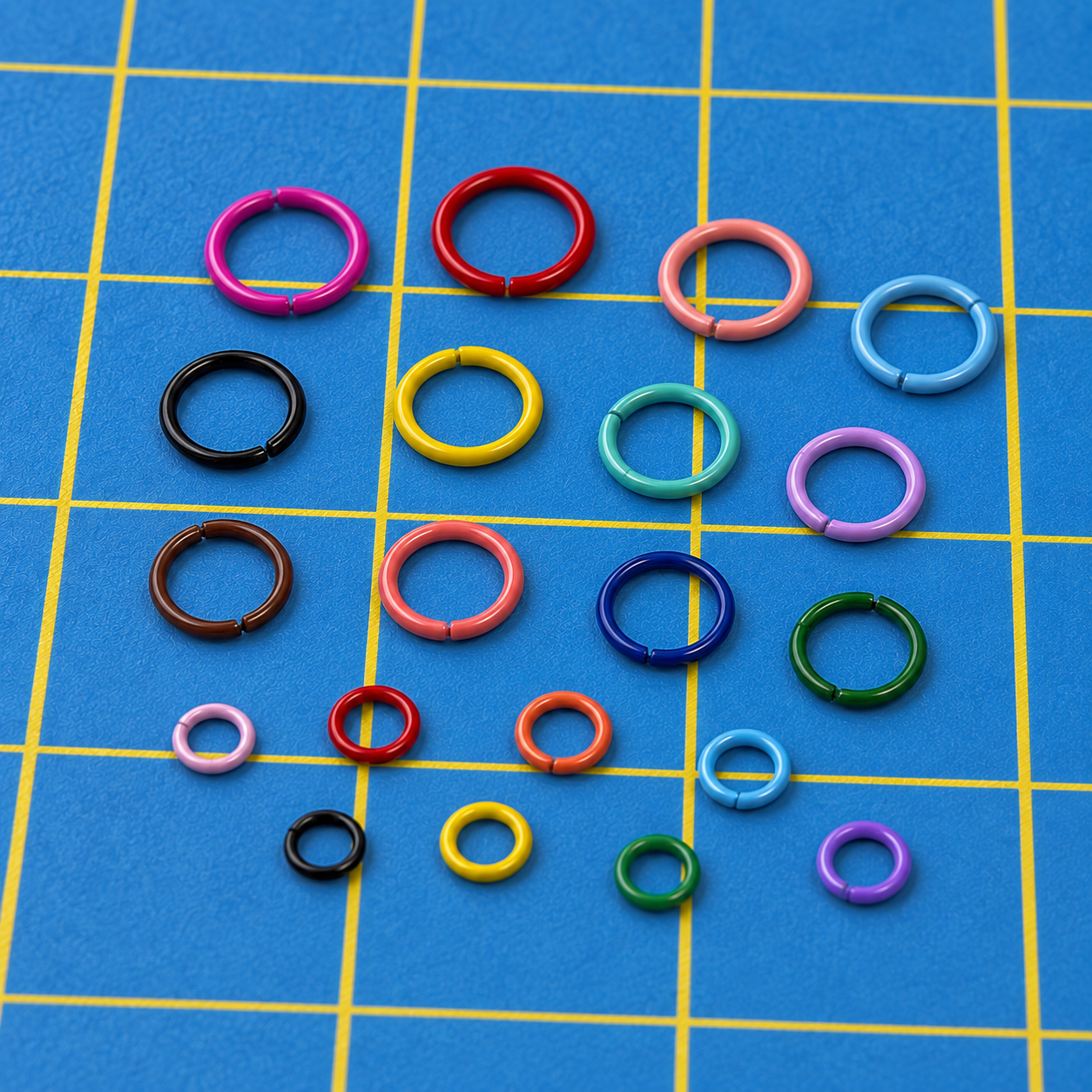
You can search Amazon for coloured open rings to continue a clay colour through the connection or add a contrast between sections. Hold a sample beside the finished clay and ear hook before ordering a large quantity. Two items both labelled “gold” may still look quite different together.
For earrings you sell, record the ring material and coating separately from the ear hook or post. That lets you describe each component accurately. Do not describe the whole earring as nickel-free or suitable for sensitive skin just because one component has that description.
What if a jump ring bends or opens too easily?
Inspect one ring while assembling a sample earring. After you close it, the two ends should stay aligned as you lift the earring by its hook and gently move the clay drop. Set the ring aside if it becomes oval, the ends slide past each other or a gap reappears during ordinary handling. Do not pull hard on the clay to test the ring; that puts stress on the clay hole too.
If the ring deforms, compare a replacement with thicker wire that still passes through both the clay hole and the finding. Check the inside diameter again: at the same outside diameter, thicker wire leaves less room for the clay.
If the pack lists the wire as “dead-soft” or “half-hard”, that describes how readily it bends; half-hard wire resists bending more than dead-soft wire of the same metal and size. Compare that with the wire thickness. If the pack gives no hardness, buy a small quantity first and check that you can close a ring neatly and that it stays closed on a sample earring.
If thicker wire will not fit, keep the clay hole intact and reconsider the connector or finding with the hole and bail guide.
How to clean silver rings without rubbing the clay decoration
For a plain sterling silver ring with light tarnish, use a polishing cloth whose instructions cover sterling silver (search Amazon for silver polishing cloths) and polish only the exposed silver, keeping the cloth off the clay, painted details and coatings. If you cannot reach the silver without rubbing the decoration, open the ring with two pliers, clean it separately, then refit it and check that the ends meet. For plated, deliberately darkened or coated rings, follow the component supplier's care directions. Keep silver dips and polishing liquids away from the assembled clay piece, and include the relevant care instructions when selling the earrings.
Open, closed and split jump rings
An open ring can be threaded through an existing clay hole because its cut ends separate. A soldered-closed ring has its ends permanently joined. To use one, you need something else that opens, such as a second open ring, to connect it to the clay.
A split ring has overlapping coils, like a small key ring. The part being attached has to slide between those coils. The front-and-back twist described above is for open jump rings, so check the type before ordering.
Why does the clay catch or hang sideways?
Hold the earring by the actual ear wire or post loop and let it settle. Keep the hook in the position it will sit when worn. Then inspect the problem you can see:
- The clay catches: look for contact at the hole, the outer edge or the neighbouring piece. If the inside of the ring presses against the clay edge, try a ring with a larger opening. If the wire itself will not move in the hole, compare its thickness with the hole diameter.
- The seam is open: realign the ring ends. Do not use the clay piece as a lever while squeezing the join.
- The decoration faces sideways: add one more ring between the finding and the first ring, then hang it again. Two interlocked rings sit at right angles to each other, so each extra ring turns the drop a quarter turn, and a drop that faced sideways now faces forward. A loose fit or an angled hook loop can let it settle slightly off square.
Add a connecting ring if you need to turn the drop so it faces forward. Check both earrings together after any change: an extra link also changes the length. For help choosing an ear post with a loop to attach the clay drop, see the earring-post guide.
Buying rings for several pairs of earrings
An assortment is useful when you are still choosing sizes. Keep the compartments labelled so the ring that worked does not disappear into a mixed pile. Once a design is settled, record the supplier, product, material, wire thickness, ID or OD, and the number of rings per finished piece.
Keep a reference earring beside those notes. On the next order, compare the new rings with it before assembling the whole run. Use the batch-production checklist to keep the clay recipe, ring size and other supplies recorded for your next order.
More guides in this path
Open these when the next decision is material choice, attachment, or finishing.
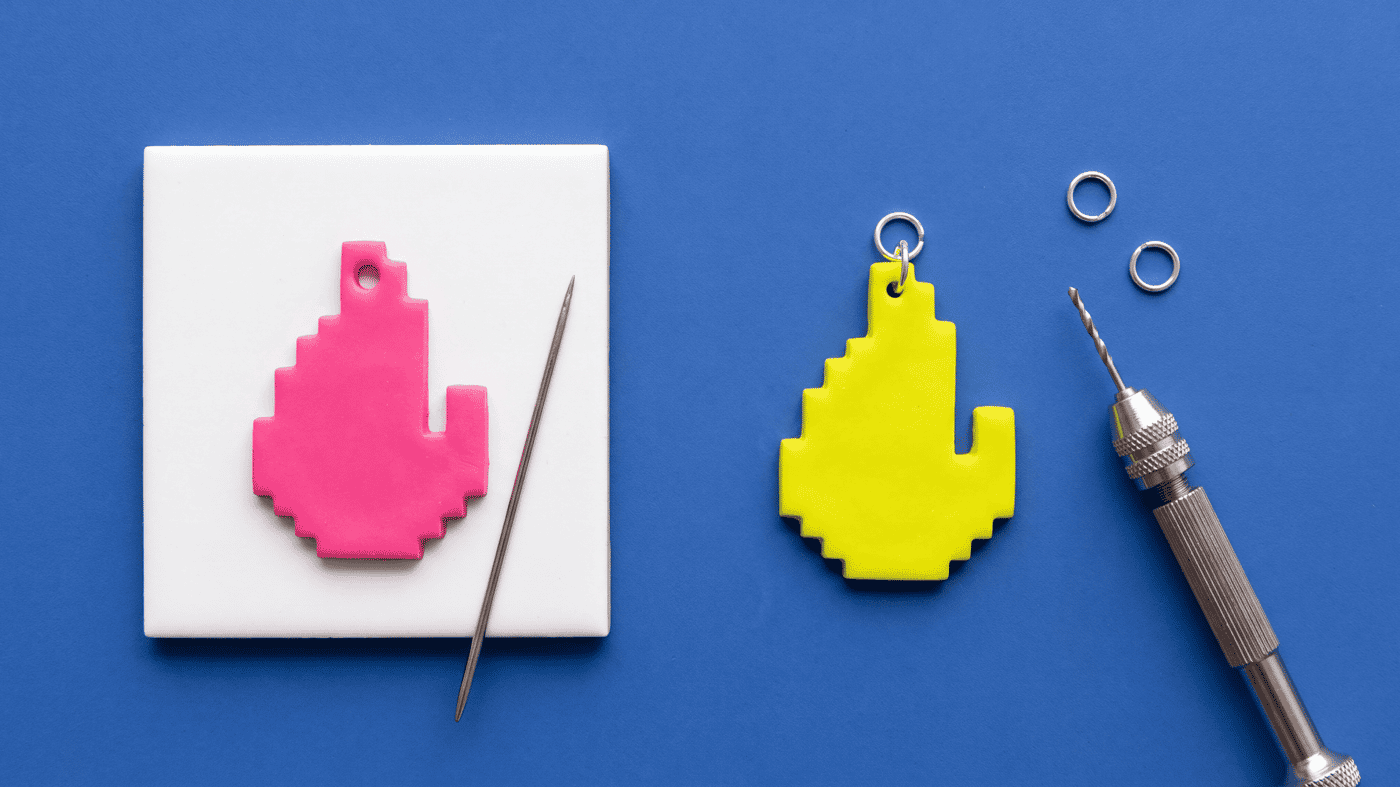
Jump ring holes in polymer clay: punch before baking or drill after?
Punch the hole in raw clay when the slab is thick, chilled and still on the tile. Drill after baking when the piece is a thin veneer, a layered stack, a pixel corner or a hole close to an edge. Fixed-hole cutters skip the marking step but carry the raw-hole caveats.
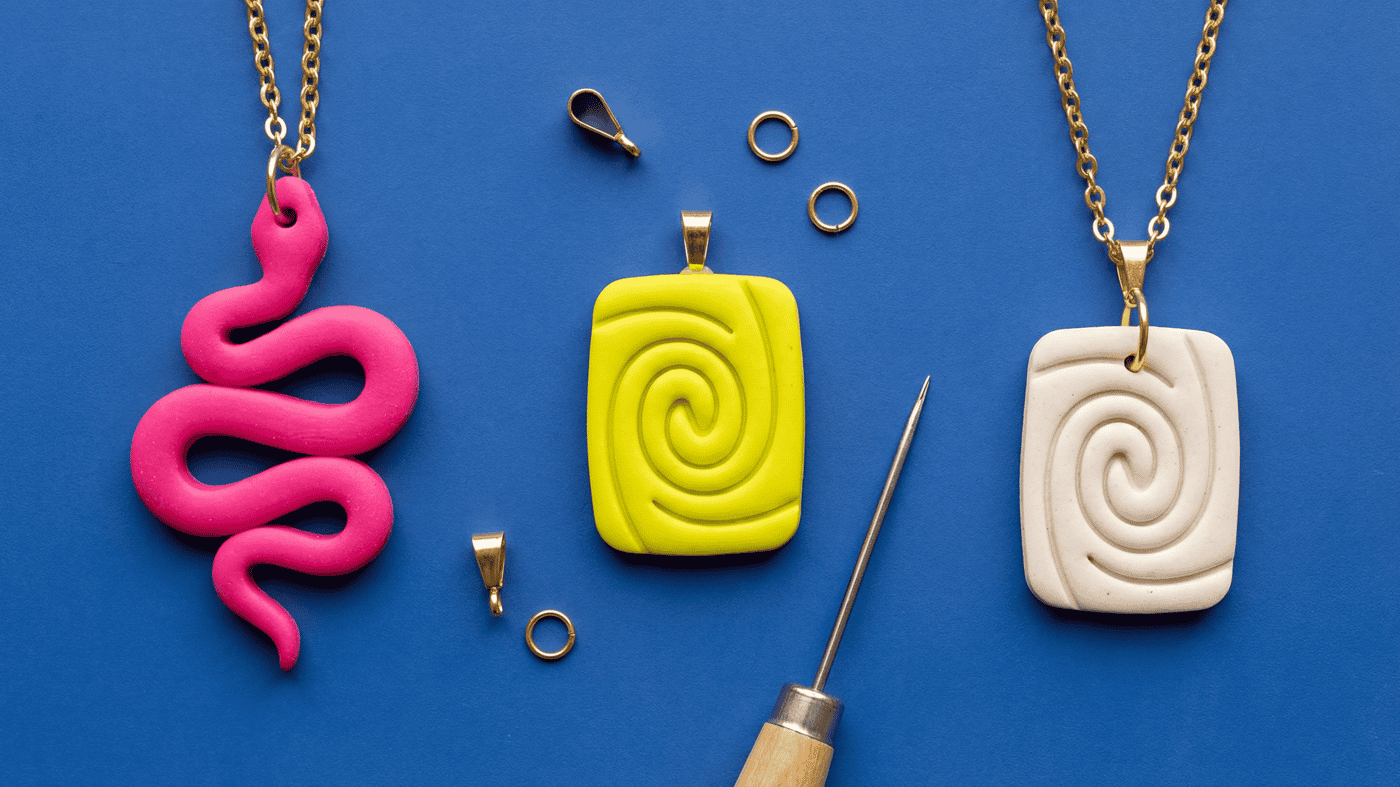
Polymer Clay Pendant Holes, Bails, and Jump Ring Placement
Choose a hole when the top has room for it, or a glue-on bail when you want an uninterrupted front. Position the attachment, leave clearance for the chain, and check which way the finished pendant faces.
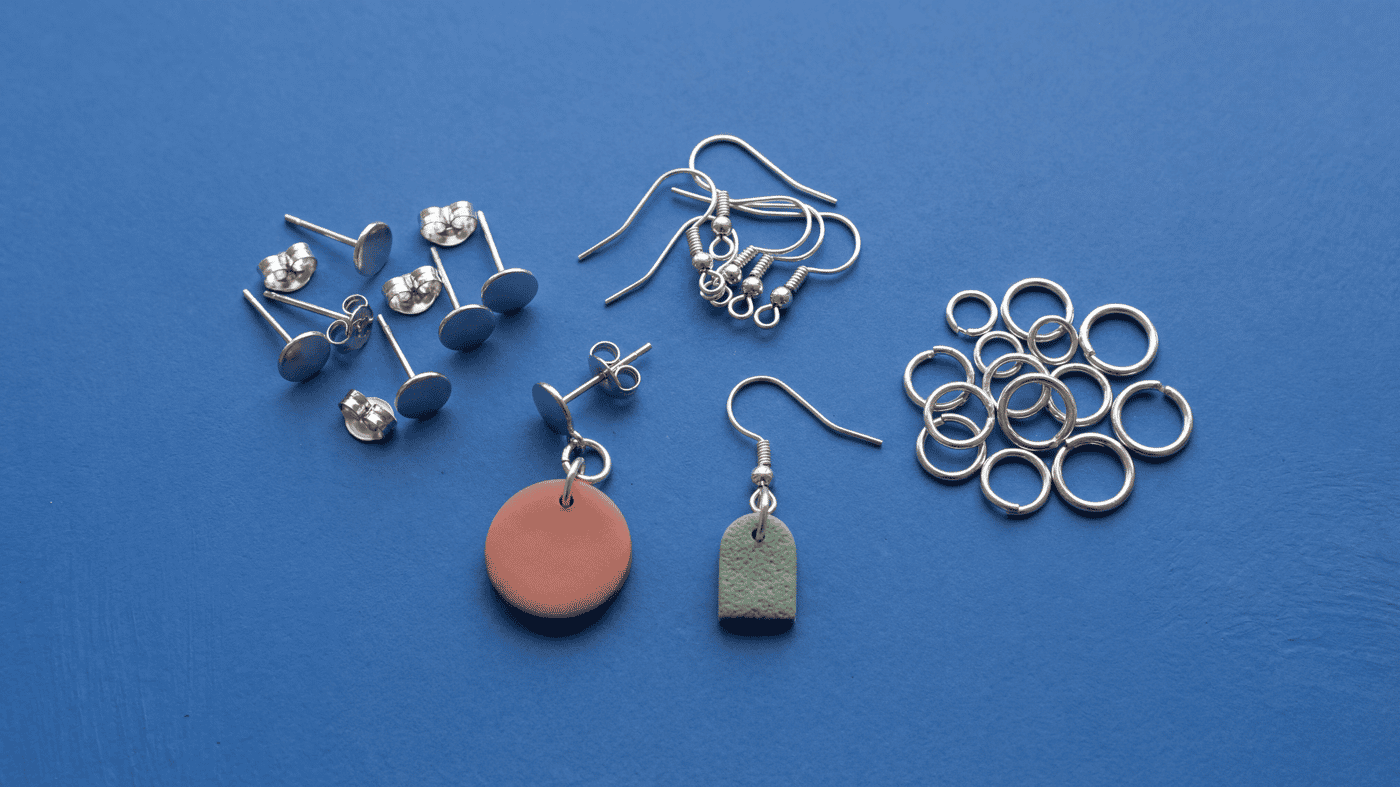
How to attach earring findings to polymer clay earrings
Choose a fish hook, leverback or looped stud, join it with a jump ring, add a second ring if the drop shows its edge, and check the pair before you wear it.
Finished examples with related clay decisions
Each piece shows how a material, attachment, or surface choice changes the final form.