Polymer Clay Creative Block and the Bestseller Trap
The block that stops sellers is usually not 'no ideas.' It is being trapped by the one design everyone buys, or staring at orders you no longer want to make. This guide names the seller-specific triggers and gives 8 resets that clear the worktable faster than another mood board.

In brief
Key takeaways
- Block usually has a cause: perfectionism, decision fatigue, or burnout. Naming yours points at the fix
- Cut your choices on purpose. Two colors and one shape is a useful constraint when the blank slab feels paralyzing
- Set a 10-minute timer and start touching clay. Action almost always returns first; ideas follow
- Use scrap clay for the next session. Cheap material lowers the stakes and shortens the recovery loop
- Take 48 hours off Instagram and Pinterest. The comparison spiral resets faster than you expect
Article contentsOpenClose
Polymer clay block usually shows up as a slab you keep rolling out and stopping on, a Pinterest tab full of saves you cannot translate into actual canes, or a queue of orders you no longer feel like making. The clay is fine. The brain is the bottleneck.
Below: a quick read on why polymer clay makers most often get stuck, and eight resets that work better than scrolling another reference feed.
Figure Out Which Kind Of Block You Have
Creative block in polymer clay usually stems from perfectionism, decision fatigue from too many options, comparison spiraling on social media, or burnout from selling.
The four blocks below have different roots, which is why the same pep talk does not fix all of them. Find the row that sounds like your week.
| Block Type | Root Cause | Signs | Fastest Fix |
|---|---|---|---|
| Perfectionism | Standards higher than skill | Nothing feels "good enough" | Make something ugly on purpose |
| Decision Fatigue | Too many options | Can't choose where to start | Limit to 2 colors, 1 shape |
| Comparison Spiral | Social media overload | Everything feels derivative | 48-hour social media break |
| Burnout | Hobby became a job | Creating feels like a chore | Make something you won't sell |
The Perfectionism Trap
You set an impossibly high bar. Maybe you saw someone's work on Instagram and now everything you make feels "not good enough." This block lands hardest on makers who already have real skill, because the better you get, the more critical your eye becomes.
The fix: Give yourself permission to make something ugly that you would never post. Lowering the stakes on the next piece is what gets your hands moving again.
Decision Fatigue
Too many choices = paralysis. Which clay? Which colors? Which shape? Which technique? When everything is possible, nothing feels right. This often hits makers with large supply collections or those planning new collections.
The fix: Impose artificial constraints. Limit yourself to 2 colors, 1 shape, and see what happens.
The Comparison Spiral
You've been scrolling Pinterest or Instagram for "inspiration" but really you've been comparing. Your work feels derivative of people you admire, or you feel like "everything's been done."
The fix: Take a social media break (even 48 hours helps). Create from memory and feeling, not reference images.
Burnout (Physical and Mental)
You have been producing so much that creating feels like a chore. This lands hardest on makers who sell, because the hobby has turned into a job and stopped being an escape.
The fix: Make something you will never sell. Make a gift. Make something just for you. Reconnect with the reason you started.
Naming the cause matters because the fixes are not interchangeable. Perfectionism asks you to lower the bar on the next piece. Decision fatigue asks you to cut your options on purpose. Comparison spiraling asks you to step away from the feed for a couple of days. Burnout asks you to stop optimizing and make something that has nothing to do with the shop.
The Bestseller Trap
The seller-specific version of this is the bestseller trap. One design carries your shop, so you keep remaking it long after it stopped being interesting, and every new idea feels like a detour from money. The reset is to schedule one low-stakes non-bestseller batch a week, so the shop does not eat the maker.
Browse pieces with this feel
Open related pieces when you want a starting point for palette, silhouette, texture, or hardware.
8 Exercises to Break Through
Limiting your choices restarts a stalled session fast: use only scrap clay, set a ten-minute timer, or pick just two colors and start making.
These exercises come from patterns polymer clay makers return to when they're stuck.
Artificial constraints are a practical way to restart momentum in many creative sessions. Limiting yourself to only scrap clay, a two-color palette, or a 10-minute timer removes some of the paralysis of infinite choice and pushes your brain back into problem-solving mode.
1. The "Scrap Clay" Challenge
Take your scrap bucket of mixed leftovers. Chop it up, mix it into a marble, and make a slab. No new clay allowed. The limitation forces you to focus on shape and texture instead of color planning, and the results are often shapes you would never have planned on a fresh block.
The pressure is off because the clay is already mixed past planning, so the session usually turns into shape and texture practice instead of color decisions.
2. The "Opposite Hand" Sketch
Grab a sketchbook and draw 10 earring shapes with your non-dominant hand. They will look wonky, and that is the point. Removing fine motor control often pushes your hand into shapes you would not have planned with full precision.
3. Nature Mimicry
Go outside. Find a leaf, a rock, a piece of bark, or a flower. Try to recreate that exact texture in clay. Don't worry about making it into jewelry yet. Just study the texture deeply. This exercise reconnects you with the tactile, observational part of creating.
4. The Color Palette Swap
Go to a color palette generator like Coolors.co and hit random. Use the first palette that comes up, even if you do not like it. Make one pair of earrings from it. The forced palette pulls you into contrast and color relationships you would never have picked on your own.
5. Clean Your Studio
Clutter creates mental static. Organizing your cutters, color-coding your clay, or wiping down your tile can be meditative and clear the space for new ideas to land. Many makers find their next project while doing the kind of small organizing that does not feel like work.
Sorting cutters by shape instead of purchase date often surfaces pairings you have not tried, especially when similar arches and circles end up next to each other for the first time.
6. The 10-Minute Timer Challenge
Set a timer for 10 minutes. Make any small thing before it goes off. Do not think, do not plan, just make. The time pressure overrides your inner critic. It does not matter if it is good. What matters is that you made something, and that momentum often carries into the next session.
7. Study One Design Privately, Then Change the Brief
Pick one design you admire and study it as a private practice prompt. Instead of trying to reproduce it for sale, name one thing you want to learn from it: the shape logic, color contrast, or layer order. Then change the brief on purpose. Shift the palette, alter the silhouette, swap the finish, or combine the idea with a different technique family. If you want a repeatable method for this, the reverse-engineer any clay design guide walks the full study-then-diverge process. By the second or third pass you should be using the study to build your own direction, not to clone the original.
Important: Keep this as a learning exercise, write down what you learned, and do not publish or sell close copies of another maker's design.
8. Make Something for Someone Specific
Making for one specific person pulls you out of your own aesthetic and gives you a finished gift. Picture a friend, family member, or coworker and build what they would actually love to wear, and you have a gift ready when you are done.
A Few Resets Worth Keeping On Hand
Unfamiliar tutorials, working alongside kids, and switching to a different medium for an afternoon can all reset creative energy.
A few resets makers reach for again and again: watching a tutorial for a technique you have no plans to use, keeping a low-pressure "someday" folder you flip through without obligation, making alongside a kid who has no fear of doing it wrong, or switching to a completely different medium for an afternoon so your hands work a new way.
Make Something Ugly On Purpose To Beat Perfectionism
Making something ugly on purpose can be a useful reset when perfectionism is the block, because it removes the pressure of polish for a session.
Make something ugly today. Every maker who sells has a drawer of rejects that taught them more than the keepers did. Pick the ten-minute timer or the scrap-clay challenge, set the timer, and let the first bad piece be the warm-up. The momentum shows up in the doing, not before it.
Creative blocks can last a few hours, a few days, or longer. If the stuck feeling keeps repeating, it may be burnout rather than a one-off rut. Rest, lower the pressure, and come back when the work feels less combative. Shorter ruts often respond well to action-based exercises like the 10-minute timer challenge, where time pressure can override the inner critic for a moment.
Other reads on this topic
Polymer Clay for Beginners: Clay, Tools, and a First Test Piece
Choose one clay line, use three basic tools, and make a small package-directed test piece before adding more supplies.
Three 2026 Paint Color Signals to Test in Polymer Clay
Chasing every 2026 trend color can leave you with blocks you do not use. Before you commit to a full batch, bake small swatch chips and test the finish. This guide gives you three 2026 color directions plus the swatch test that confirms a color before you scale it.
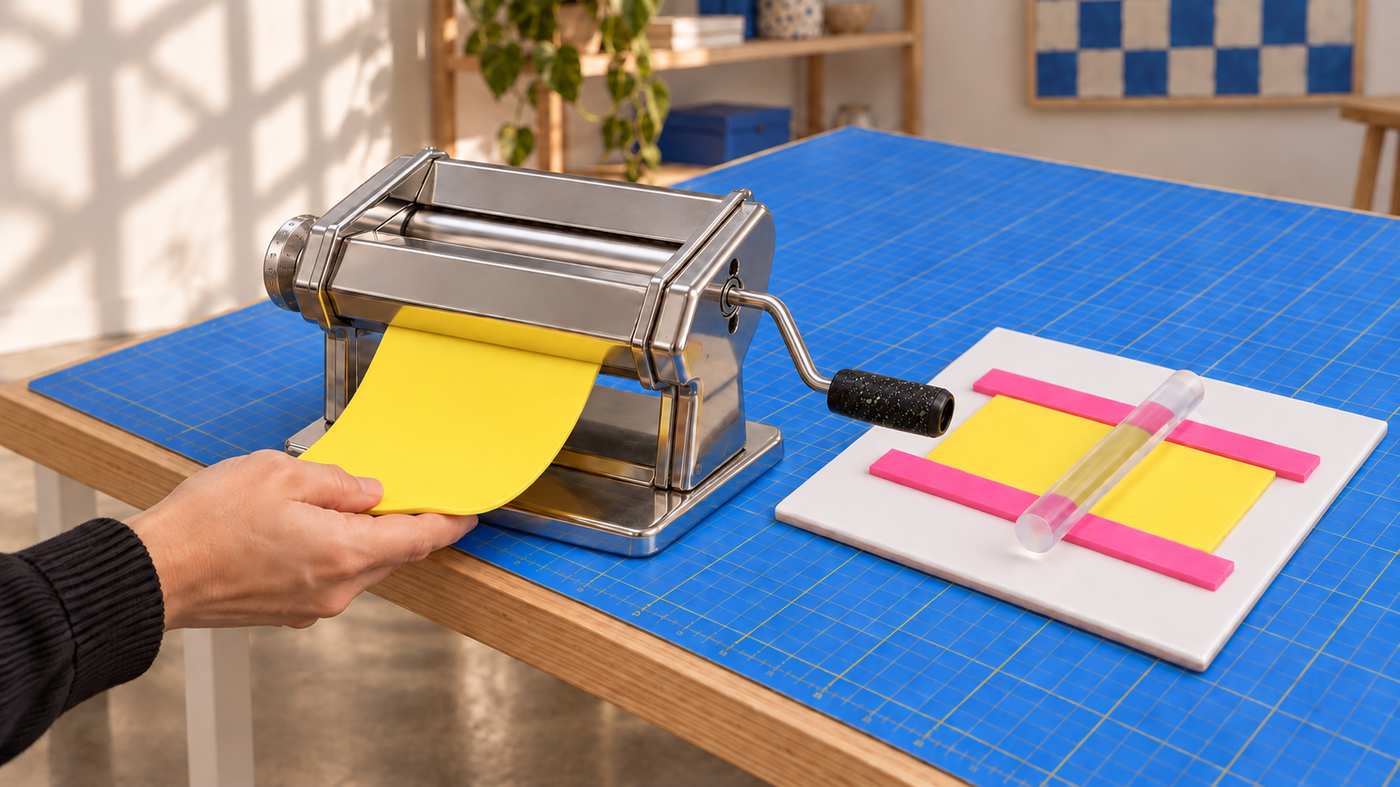
Best pasta machine for polymer clay: Atlas, Sculpey, Makin's or a roller
Buy the Marcato Atlas 150 for earring slabs and blends, or the Atlas 180 for slabs over 14 cm wide. Measured widths, thickest settings and lower-cost machines, compared.
Finished examples with related clay decisions
Each piece shows how a material, attachment, or surface choice changes the final form.